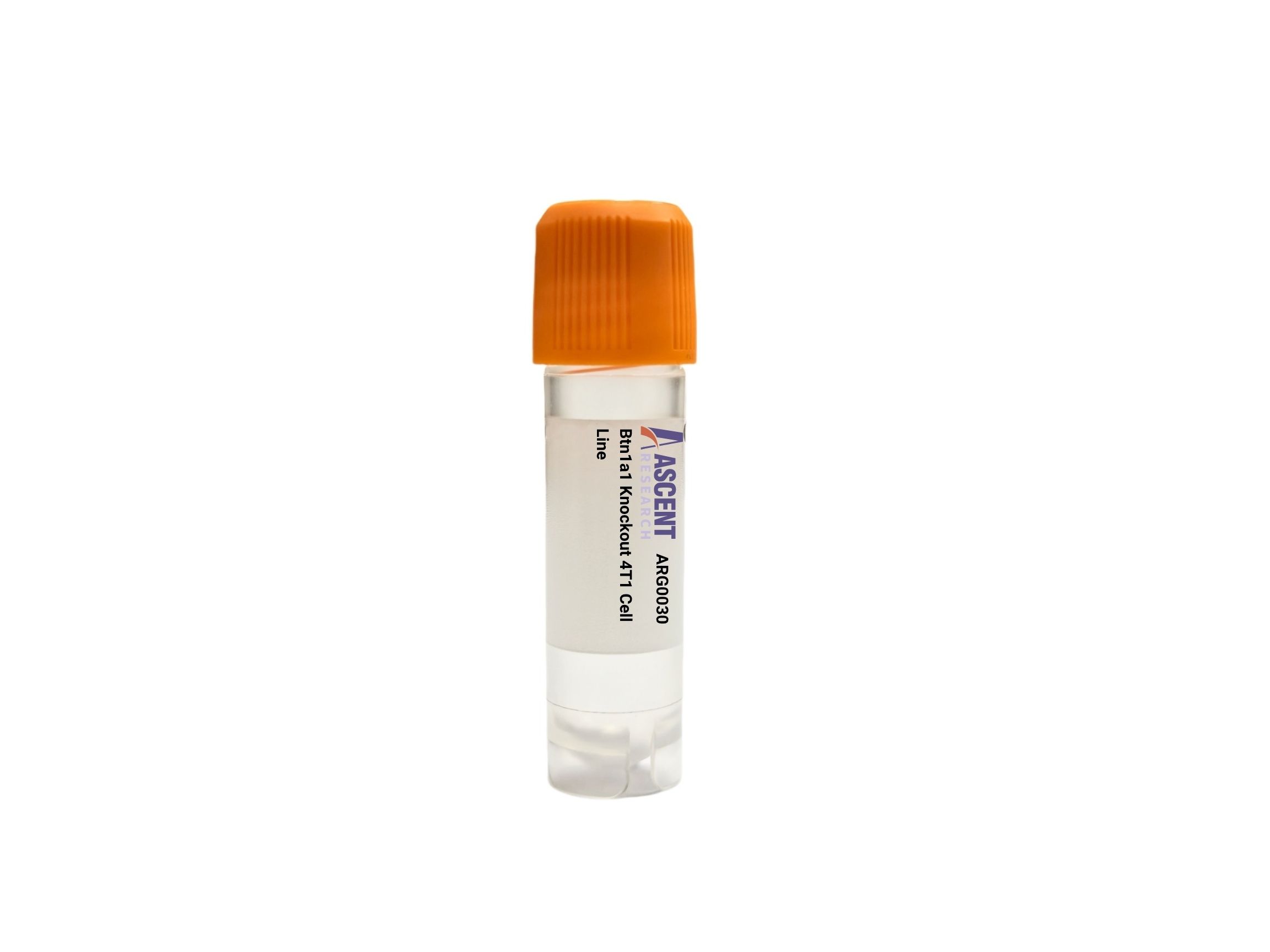
Genome-edited Cells
Breast (mammary gland)
Btn1a1 Knockout 4T1 is a CRISPR/Cas9-edited mouse mammary carcinoma cell line with disruption of Btn1a1 in the highly metastatic 4T1 TNBC model. BTN1A1 is a butyrophilin family transmembrane glycoprotein linked to mammary membrane organization, secretion biology, and immunoregulatory cell-surface interactions. Its expression is associated with epithelial differentiation programs and PRLR-JAK2-STAT5A signaling, and it interacts with XDH and related secretory machinery. This knockout model supports studies of breast cancer cell-surface biology, tumor-immune interactions, differentiation state, transcriptomic changes, and metastatic phenotypes using flow cytometry, RNA-seq, co-culture, and in vivo syngeneic assays.
 MSRB2 Knockout K562 Polyclonal Cells
Cat. No. ARG19352
MSRB2 Knockout K562 Polyclonal Cells
Cat. No. ARG19352
 Mkrn1 Knockout RAW 264.7 Cell Line
Cat. No. ARG43981
COMMD3 Knockout Hela Polyclonal Cells
Cat. No. ARG8315
GULP1 Knockout A2780 Polyclonal Cells
Cat. No. ARG29073
GPANK1 Knockout huh-7 Polyclonal Cells
Cat. No. ARG28216
Mkrn1 Knockout RAW 264.7 Cell Line
Cat. No. ARG43981
COMMD3 Knockout Hela Polyclonal Cells
Cat. No. ARG8315
GULP1 Knockout A2780 Polyclonal Cells
Cat. No. ARG29073
GPANK1 Knockout huh-7 Polyclonal Cells
Cat. No. ARG28216
 HCC1937 Luciferase Stable Cell Line
Cat. No. ARG0260
HCC1937 Luciferase Stable Cell Line
Cat. No. ARG0260
The Btn1a1 Knockout 4T1 Cell Line is a CRISPR/Cas9-engineered murine cancer model in which the mouse Btn1a1 gene has been disrupted to eliminate functional gene expression. Generated in the 4T1 host background, this stable knockout cell line provides an in vitro system for investigating butyrophilin-associated biology in a mammary carcinoma setting. Because 4T1 cells are broadly used to study aggressive breast cancer phenotypes, this model is suited for mechanistic evaluation of how Btn1a1 loss alters tumor cell behavior, cell-surface composition, and tumor-immune interaction programs.
4T1 is a highly tumorigenic and metastatic mammary carcinoma cell line derived from BALB/c mouse and is widely used as a syngeneic model of triple-negative breast cancer. The line recapitulates key features relevant to disease progression, including rapid growth, dissemination, and interaction with the immune microenvironment. As a murine mammary carcinoma model with strong utility in immuno-oncology, 4T1 supports studies of metastatic competence, inflammatory signaling, immune-cell engagement, and phenotypes linked to epithelial state. These characteristics make it a practical background for assessing gene-specific contributions to breast cancer progression in both cell-autonomous and microenvironment-facing contexts.
BTN1A1 encodes a butyrophilin family type I transmembrane glycoprotein associated with membrane organization and secretion biology, classically in mammary epithelial cells and the milk fat globule membrane. Its expression is regulated by mammary epithelial differentiation programs and by lactogenic signaling, including PRLR-JAK2-STAT5A pathway activity and broader prolactin-dependent differentiation states. BTN1A1 interacts with xanthine dehydrogenase (XDH), other BTN family proteins, and membrane-associated secretory complexes, and functions in pathways linked to epithelial junctional and secretory machinery. In this context, Btn1a1 acts upstream of cell-surface immune modulatory cues, membrane lipid droplet secretion processes, and differentiation-associated gene expression patterns, making it relevant to butyrophilin family immunoregulation and tumor-immune interaction pathways.
Disruption of Btn1a1 in 4T1 cells is therefore a useful approach for examining how loss of a mammary membrane-organizing and immunoregulatory surface protein influences carcinoma phenotypes in an aggressive breast cancer model. In the 4T1 background, this knockout can support investigation of altered epithelial differentiation state, changes in membrane trafficking and secretion, and modification of immune-recognition interfaces that may influence co-culture behavior or in vivo tumor progression.
This model is applicable to western blotting and RT-qPCR confirmation workflows, RNA-seq profiling of differentiation and immune-related transcriptional changes, flow cytometry and cell-surface staining to assess butyrophilin-associated membrane phenotypes, and immunofluorescence for subcellular organization studies. It is also suitable for co-immunoprecipitation analyses of BTN1A1-linked complexes, immune cell co-culture assays and cytokine profiling to interrogate tumor-immune interactions, and migration, invasion, proliferation, and apoptosis assays to define broader cancer-associated consequences of Btn1a1 loss. In vivo syngeneic tumor growth and metastasis studies in immunocompetent BALB/c settings may further enable evaluation of host-relevant phenotypes. Researchers may contact Ascent Research for additional technical information, product details, or related gene-edited cell models.