Genome-edited Cells
Lung
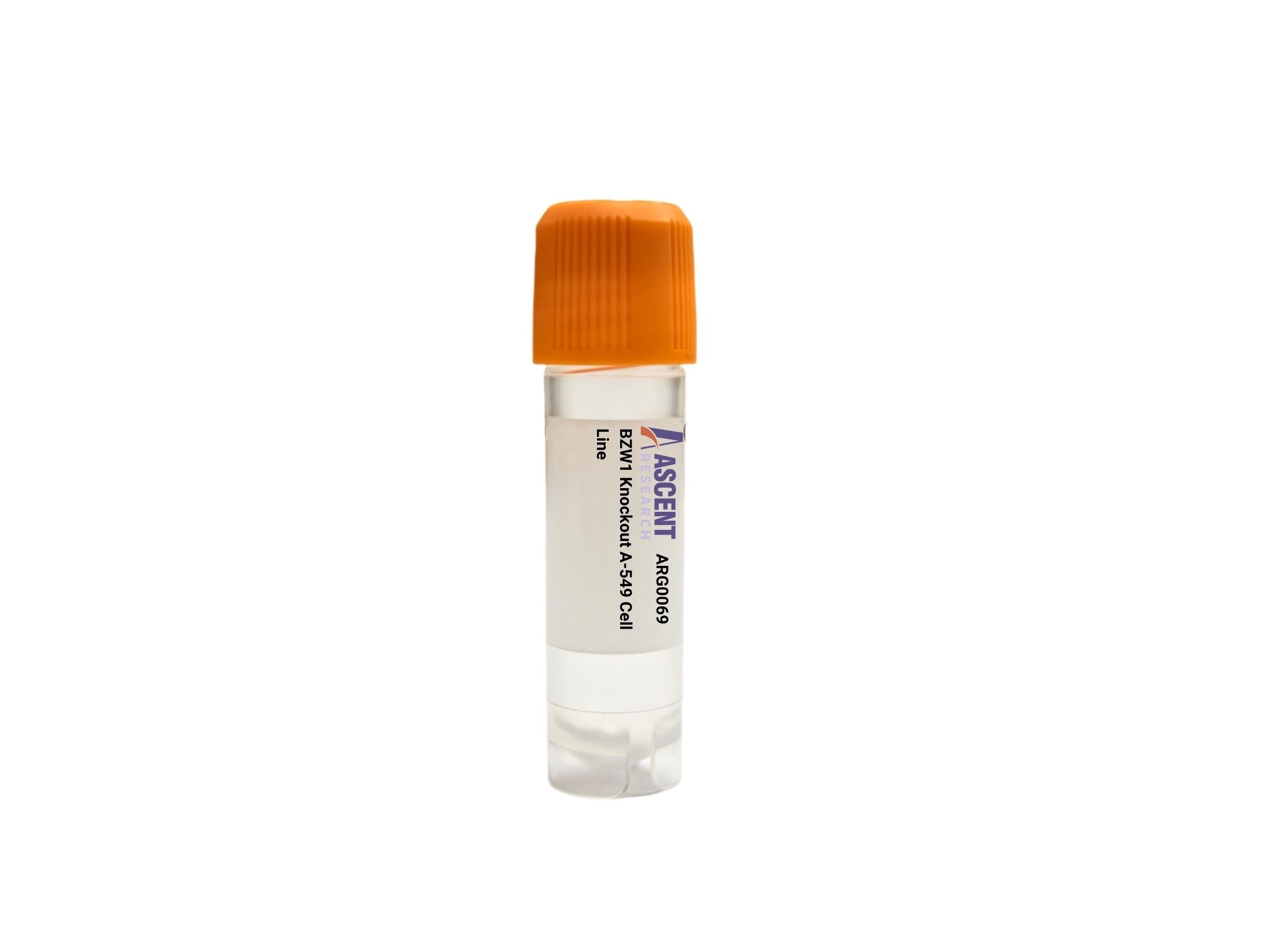
BZW1 Knockout A-549 is a human CRISPR/Cas9-edited lung adenocarcinoma epithelial cell line with disruption of the translation regulatory factor BZW1. In the alveolar epithelial-like A-549 background, this model supports studies of translation initiation, start codon selection fidelity, and cancer cell stress adaptation. BZW1 functions within the eIF2-eIF5 axis and is linked to EIF2S1, EIF1, ATF4, and MTOR-associated translational control. The cell line is suited for ribosome profiling, polysome profiling, puromycin incorporation, start codon reporter assays, proliferation and apoptosis studies, and drug sensitivity experiments in lung cancer research.
 GFPT2 Knockout Lovo Polyclonal Cells
Cat. No. ARG11724
BNIP3L Knockout NCI-H1299 Polyclonal Cells
Cat. No. ARG30543
HCAR2 Knockout HGC-27 Polyclonal Cells
Cat. No. ARG36126
IL1R1 Knockout HCT116 Polyclonal Cells
Cat. No. ARG36054
DNPH1 Knockout NCI-H1703 Polyclonal Cells
Cat. No. ARG39503
BZW1 Knockout HAP1 Polyclonal Cells
Cat. No. ARG27422
GFPT2 Knockout Lovo Polyclonal Cells
Cat. No. ARG11724
BNIP3L Knockout NCI-H1299 Polyclonal Cells
Cat. No. ARG30543
HCAR2 Knockout HGC-27 Polyclonal Cells
Cat. No. ARG36126
IL1R1 Knockout HCT116 Polyclonal Cells
Cat. No. ARG36054
DNPH1 Knockout NCI-H1703 Polyclonal Cells
Cat. No. ARG39503
BZW1 Knockout HAP1 Polyclonal Cells
Cat. No. ARG27422
The BZW1 Knockout A-549 Cell Line is a human CRISPR/Cas9-engineered knockout model in which the BZW1 gene has been disrupted to eliminate functional BZW1 expression. This stable edited cell population is generated in the A-549 background, an adherent human lung adenocarcinoma epithelial cell line, and provides an in vitro system for investigating how loss of a translation initiation regulatory factor influences cancer-associated cellular programs. The model is intended for mechanistic studies in translational control, stress adaptation, and tumor cell phenotyping in a clinically relevant pulmonary epithelial context.
A-549 cells are derived from human lung adenocarcinoma and are widely used as an alveolar epithelial-like cancer model for studies of lung tumor biology, epithelial signaling, metabolism, and pharmacologic response. Because A-549 cells retain strong utility in assays of proliferation, survival, and anticancer agent sensitivity, they are frequently applied to investigate oncogenic pathway dependence and treatment-associated stress responses. Their epithelial origin and established use in airway and alveolar research make this background particularly suitable for examining gene functions linked to lung cancer progression and adaptive changes in mRNA translation.
BZW1 encodes a basic leucine zipper and W2 domain-containing translation regulatory protein that functions in translation initiation and start codon selection stringency. Mechanistically, BZW1 acts within the eIF2-eIF5 functional axis and interacts with components of the 40S ribosomal subunit-associated initiation machinery, including eIF5, eIF1, and eIF2, with pathway-level relationships to BZW2, EIF2S1, the EIF2B complex, ATF4, RPS6KB1, and MTOR. Its activity is linked to upstream inputs such as growth factor signaling, nutrient availability, cellular stress, and the phosphorylation state of EIF2S1, which collectively shape integrated stress response output. Loss of BZW1 is therefore expected to alter translation initiation fidelity, global protein synthesis output, non-AUG translation events, and stress-responsive translational programs relevant to cancer cell proliferation and survival.
In the A-549 host context, BZW1 disruption enables analysis of how translational control contributes to lung adenocarcinoma cell growth and adaptation under basal and stress conditions. This model is useful for examining dependencies between translation initiation fidelity and epithelial tumor phenotypes, including proliferation, colony formation capacity, apoptosis susceptibility, and cell-cycle behavior. It also supports studies of how altered start codon selection intersects with MTOR-RPS6KB1-linked growth cues and ATF4-associated stress programs in lung cancer cells.
This knockout cell line can be applied in western blotting and RT-qPCR workflows to characterize BZW1 loss and downstream pathway responses; in RNA-seq, ribosome profiling, and polysome profiling studies to quantify transcript-selective and global changes in translational output; and in puromycin incorporation assays to assess bulk protein synthesis. Reporter assays for start codon selection are particularly relevant for measuring initiation fidelity and non-AUG translation. Co-immunoprecipitation and immunofluorescence may be used to examine effects on initiation factor interactions and subcellular organization, while cell proliferation assays, colony formation assays, apoptosis assays, cell-cycle analysis, and drug sensitivity studies support functional interrogation of survival pathways and therapeutic response. Researchers may contact Ascent Research for additional technical information, product details, or related gene-edited cell models.