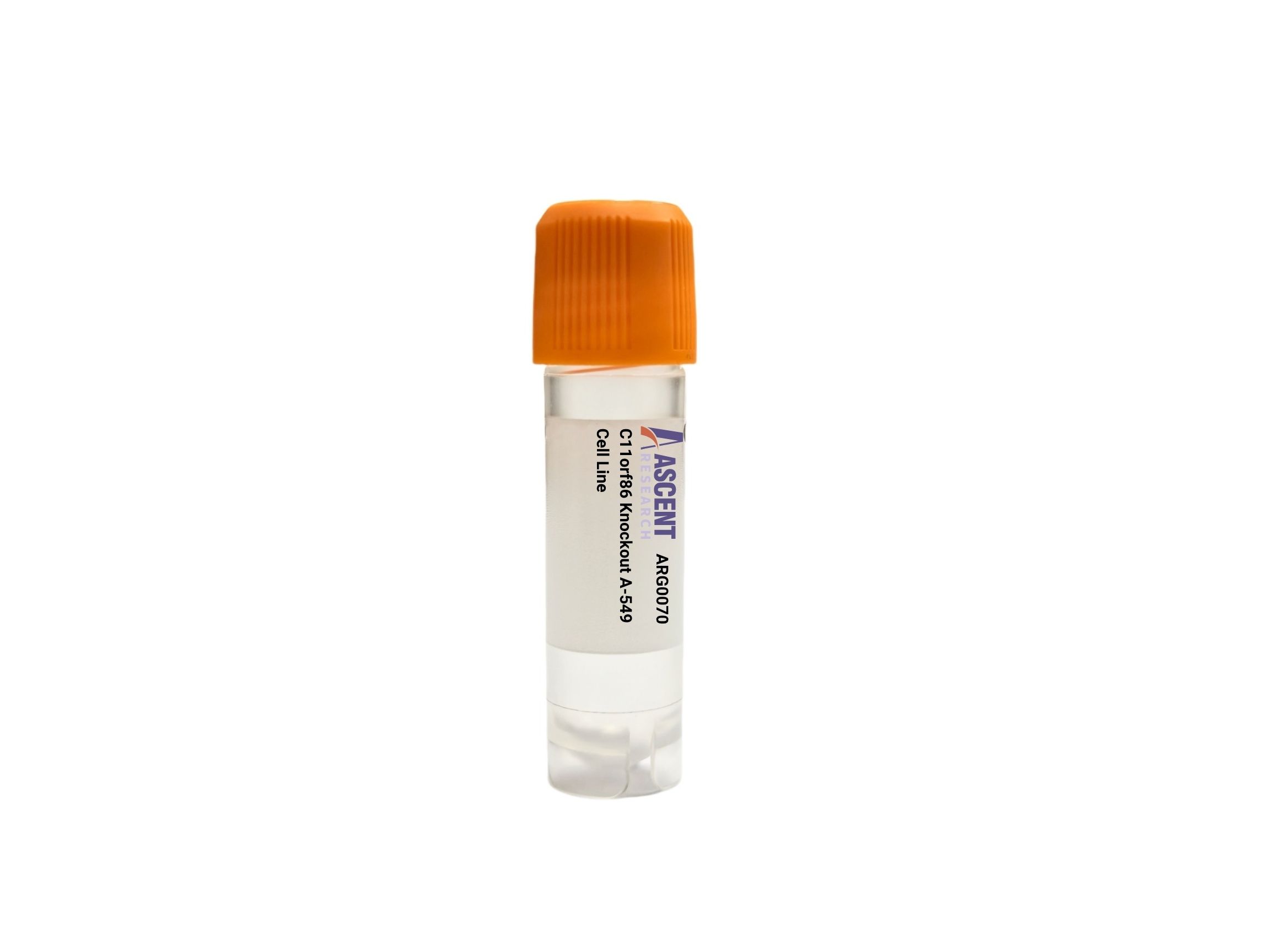
Genome-edited Cells
Lung
C11orf86 Knockout A-549 is a human CRISPR/Cas9-edited lung adenocarcinoma epithelial cell model with disruption of the poorly characterized C11orf86 gene. Generated in the A-549 alveolar type II-like background, this line supports functional genomics studies in lung cancer-relevant contexts including epithelial signaling, proliferation, survival, and drug response. Because C11orf86 pathway placement is not well established, the model is best used for unbiased transcriptomic, proteomic, and phenotypic profiling, with readouts interpreted alongside major A-549-associated regulators such as TP53, EGFR, KRAS, MAPK1, AKT1, and MYC. Representative applications include RNA-seq, proliferation assays, apoptosis studies, migration assays, and drug sensitivity testing.
 MYO1E Knockout NCI-H1975 Polyclonal Cells
Cat. No. ARG16667
CNOT6L Knockout NCI-H1703 Polyclonal Cells
Cat. No. ARG12597
MLEC Knockout A549 Polyclonal Cells
Cat. No. ARG10831
C15orf40 Knockout HGC-27 Polyclonal Cells
Cat. No. ARG29762
IFT20 Knockout A549 Polyclonal Cells
Cat. No. ARG34099
CEP170B Knockout 786-O Polyclonal Cells
Cat. No. ARG5586
MYO1E Knockout NCI-H1975 Polyclonal Cells
Cat. No. ARG16667
CNOT6L Knockout NCI-H1703 Polyclonal Cells
Cat. No. ARG12597
MLEC Knockout A549 Polyclonal Cells
Cat. No. ARG10831
C15orf40 Knockout HGC-27 Polyclonal Cells
Cat. No. ARG29762
IFT20 Knockout A549 Polyclonal Cells
Cat. No. ARG34099
CEP170B Knockout 786-O Polyclonal Cells
Cat. No. ARG5586
The C11orf86 Knockout A-549 Cell Line is a human CRISPR/Cas9-engineered loss-of-function model in which the C11orf86 locus has been disrupted to eliminate functional gene expression. This edited derivative of the A-549 background provides a stable in vitro system for investigating the consequences of C11orf86 depletion in a lung epithelial adenocarcinoma context. Because C11orf86 is a poorly characterized open reading frame-encoded gene with limited experimentally established molecular function, this model is particularly suited to hypothesis-generating studies designed to define gene-dependent molecular and cellular phenotypes.
A-549 is a widely used human lung adenocarcinoma epithelial cell line with alveolar type II-like features and substantial relevance to airway and alveolar biology. The line serves as a tractable model for pulmonary epithelial barrier function, tumor-associated signaling, infection-related responses, and therapeutic testing. In biomedical research, A-549 cells are commonly used to study oncogenic programs linked to lung adenocarcinoma and non-small cell lung cancer, including pathways centered on EGFR, KRAS, MAPK1, AKT1, MYC, and TP53. This background makes the host cell line well suited for evaluating how gene disruption modifies proliferation, survival, stress responses, epithelial phenotype, and drug sensitivity in a lung cancer-relevant setting.
Current knowledge does not place C11orf86 in a definitively established molecular pathway, and its direct binding partners, upstream regulators, and downstream effectors remain insufficiently resolved. Based on available metadata, C11orf86 is most appropriately considered in the context of general transcriptional regulation, epigenetic regulation, gene expression control, and cellular programs governing proliferation and survival. In A-549 cells, knockout can therefore be used to assess whether C11orf86 acts upstream of transcriptomic outputs linked to canonical lung cancer regulators such as TP53, EGFR, KRAS, MAPK1, AKT1, and MYC, without presuming direct interaction or linear pathway placement. Downstream consequences are expected to be most effectively captured through unbiased profiling rather than single-pathway readouts.
Loss of C11orf86 in the A-549 background provides a meaningful system for testing how an uncharacterized gene contributes to lung cancer cell-state regulation. In this host context, researchers can examine whether C11orf86 disruption alters growth kinetics, apoptosis susceptibility, migration behavior, colony-forming capacity, or responses to perturbation of EGFR-MAPK or AKT-associated signaling axes. The model is also useful for determining whether gene knockout produces measurable changes in epithelial morphology, stress adaptation, or transcriptional programs relevant to lung adenocarcinoma biology.
Typical applications include functional genomics, target discovery, and follow-up of loss-of-function screening hits. Recommended analytical workflows include genomic PCR and Sanger sequencing of the edited locus, RT-qPCR for transcript assessment, western blotting where suitable reagents are available, and RNA-seq or proteomic analysis for unbiased characterization of downstream changes. Phenotypic studies may include immunofluorescence, flow cytometry, cell proliferation assays, apoptosis assays, migration assays, colony formation assays, and drug sensitivity studies to define context-specific dependencies created by C11orf86 loss. Researchers may contact Ascent Research for additional technical information, product details, or related gene-edited cell models.