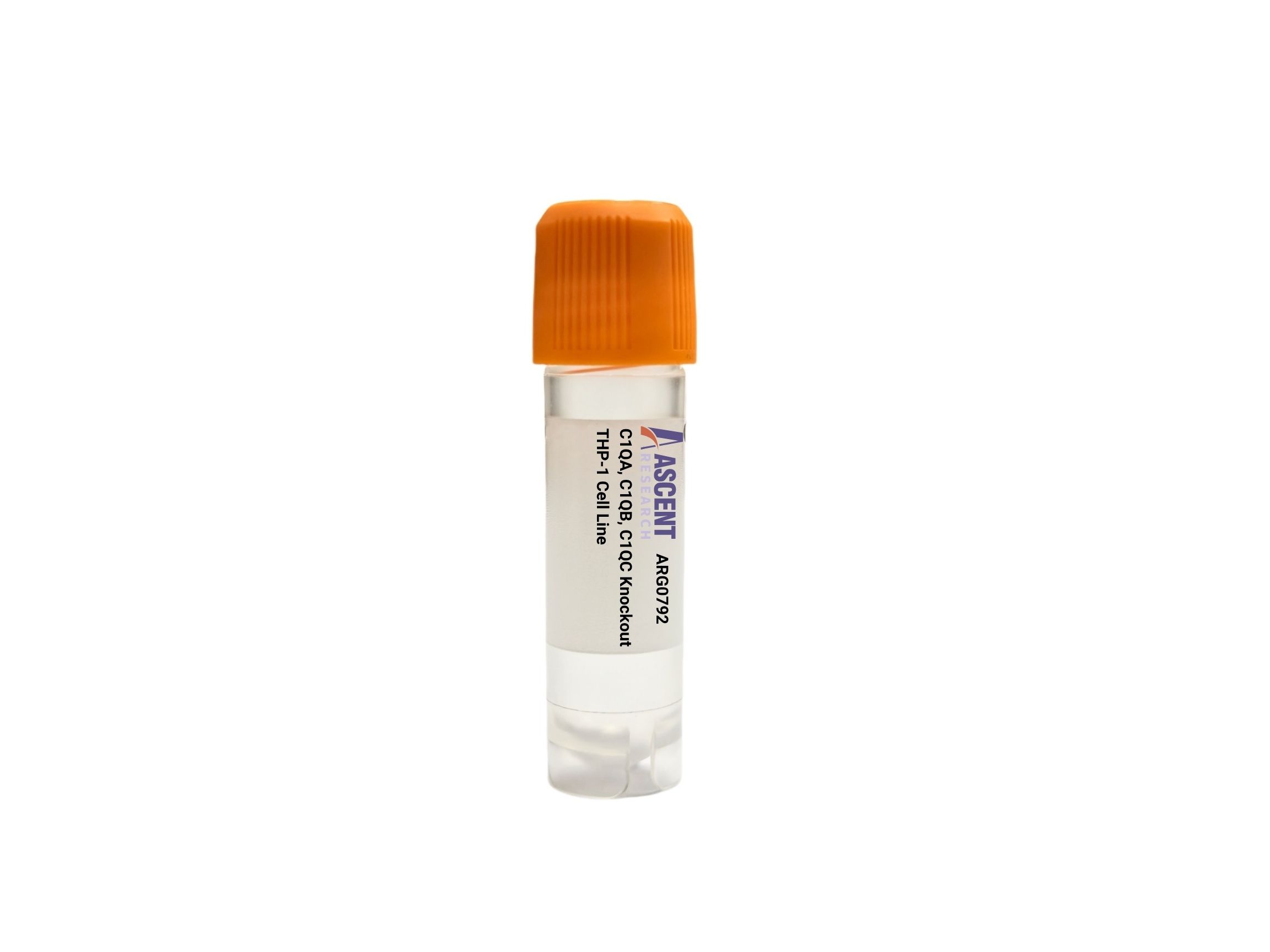
Genome-edited Cells
Blood (peripheral blood)
The C1QA, C1QB, C1QC Knockout THP-1 Cell Line is a CRISPR/Cas9-edited human monocytic leukemia cell line deficient in all three chains of complement C1q. Loss of C1q abrogates immune complex recognition by the C1 complex, preventing activation of C1r and C1s and subsequent C3 opsonization and phagocytic receptor engagement. This knockout model enables detailed study of complement deficiency, systemic lupus erythematosus pathogenesis, and macrophage-mediated immune complex clearance. Applications include C3b deposition assays, phagocytosis measurements, C1q immunodetection, and drug screening targeting complement-driven inflammation.
 IL4I1 Knockout HAP1 Polyclonal Cells
Cat. No. ARG22799
HDAC3 Knockout THP-1 Polyclonal Cells
Cat. No. ARG23481
APMAP Knockout huh-7 Polyclonal Cells
Cat. No. ARG27936
KALRN Knockout Hela Polyclonal Cells
Cat. No. ARG37569
ENHO Knockout HCT116 Polyclonal Cells
Cat. No. ARG6992
CIC Knockout Raji Polyclonal Cells
Cat. No. ARG1930
IL4I1 Knockout HAP1 Polyclonal Cells
Cat. No. ARG22799
HDAC3 Knockout THP-1 Polyclonal Cells
Cat. No. ARG23481
APMAP Knockout huh-7 Polyclonal Cells
Cat. No. ARG27936
KALRN Knockout Hela Polyclonal Cells
Cat. No. ARG37569
ENHO Knockout HCT116 Polyclonal Cells
Cat. No. ARG6992
CIC Knockout Raji Polyclonal Cells
Cat. No. ARG1930
The C1QA, C1QB, C1QC Knockout THP-1 Cell Line is a CRISPR/Cas9-edited human knockout cell line engineered to disrupt all three genes encoding the A, B, and C chains of complement component C1q. By ablating C1q expression in the THP-1 monocytic background, this model eliminates the recognition subunit of the C1 complex, providing a complete loss-of-function system for studying classical complement pathway initiation.
The parental THP-1 cell line is a well-established human acute monocytic leukemia line derived from the peripheral blood of a one-year-old male. THP-1 cells can be differentiated into macrophage-like cells upon phorbol ester treatment, making them a widely used surrogate for monocyte-derived macrophages. This differentiation capacity enables functional studies of innate immune processes including phagocytosis, cytokine secretion, and complement-mediated effector functions.
C1q is the recognition subunit of the C1 complex, binding via its globular heads to the Fc regions of antibodies within immune complexes and to pentraxins such as CRP and PTX3. This binding activates C1r and C1s serine proteases, leading to cleavage of C4 and C2 and generation of the C3 convertase. Downstream, this cascade promotes C3 opsonization, formation of the membrane attack complex (C5?CC9), and engagement of phagocytic receptors CD11b/CD18 (CR3). C1q also interacts with CD91 and calreticulin to mediate apoptotic cell clearance. Transcription of C1Q genes is driven by PU.1, IRF8, and NF-??B, and is modulated by IFN-??, TLR4 ligands (LPS), and IL-6.
In the context of THP-1 cells, knockout of C1QA, C1QB, and C1QC permanently eliminates all three C1q chains, thereby abrogating C1 complex formation and subsequent classical pathway activation. This disruption impairs opsonization and complement-dependent phagocytosis, faithfully recapitulating features of human C1q deficiency. Consequently, the cell line serves as a pertinent model for systemic lupus erythematosus (SLE), recurrent pyogenic infections, and other autoimmune conditions linked to defective immune complex clearance.
This knockout cell line enables dissection of C1q-dependent mechanisms in macrophage phagocytosis and opsonization, as well as cross-talk with Fc?? receptors. Typical assays include RT-qPCR and western blotting for C1q chains, C3b deposition, flow cytometry for surface C1q, and phagocytosis of fluorescent immune complexes. The model is also suitable for drug screening in complement-mediated inflammatory diseases. For further details, please contact Ascent Research.