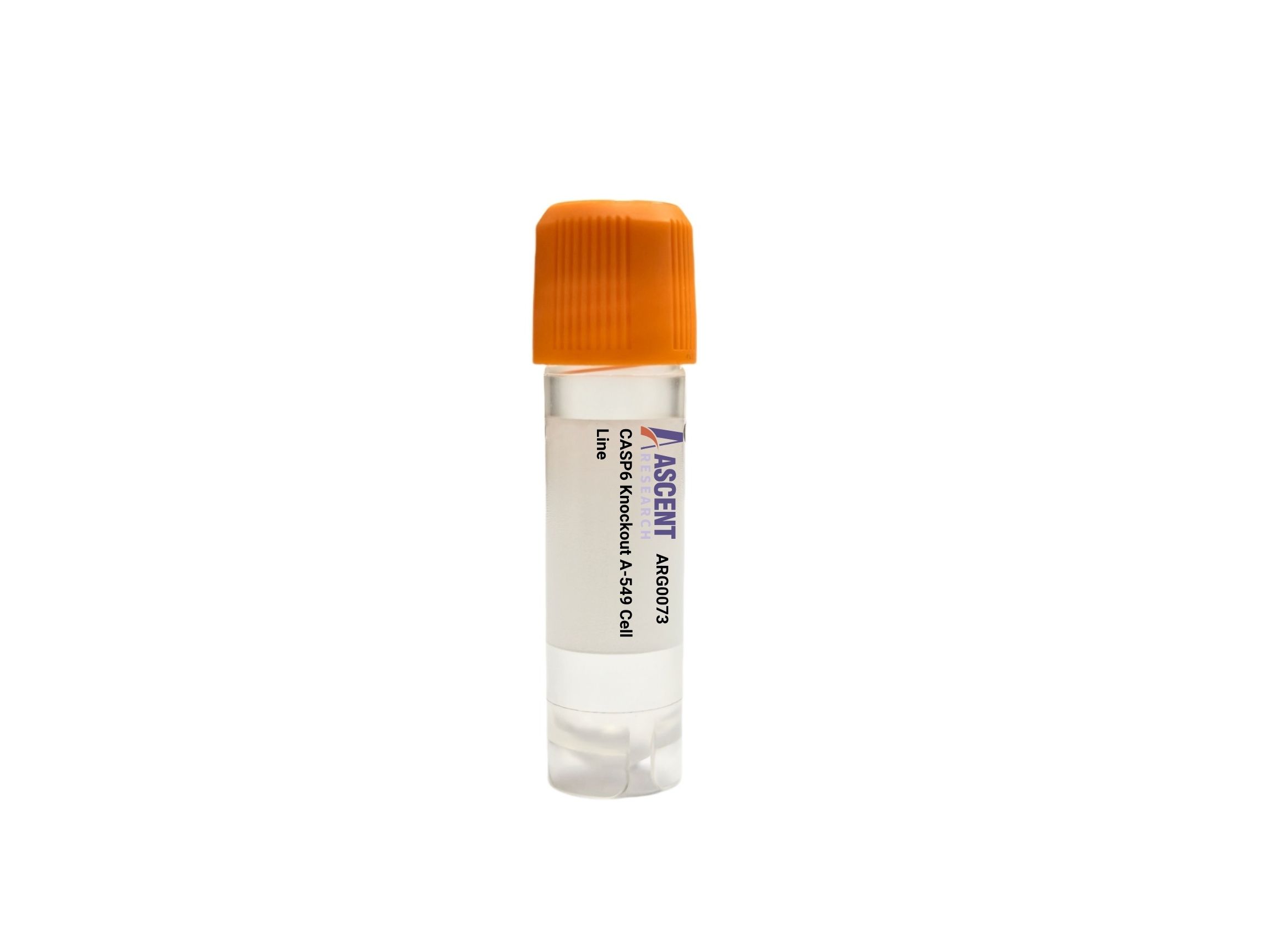
Genome-edited Cells
Lung
CASP6 Knockout A-549 Cell Line is a CRISPR/Cas9-edited human alveolar epithelial adenocarcinoma model with disruption of CASP6, encoding the executioner protease caspase-6. In A-549 cells, this knockout supports analysis of apoptotic signaling downstream of FAS, TRAIL/TNFSF10, cytochrome c, APAF1, CASP9, and CASP3, with downstream effects on substrates such as LMNA and PARP1. The model is useful for apoptosis mechanism studies, lung cancer cell death signaling, cytotoxic drug response profiling, death receptor and mitochondrial apoptosis assays, and quantitative evaluation by western blotting, flow cytometry, annexin V/PI staining, caspase activity assays, and RNA-seq.
 ABCG2 Knockout Hela Polyclonal Cells
Cat. No. ARG20187
NCS1 Knockout HT29 Polyclonal Cells
Cat. No. ARG14779
BRCC3 Knockout MES-OV Polyclonal Cells
Cat. No. ARG24357
LCLAT1 Knockout Hela Polyclonal Cells
Cat. No. ARG7853
NPTX1 Knockout HEK293T Polyclonal Cells
Cat. No. ARG3617
D2HGDH Knockout Raji Polyclonal Cells
Cat. No. ARG1019
ABCG2 Knockout Hela Polyclonal Cells
Cat. No. ARG20187
NCS1 Knockout HT29 Polyclonal Cells
Cat. No. ARG14779
BRCC3 Knockout MES-OV Polyclonal Cells
Cat. No. ARG24357
LCLAT1 Knockout Hela Polyclonal Cells
Cat. No. ARG7853
NPTX1 Knockout HEK293T Polyclonal Cells
Cat. No. ARG3617
D2HGDH Knockout Raji Polyclonal Cells
Cat. No. ARG1019
CASP6 Knockout A-549 Cell Line is a CRISPR/Cas9-engineered human cell model in which the CASP6 gene has been disrupted to eliminate functional caspase-6 expression. This edited line is generated in A-549 cells, a human alveolar epithelial adenocarcinoma background, and provides a stable in vitro system for investigating the contribution of CASP6 to apoptotic execution, proteolytic signaling, and treatment response. As a defined loss-of-function model, it is suited for studies requiring direct comparison of CASP6-deficient and parental epithelial tumor cells under basal conditions or after pathway stimulation.
A-549 is a widely used lung adenocarcinoma cell line with alveolar epithelial type II-like features and barrier-forming epithelial characteristics. The line is broadly applied in pulmonary epithelial biology, lung cancer signaling, inflammatory signaling, viral infection research, and cytotoxic drug studies. Its relevance derives from the combination of epithelial lineage features and robust experimental tractability across molecular, biochemical, and phenotypic assays. In this context, A-549 cells are frequently used to model epithelial stress responses, apoptosis regulation, and signaling adaptations associated with tumor cell survival and therapeutic exposure.
CASP6 encodes caspase-6, an effector cysteine-aspartate protease that functions downstream of initiator and executioner caspases in apoptotic pathways. CASP6 is activated in signaling networks initiated by FAS, TNF, and TRAIL/TNFSF10 through death receptor components including FADD and CASP8, and also in mitochondrial apoptosis downstream of cytochrome c, APAF1, and CASP9 following BAX/BAK1-dependent mitochondrial outer membrane permeabilization. CASP6 interacts within the broader caspase network with CASP3 and CASP7 and is modulated by apoptosis regulators such as XIAP and DIABLO/SMAC. Its downstream proteolytic targets include LMNA and PARP1, and CASP6-mediated substrate cleavage contributes to nuclear lamina disassembly, chromatin condensation, cytoskeletal remodeling, and apoptotic cell death. CASP6-dependent processing of substrates such as HTT and MAPT also links this protease to neurodegeneration-associated proteolysis.
Loss of CASP6 in the A-549 background creates a useful model for defining how executioner caspase specificity shapes apoptotic morphology and signaling output in lung epithelial tumor cells. This system can help distinguish CASP6-dependent events from parallel activities mediated by CASP3 or CASP7, clarify pathway dependence downstream of TP53 activation or genotoxic stress, and evaluate how CASP6 deficiency alters responses to death receptor ligands or mitochondrial apoptotic stimuli. In a lung cancer context, the model is relevant to apoptosis dysregulation, inflammation-associated cell death, and sensitivity to cytotoxic or combination therapies.
Applications include western blot analysis of LMNA and PARP1 cleavage, caspase activity assays following FAS or TRAIL stimulation, annexin V/propidium iodide staining and flow cytometry to quantify apoptotic progression, and mitochondrial membrane potential assays to relate upstream mitochondrial dysfunction to downstream execution. Researchers may combine RT-qPCR, RNA-seq, immunofluorescence, and co-immunoprecipitation to assess compensatory signaling, caspase network remodeling, and protein interaction changes in CASP6-deficient cells. The model is also suitable for drug sensitivity studies, mechanism-of-action profiling of pro-apoptotic agents, and evaluation of neurodegeneration-related substrate cleavage in a controlled human epithelial background. Researchers may contact Ascent Research for additional technical information, product details, or related gene-edited cell models.