Genome-edited Cells
Lung
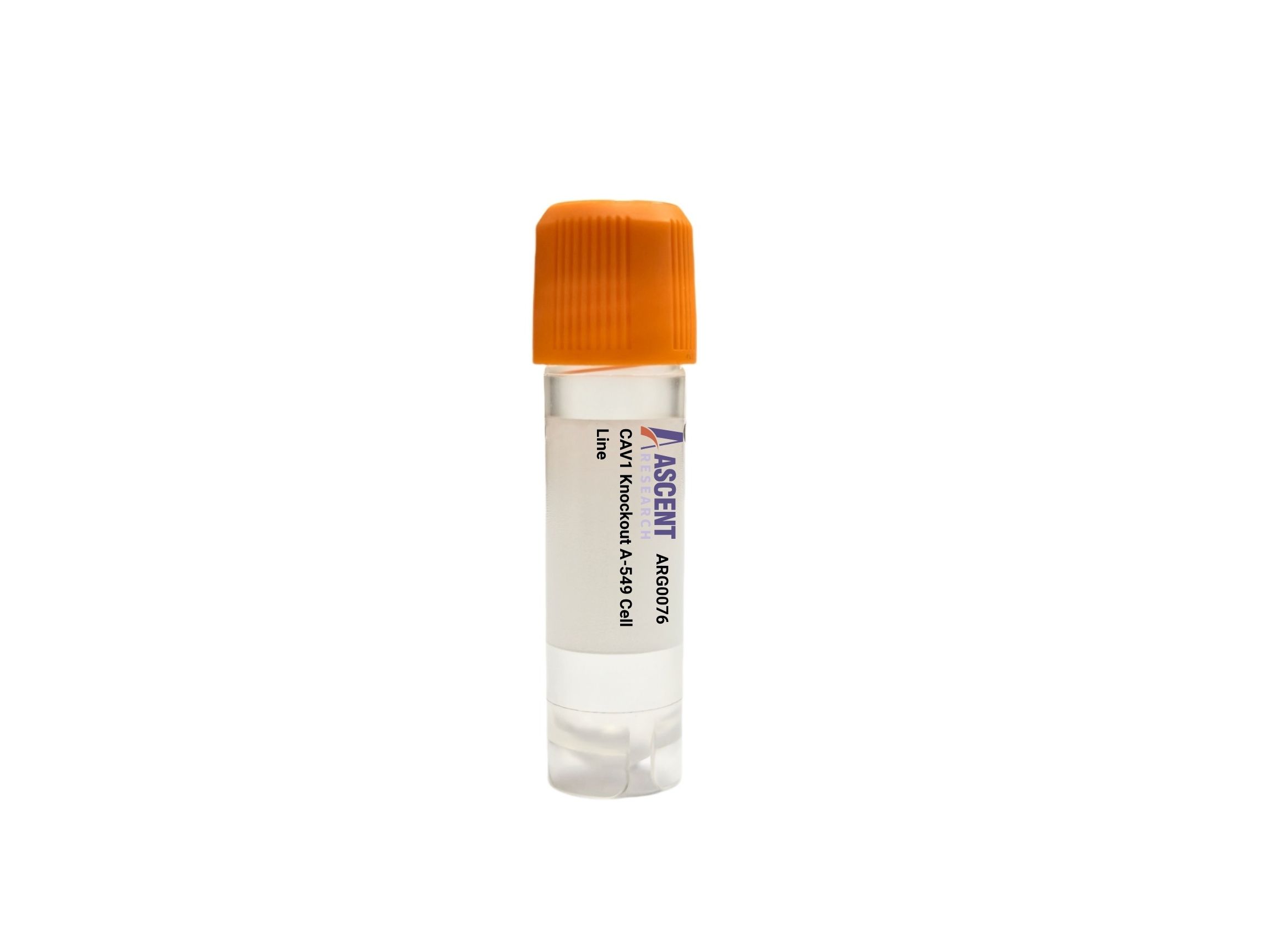
CAV1 Knockout A-549 is a human CRISPR/Cas9-edited alveolar epithelial adenocarcinoma cell line with disruption of the caveolin-1 gene. In the lung-derived A-549 background, this model supports analysis of caveolae biology, membrane trafficking, and signaling pathways regulated by CAV1, including EGFR, SRC-PTK2/FAK, PI3K-AKT, MAPK-ERK, mechanotransduction, and cholesterol homeostasis. Loss of CAV1 provides a useful system for studying epithelial adhesion, migration, endocytosis, and treatment response in lung cancer-relevant contexts using western blotting, phospho-signaling assays, microscopy, RNA-seq, cholesterol transport assays, and migration or invasion assays.
 CFH Knockout A549 Polyclonal Cells
Cat. No. ARG11176
FRS2 Knockout jurkat Polyclonal Cells
Cat. No. ARG13043
CECR2 Knockout THP-1 Polyclonal Cells
Cat. No. ARG7399
KDM5D Knockout 786O Polyclonal Cells
Cat. No. ARG35745
CD44 Knockout Raji Polyclonal Cells
Cat. No. ARG43597
MTCH1 Knockout 786-O Polyclonal Cells
Cat. No. ARG5217
CFH Knockout A549 Polyclonal Cells
Cat. No. ARG11176
FRS2 Knockout jurkat Polyclonal Cells
Cat. No. ARG13043
CECR2 Knockout THP-1 Polyclonal Cells
Cat. No. ARG7399
KDM5D Knockout 786O Polyclonal Cells
Cat. No. ARG35745
CD44 Knockout Raji Polyclonal Cells
Cat. No. ARG43597
MTCH1 Knockout 786-O Polyclonal Cells
Cat. No. ARG5217
The CAV1 Knockout A-549 Cell Line is a human CRISPR/Cas9-engineered cell model in which the CAV1 gene has been disrupted to eliminate functional caveolin-1 expression. This stable edited line is generated in A-549 cells, a human alveolar basal epithelial adenocarcinoma background, and provides an in vitro system for investigating caveolae-associated membrane organization, receptor signaling, and epithelial response programs in a lung-derived context.
A-549 cells are widely used as a pulmonary epithelial model because they retain alveolar type II-like features and support studies of epithelial barrier biology, lung cancer signaling, membrane trafficking, and pharmacologic response. As a human lung adenocarcinoma cell line, A-549 is relevant to research on tumor progression, epithelial plasticity, growth-factor signaling, and host response pathways. Its established use in imaging, biochemical signaling assays, and functional perturbation studies makes it a practical host background for defining how specific gene loss alters pulmonary epithelial behavior.
CAV1 encodes caveolin-1, a principal structural component of caveolae that forms membrane-associated complexes with factors including CAVIN1/PTRF, EHD2, EGFR, SRC, PTK2/FAK, ITGB1, NOS3, and filamin A. Caveolin-1 organizes lipid raft and caveolar microdomains and modulates signaling downstream of integrin engagement, EGF stimulation, TGF-beta1, mechanical stress, hypoxia, and altered cholesterol availability. Through these interactions, CAV1 regulates caveolae-mediated endocytosis, cholesterol trafficking, and mechanotransduction, while influencing SRC phosphorylation state, FAK/PTK2 signaling, AKT1 activation, MAPK1/MAPK3-driven ERK1/2 signaling, RHOA activity, CDH1-associated adhesion dynamics, and migratory behavior. Because these signaling axes are strongly linked to lung cancer, fibrosis-associated remodeling, and vascular or metabolic dysfunction, CAV1 loss is a useful perturbation for pathway-level studies.
In the A-549 background, knockout of CAV1 enables direct analysis of how caveolar disruption reprograms epithelial membrane architecture and signaling output in a lung cancer-relevant system. This model is particularly informative for examining dependencies between caveolae integrity and EGFR, PI3K-AKT, MAPK-ERK, integrin-SRC-FAK, or TGF-beta pathway activity, as well as the effects of altered cholesterol distribution on adhesion, motility, and growth control.
Researchers can apply this cell line in western blotting and phospho-signaling studies to assess SRC, FAK, AKT1, or ERK1/2 pathway responses; in RT-qPCR or RNA-seq to profile gene-expression changes following growth-factor, hypoxic, or mechanical perturbation; and in immunofluorescence or confocal microscopy to examine caveolae markers, membrane organization, and cytoskeletal remodeling. The model is also suited for co-immunoprecipitation of caveolar signaling complexes, cholesterol uptake or efflux assays, endocytosis measurements, migration and invasion assays, proliferation and apoptosis studies, and drug sensitivity testing in lung cancer and membrane-trafficking research workflows. Researchers may contact Ascent Research for additional technical information, product details, or related gene-edited cell models.