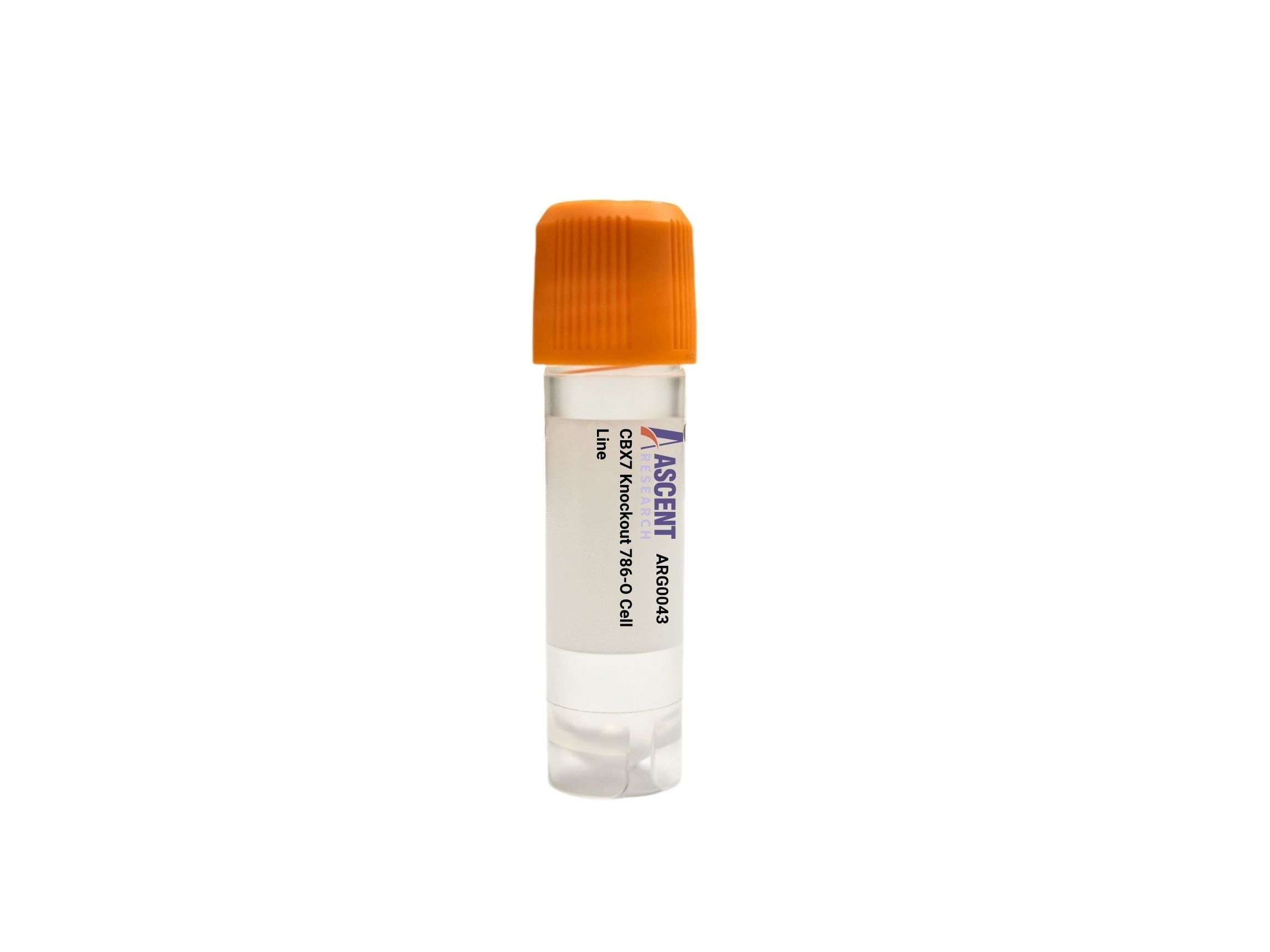
Genome-edited Cells
Kidney
CBX7 Knockout 786-O is a human CRISPR/Cas9-edited renal cell carcinoma epithelial line generated in the widely used 786-O clear cell renal cancer background. 786-O cells model VHL-deficient, HIF-active kidney tumor biology, while CBX7 functions in canonical PRC1 by recognizing H3K27me3 and cooperating with RNF2/RING1B, BMI1, and other Polycomb factors to repress genes such as CDKN2A and CDKN1A. This knockout model supports studies of epigenetic repression, chromatin organization, proliferation, senescence, transcriptional profiling, and drug response using assays including RNA-seq, ChIP-based analysis, cell-cycle profiling, colony formation, and sensitivity testing.
 NFKB1 Knockout SK-HEP-1 Polyclonal Cells
Cat. No. ARG15989
PDHX Knockout NCI-H1975 Polyclonal Cells
Cat. No. ARG17085
ERC1 Knockout HT29 Polyclonal Cells
Cat. No. ARG14935
PCLAF Knockout HEK293 Polyclonal Cells
Cat. No. ARG12674
FOXA1 Knockout Hela Polyclonal Cells
Cat. No. ARG8683
AP1S1 Knockout SK-HEP-1 Polyclonal Cells
Cat. No. ARG32198
NFKB1 Knockout SK-HEP-1 Polyclonal Cells
Cat. No. ARG15989
PDHX Knockout NCI-H1975 Polyclonal Cells
Cat. No. ARG17085
ERC1 Knockout HT29 Polyclonal Cells
Cat. No. ARG14935
PCLAF Knockout HEK293 Polyclonal Cells
Cat. No. ARG12674
FOXA1 Knockout Hela Polyclonal Cells
Cat. No. ARG8683
AP1S1 Knockout SK-HEP-1 Polyclonal Cells
Cat. No. ARG32198
The CBX7 Knockout 786-O Cell Line is a human CRISPR/Cas9-engineered renal cancer model in which the CBX7 gene has been disrupted to eliminate functional CBX7 expression. This edited line is generated in 786-O cells, a human renal cell carcinoma epithelial cell line, and provides a stable in vitro system for studying the consequences of CBX7 loss in tumor-associated chromatin regulation. As a CBX7-deficient derivative of a widely used kidney cancer model, it is suited for mechanistic studies of Polycomb-dependent gene repression, cell-state control, and therapeutic response.
786-O is a clear cell renal cell carcinoma cell line derived from kidney epithelium and is broadly used to investigate renal carcinoma biology. The line is especially relevant for studies of VHL-deficient renal cancer and prominent HIF signaling activity, making it valuable for examining transcriptional adaptation, tumor cell proliferation, and responses to targeted agents. In addition to its utility in hypoxia-related research, 786-O serves as a practical epithelial tumor model for analyzing pathways that integrate chromatin regulation with oncogenic and stress-associated programs in renal cancer.
CBX7 encodes a chromobox protein within canonical Polycomb repressive complex 1 (PRC1). CBX7 binds H3K27me3-marked nucleosomes deposited upstream by PRC2 components including EZH2, SUZ12, and EED, and helps recruit or stabilize PRC1 complexes containing RING1A, RING1B/RNF2, BMI1, PHC1, PHC2, and SCMH1 on repressed chromatin. Through these interactions, CBX7 promotes chromatin compaction and transcriptional silencing of loci linked to cell-cycle control, senescence, and differentiation. Representative downstream targets and affected programs include repression of CDKN2A/p16INK4a, CDKN2A/p14ARF, CDKN1A/p21, E2F-responsive cell-cycle genes, senescence-associated transcriptional programs, and differentiation-associated genes. CBX7 activity is also regulated by developmental cues and long noncoding RNAs such as ANRIL, placing it at the interface of epigenetic maintenance and tumor cell state regulation.
Loss of CBX7 in the 786-O background is therefore a relevant model for examining how disruption of canonical PRC1 function reshapes transcriptional repression in renal carcinoma cells. In a VHL-deficient, HIF-active context, CBX7 knockout can be used to assess how Polycomb-associated chromatin control influences proliferative capacity, senescence susceptibility, lineage-related transcriptional states, and adaptive responses to targeted or epigenetic perturbation. This host-target combination is particularly useful for dissecting dependencies between chromatin repression machinery and renal tumor cell behavior.
Researchers can apply this cell line in western blotting and RT-qPCR workflows to confirm loss of CBX7-linked repression programs, and in RNA-seq to define transcriptome-wide effects on cell-cycle, senescence, and differentiation gene sets. ChIP-qPCR or ChIP-seq can be used to investigate changes in H3K27me3 occupancy, PRC1-associated chromatin binding, or recruitment of factors such as RNF2 and BMI1, while chromatin accessibility assays can evaluate broader epigenomic remodeling. Functional consequences may be assessed using cell proliferation assays, colony formation assays, cell-cycle analysis, senescence-associated beta-galactosidase staining, apoptosis assays, and migration or invasion studies. The model is also suitable for co-immunoprecipitation, immunofluorescence, and drug sensitivity studies involving anticancer compounds or epigenetic modulators. Researchers may contact Ascent Research for additional technical information, product details, or related gene-edited cell models.