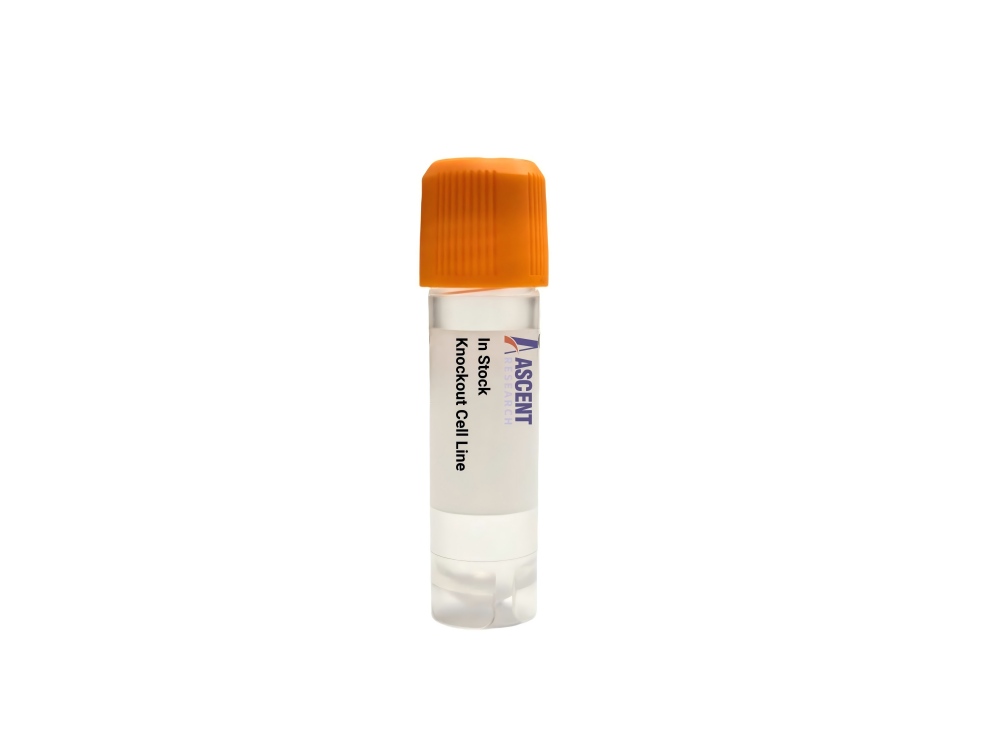
In Stock Cell Lines
The CD274 Knockout CMT-U27 Cell Line is a CRISPR/Cas9-edited knockout cell line derived from canine bladder transitional cell carcinoma. It features targeted disruption of PD-L1 (CD274), eliminating the immune checkpoint ligand that suppresses T-cell activity via PD-1 binding and SHP-2 recruitment. This model allows researchers to study PD-1/PD-L1 immunobiology and tumor immune evasion in a spontaneous canine cancer context. Typical applications include co-culture assays, checkpoint inhibitor testing, and signaling pathway analysis using western blotting, flow cytometry, and ELISpot. For further information, please contact Ascent Research.
 ERCC5 Knockout K562 Polyclonal Cells
Cat. No. ARG19400
MS4A7 Knockout HGC-27 Polyclonal Cells
Cat. No. ARG18210
NDFIP1 Knockout Hela Polyclonal Cells
Cat. No. ARG8649
HNRNPA3 Knockout Hela Polyclonal Cells
Cat. No. ARG37549
EIF4E3 Knockout HAP1 Polyclonal Cells
Cat. No. ARG41041
GCNT2 Knockout MES-OV Polyclonal Cells
Cat. No. ARG6571
ERCC5 Knockout K562 Polyclonal Cells
Cat. No. ARG19400
MS4A7 Knockout HGC-27 Polyclonal Cells
Cat. No. ARG18210
NDFIP1 Knockout Hela Polyclonal Cells
Cat. No. ARG8649
HNRNPA3 Knockout Hela Polyclonal Cells
Cat. No. ARG37549
EIF4E3 Knockout HAP1 Polyclonal Cells
Cat. No. ARG41041
GCNT2 Knockout MES-OV Polyclonal Cells
Cat. No. ARG6571
The CD274 Knockout CMT-U27 Cell Line is a CRISPR/Cas9-edited knockout cell line derived from the CMT-U27 canine bladder transitional cell carcinoma cell line. This product features targeted disruption of the CD274 gene, which encodes the immune checkpoint ligand PD-L1. The resulting loss-of-function model provides a stable and well-defined genetic background for investigating PD-L1-dependent signaling, immune evasion, and therapeutic response in a spontaneous canine carcinoma context. As a cell line product, it is suitable for a broad range of in vitro experimental applications, including co-culture, functional, and pharmacologic studies.
The CMT-U27 host cell line was established from a spontaneously arising canine transitional cell carcinoma of the urinary bladder. This cell line retains key molecular and phenotypic features of urothelial carcinoma, making it a physiologically relevant model for both veterinary and comparative oncology research. Its canine origin offers unique advantages for translational immunology, particularly in evaluating cross-species reactivity of immune checkpoint inhibitors and for studying tumor-immune interactions in an outbred large animal model system.
CD274 encodes PD-L1 (Programmed Death-Ligand 1), a transmembrane protein that functions as a critical immune checkpoint molecule. Upon binding to its receptor PD-1 on T cells, PD-L1 recruits SHP-2 phosphatase, which dephosphorylates ZAP70 and attenuates downstream TCR signaling, leading to reduced IL-2 and IFN-?? production and promotion of T-cell exhaustion. PD-L1 expression is transcriptionally activated by upstream regulators such as IFN-?? via STAT3 and NF-??B, as well as HIF-1?? under hypoxic conditions, and can be driven by oncogenic pathways involving EGFR and MYC. In addition to PD-1, PD-L1 interacts with B7-1 (CD80) and competes with CD28-mediated co-stimulation. The PD-1/PD-L1 axis integrates with multiple signaling cascades including PI3K/AKT, JAK/STAT, NF-??B, and MAPK/ERK pathways, positioning PD-L1 as a central node in immune regulation and tumor immune escape.
In the context of canine bladder transitional cell carcinoma, PD-L1-mediated immune checkpoint signaling contributes to tumor immune evasion by suppressing anti-tumor T-cell responses. Disruption of CD274 in the CMT-U27 cell line eliminates this suppressive ligand-receptor interaction, thereby permitting re-activation of T-cell effector functions in co-culture settings. This knockout model enables precise dissection of PD-L1??s role in modulating immune surveillance and provides a platform to explore how loss of PD-L1 affects intrinsic tumor cell signaling and sensitivity to various immunotherapeutic strategies.
Researchers can utilize the CD274 Knockout CMT-U27 Cell Line in a variety of applications, including functional studies of the PD-1/PD-L1 immune checkpoint, screening and validation of novel PD-L1 inhibitors or blocking antibodies, and mechanistic investigations of PD-L1-mediated signal transduction. Typical assays include western blotting for PD-L1 and downstream signaling proteins, RT-qPCR to assess transcriptional changes, flow cytometry for surface marker expression, T-cell co-culture IFN-?? ELISpot to measure functional T-cell responses, and cytotoxicity assays to evaluate tumor cell killing. The cell line can also be employed in xenograft tumor growth models to study in vivo tumorigenicity and therapeutic response. For further information, please contact Ascent Research.