Genome-edited Cells
Large intestine (colon)
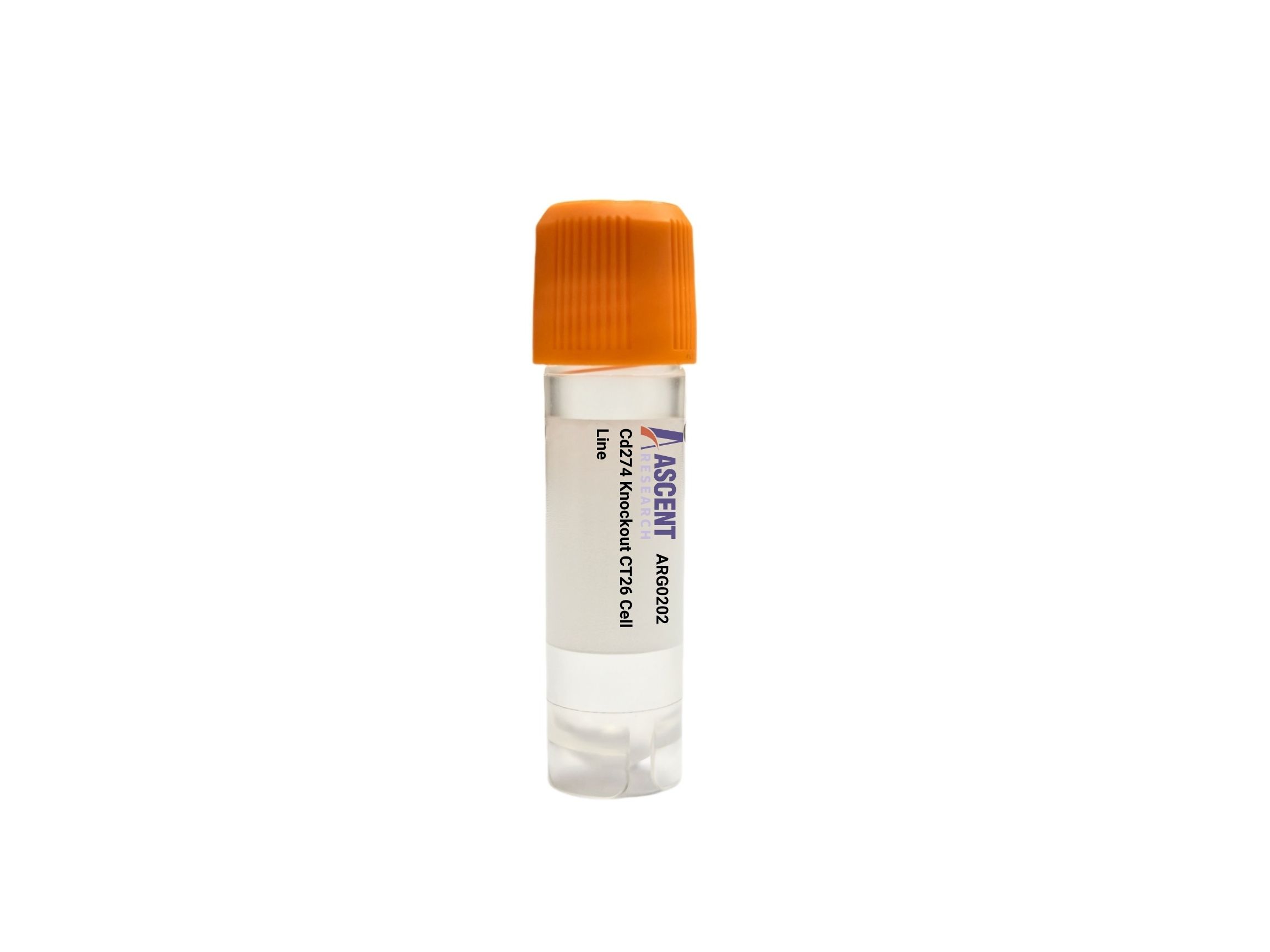
Cd274 Knockout CT26 is a CRISPR/Cas9-edited mouse colon carcinoma cell line with disruption of Cd274, which encodes the immune checkpoint ligand PD-L1. In the BALB/c-derived CT26 syngeneic tumor model, PD-L1 is regulated by IFNG-IFNGR1/2-JAK1/JAK2-STAT1-IRF1 signaling and acts through PDCD1 on T cells to suppress activation, cytokine production, and cytotoxicity. This knockout model is useful for studies of tumor immunology, immune evasion, checkpoint biology, interferon responses, and cancer immunotherapy resistance using flow cytometry, co-culture assays, RNA analysis, and in vivo syngeneic tumor experiments.
 NT5C3A Knockout A2780 Polyclonal Cells
Cat. No. ARG19047
BCL6 Knockout A549 Polyclonal Cells
Cat. No. ARG23112
INF2 Knockout SK-HEP-1 Polyclonal Cells
Cat. No. ARG32671
DNTTIP1 Knockout AGS Polyclonal Cells
Cat. No. ARG39518
LAMA5 Knockout HEK293T Polyclonal Cells
Cat. No. ARG4215
NT5C3A Knockout A2780 Polyclonal Cells
Cat. No. ARG19047
BCL6 Knockout A549 Polyclonal Cells
Cat. No. ARG23112
INF2 Knockout SK-HEP-1 Polyclonal Cells
Cat. No. ARG32671
DNTTIP1 Knockout AGS Polyclonal Cells
Cat. No. ARG39518
LAMA5 Knockout HEK293T Polyclonal Cells
Cat. No. ARG4215
 Rat Pancreatic Acinar Epithelial Cells
Cat. No. ARP0283
Rat Pancreatic Acinar Epithelial Cells
Cat. No. ARP0283
The Cd274 Knockout CT26 Cell Line is a CRISPR/Cas9-engineered mouse tumor cell model in which the Cd274 gene has been disrupted to eliminate functional PD-L1 expression. Generated in the CT26 host background, this stable knockout line provides an in vitro system for interrogating tumor cell-intrinsic and tumor-immune regulatory functions associated with PD-L1 loss. As CT26 is an epithelial-derived murine colon carcinoma line, this model is suited for studies requiring a genetically defined colorectal tumor context with direct relevance to immune checkpoint biology and therapeutic response.
CT26 is a colon carcinoma cell line derived from BALB/c mouse and is extensively used as a syngeneic transplantation model in immuno-oncology. Its broad adoption reflects its utility in modeling tumor growth, immune regulation, and treatment response in an immunocompetent host setting. In vitro, CT26 cells are frequently used to examine cytokine-driven transcriptional programs, tumor-cell signaling states, and interactions with lymphocytes or other immune effectors. This biological background makes CT26 a valuable platform for investigating mechanisms of immune evasion and adaptive immune resistance relevant to colorectal cancer and other solid tumors.
Cd274 encodes PD-L1, an inducible transmembrane ligand that binds PDCD1 (PD-1) on activated T cells and suppresses T-cell receptor signaling, IL2 production, IFNG production, proliferation, and CD8+ cytotoxic function. In tumor cells, CD274 expression is strongly regulated by IFNG through IFNGR1/IFNGR2, JAK1, JAK2, STAT1, and IRF1, and can also be modulated by TNF-NFKB1-RELA signaling, EGFR, PI3K-AKT-MTOR, MAPK signaling, and HIF1A-dependent programs. PD-L1 stability and surface abundance are further influenced by interacting factors including CMTM6 and CMTM4, while CD80 represents an additional relevant binding partner in immune-regulatory settings. Through these signaling relationships, CD274 functions at the interface of antigen presentation, inflammatory signaling, and tumor-immune interaction.
Loss of Cd274 in the CT26 background is therefore mechanistically informative for separating checkpoint-mediated immune suppression from other tumor-cell signaling outputs. In this host context, the knockout can support analysis of how IFN-gamma-induced transcriptional responses are coupled or uncoupled from PD-L1-dependent immune inhibition, and how tumor cells engage adaptive immune resistance pathways in the absence of this ligand. The model is also useful for studying pathway dependency downstream of JAK-STAT, NF-kB, PI3K-AKT, or MAPK inputs without confounding effects from intact PD-1/PD-L1 checkpoint signaling.
This cell line can be applied in flow cytometry, western blotting, RT-qPCR, RNA-seq, and immunofluorescence workflows to characterize Cd274 loss and associated transcriptional or signaling changes, including phospho-STAT1 responses after IFNG stimulation. In tumor-immune co-culture systems, it enables direct assessment of PD-L1-dependent effects on T-cell activation, cytokine release, and cytotoxicity using cytokine measurement and killing assays. It is also appropriate for reporter assays, drug sensitivity studies, and combination treatment experiments evaluating checkpoint-related resistance mechanisms, as well as in vivo syngeneic tumor studies in BALB/c-compatible settings. Researchers may contact Ascent Research for additional technical information, product details, or related gene-edited cell models.