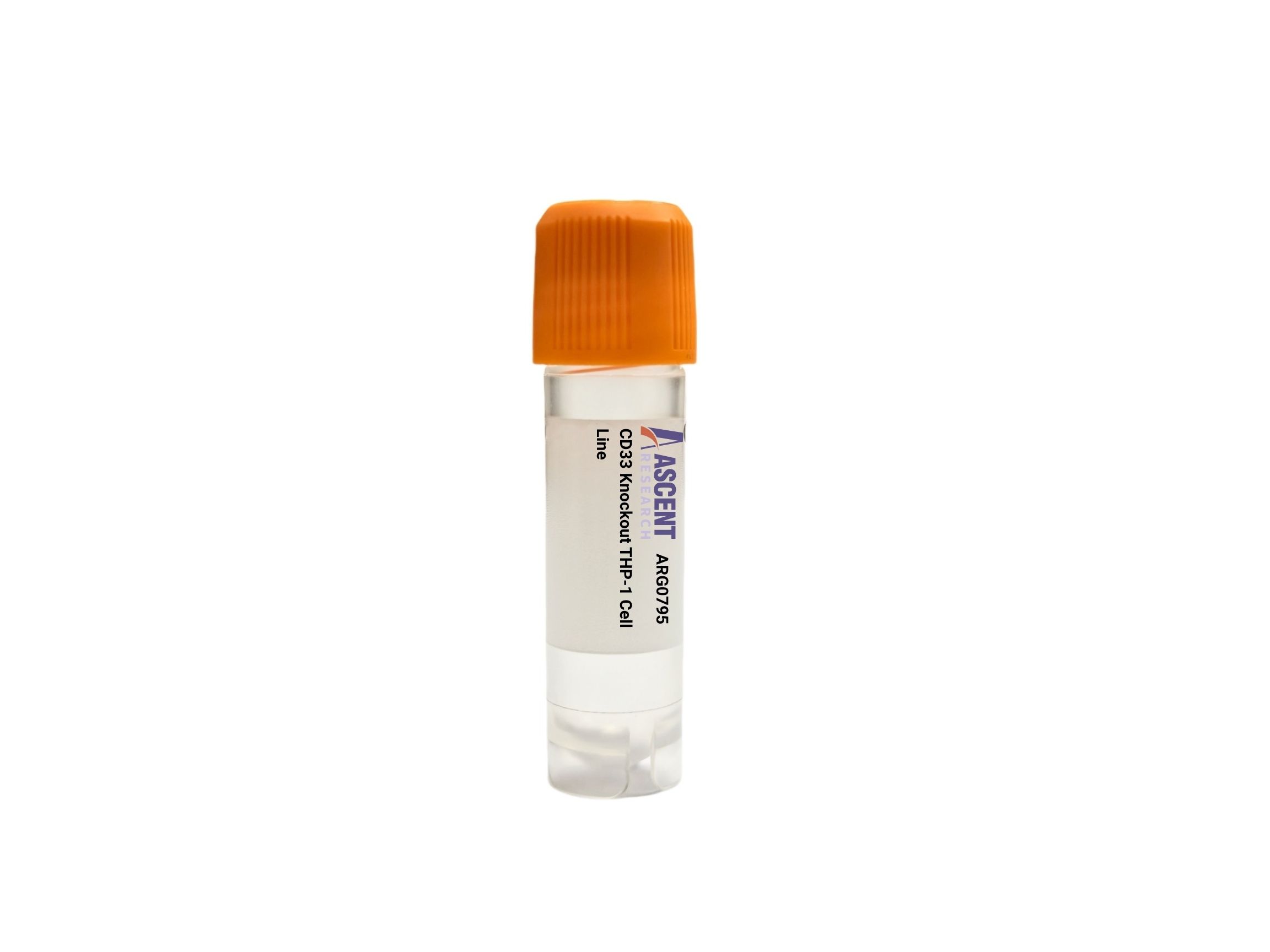
Genome-edited Cells
Blood (peripheral blood)
The CD33 Knockout THP-1 Cell Line is a CRISPR/Cas9-edited human monocytic cell line lacking functional Siglec-3 expression. Derived from THP-1 leukemia cells, it eliminates CD33-mediated inhibitory signaling via ITIM recruitment of SHP-1 and SHP-2 phosphatases, thereby enhancing myeloid phagocytosis and cytokine responses. This model is ideal for studying CD33??s role in acute myeloid leukemia and Alzheimer??s disease, evaluating immune checkpoint blockade, and developing CD33-targeted therapeutics. Key assays include flow cytometry, phagocytosis tests, and western blotting for downstream signaling analysis.
 CAMKK1 Knockout jurkat Polyclonal Cells
Cat. No. ARG34077
PGM1 Knockout A2780 Polyclonal Cells
Cat. No. ARG19160
LMF2 Knockout SK-HEP-1 Polyclonal Cells
Cat. No. ARG16107
CSNK2A2 Knockout SK-HEP-1 Polyclonal Cells
Cat. No. ARG16218
ESR1 Knockout THP-1 Polyclonal Cells
Cat. No. ARG7403
GRB10 Knockout huh-7 Polyclonal Cells
Cat. No. ARG28237
CAMKK1 Knockout jurkat Polyclonal Cells
Cat. No. ARG34077
PGM1 Knockout A2780 Polyclonal Cells
Cat. No. ARG19160
LMF2 Knockout SK-HEP-1 Polyclonal Cells
Cat. No. ARG16107
CSNK2A2 Knockout SK-HEP-1 Polyclonal Cells
Cat. No. ARG16218
ESR1 Knockout THP-1 Polyclonal Cells
Cat. No. ARG7403
GRB10 Knockout huh-7 Polyclonal Cells
Cat. No. ARG28237
The CD33 Knockout THP-1 Cell Line is a CRISPR/Cas9-edited knockout cell line derived from the THP-1 human monocytic cell line, engineered to disrupt the CD33 gene and abolish expression of the functional Siglec-3 protein. This loss-of-function model eliminates CD33-mediated inhibitory signaling, providing a robust tool for dissecting myeloid cell regulation.
THP-1 is a widely used suspension cell line originally isolated from the peripheral blood of a 1-year-old male with acute monocytic leukemia. It serves as a versatile model for studying monocyte-to-macrophage differentiation, inflammatory responses, and leukemia biology. Upon phorbol ester (PMA) induction, THP-1 cells differentiate into macrophage-like cells, enabling investigations of phagocytosis, cytokine secretion, and surface receptor dynamics.
CD33 encodes a sialic acid-binding immunoglobulin-like lectin that functions as an inhibitory receptor on myeloid cells. Upon engagement by sialylated glycans, CD33 recruits the tyrosine phosphatases SHP-1 (PTPN6) and SHP-2 (PTPN11) via its immunoreceptor tyrosine-based inhibitory motifs (ITIMs). These phosphatases dephosphorylate downstream targets including Syk kinase, thereby attenuating activating signals from the PI3K-AKT and NF-??B pathways. CD33 signaling is regulated by transcription factor PU.1 (SPI1) and cytokines such as CSF1 and IFNG, and it interacts with integrins and forms homodimers that modulate ligand responsiveness. CD33 thus acts as a molecular brake on phagocytosis, oxidative burst, and pro-inflammatory cytokine production.
In the THP-1 context, CD33 knockout removes this inhibitory constraint, enhancing innate immune effector functions. This is particularly relevant for modeling microglial phagocytosis in Alzheimer??s disease, where CD33 variants are linked to impaired amyloid-beta clearance, and for acute myeloid leukemia, where CD33 is a therapeutic target. The knockout line enables mechanistic dissection of how loss of CD33 influences downstream SHP-1/SHP-2 activity and signal transduction.
Key applications include flow cytometric verification of surface CD33 depletion, phagocytosis assays using fluorescent beads or amyloid-beta peptides, and immunoblotting for phosphorylated SHP-1/SHP-2. Additional assays encompass multiplex cytokine profiling, antibody-dependent cellular phagocytosis (ADCP) studies, RT-qPCR for pro-inflammatory gene expression, and PMA-induced differentiation coupled with functional readouts. This cell line supports target validation for CD33-directed CAR-T cells, antibody-drug conjugates, and immune checkpoint modulation. For more information, contact Ascent Research.