Genome-edited Cells
Blood (peripheral blood)
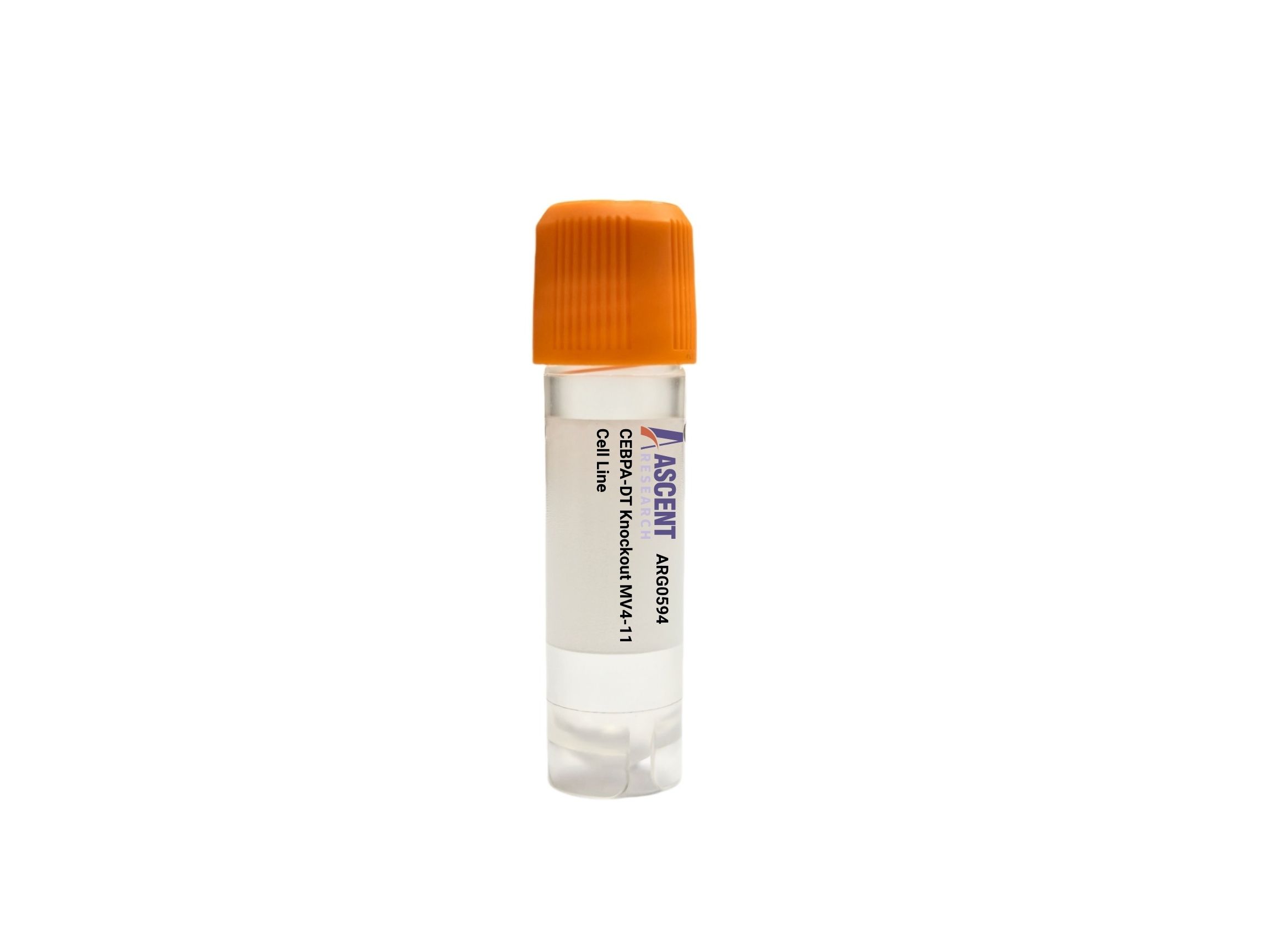
The CEBPA-DT Knockout MV4-11 Cell Line is a CRISPR/Cas9-edited knockout model disrupting the long non-coding RNA CEBPA-DT in the human AML cell line MV4-11. This lncRNA regulates the myeloid transcription factor CEBPA by interacting with the CEBPA promoter and chromatin remodeling complexes, and knockout impairs CEBPA transcriptional activity, affecting downstream targets like the G-CSF receptor and myeloperoxidase, thereby disrupting myeloid differentiation. Ideal for studying lncRNA-dependent mechanisms in AML, dissecting the CEBPA regulatory network, and screening drug responses in MLL-AF4-driven leukemia. Applications include RT-qPCR, western blot, flow cytometry for CD11b/CD14, proliferation assays, and RNA-seq.
 LHFPL2 Knockout NCI-H1975 Polyclonal Cells
Cat. No. ARG16749
NEIL2 Knockout NCI-H1975 Polyclonal Cells
Cat. No. ARG16688
LILRB4 Knockout NCI-H1299 Polyclonal Cells
Cat. No. ARG17499
ARAP1 Knockout MES-OV Polyclonal Cells
Cat. No. ARG24193
GSK3B Knockout 769-P Polyclonal Cells
Cat. No. ARG35130
COMMD4 Knockout AGS Polyclonal Cells
Cat. No. ARG2623
LHFPL2 Knockout NCI-H1975 Polyclonal Cells
Cat. No. ARG16749
NEIL2 Knockout NCI-H1975 Polyclonal Cells
Cat. No. ARG16688
LILRB4 Knockout NCI-H1299 Polyclonal Cells
Cat. No. ARG17499
ARAP1 Knockout MES-OV Polyclonal Cells
Cat. No. ARG24193
GSK3B Knockout 769-P Polyclonal Cells
Cat. No. ARG35130
COMMD4 Knockout AGS Polyclonal Cells
Cat. No. ARG2623
The CEBPA-DT Knockout MV4-11 Cell Line is a human CRISPR/Cas9-edited knockout cell line designed for investigating the function of the long non-coding RNA CEBPA-DT in acute myeloid leukemia. This reagent provides a loss-of-function model by disrupting the CEBPA-DT gene in the MV4-11 leukemic background, enabling studies of its regulatory role in myeloid differentiation and leukemic cell growth. The knockout serves as a population-based tool for functional genomics, with general CRISPR/Cas9-mediated gene disruption employed to ablate the lncRNA.
The MV4-11 host cell line is derived from a 10-year-old male with biphenotypic B-myelomonocytic leukemia carrying the MLL-AF4 translocation. This cell line is a widely used model for AML, particularly in characterizing oncogenic signaling driven by MLL fusions and evaluating therapeutic responses. Its biphenotypic nature makes it suitable for examining both myeloid and monocytic differentiation programs, providing a relevant background for probing CEBPA-DT-mediated regulation.
CEBPA-DT is a long non-coding RNA that acts as a key regulator of the myeloid transcription factor CEBPA. It interacts with the CEBPA promoter and chromatin remodeling complexes to modulate CEBPA transcription. The lncRNA functions downstream of RUNX1, PU.1, and GM-CSF signaling, and its disruption impairs the CEBPA transcriptional network, leading to altered expression of downstream targets such as the G-CSF receptor and myeloperoxidase. This regulatory axis is critical for granulocytic differentiation and is frequently dysregulated in myeloid malignancies.
In the context of MV4-11 cells harboring the MLL-AF4 oncogene, CEBPA-DT knockout provides a unique platform to dissect how lncRNA-mediated CEBPA regulation intersects with leukemogenic signaling. The model is expected to exhibit impaired myeloid differentiation and altered proliferation, making it valuable for understanding the molecular mechanisms underlying AML pathogenesis. It also allows interrogation of the interplay between the MLL fusion and CEBPA pathways, potentially revealing novel vulnerabilities.
Researchers can employ this cell line in assays such as RT-qPCR and western blot to quantify CEBPA-DT, CEBPA, and myeloid marker expression, flow cytometry for differentiation markers CD11b and CD14, cell proliferation assays, RNA-seq for transcriptome profiling, myeloid colony formation assays, and drug sensitivity screens. These applications facilitate detailed exploration of lncRNA biology, CEBPA regulatory networks, and identification of novel therapeutic targets. For further information or to inquire about this knockout cell line, please contact Ascent Research.