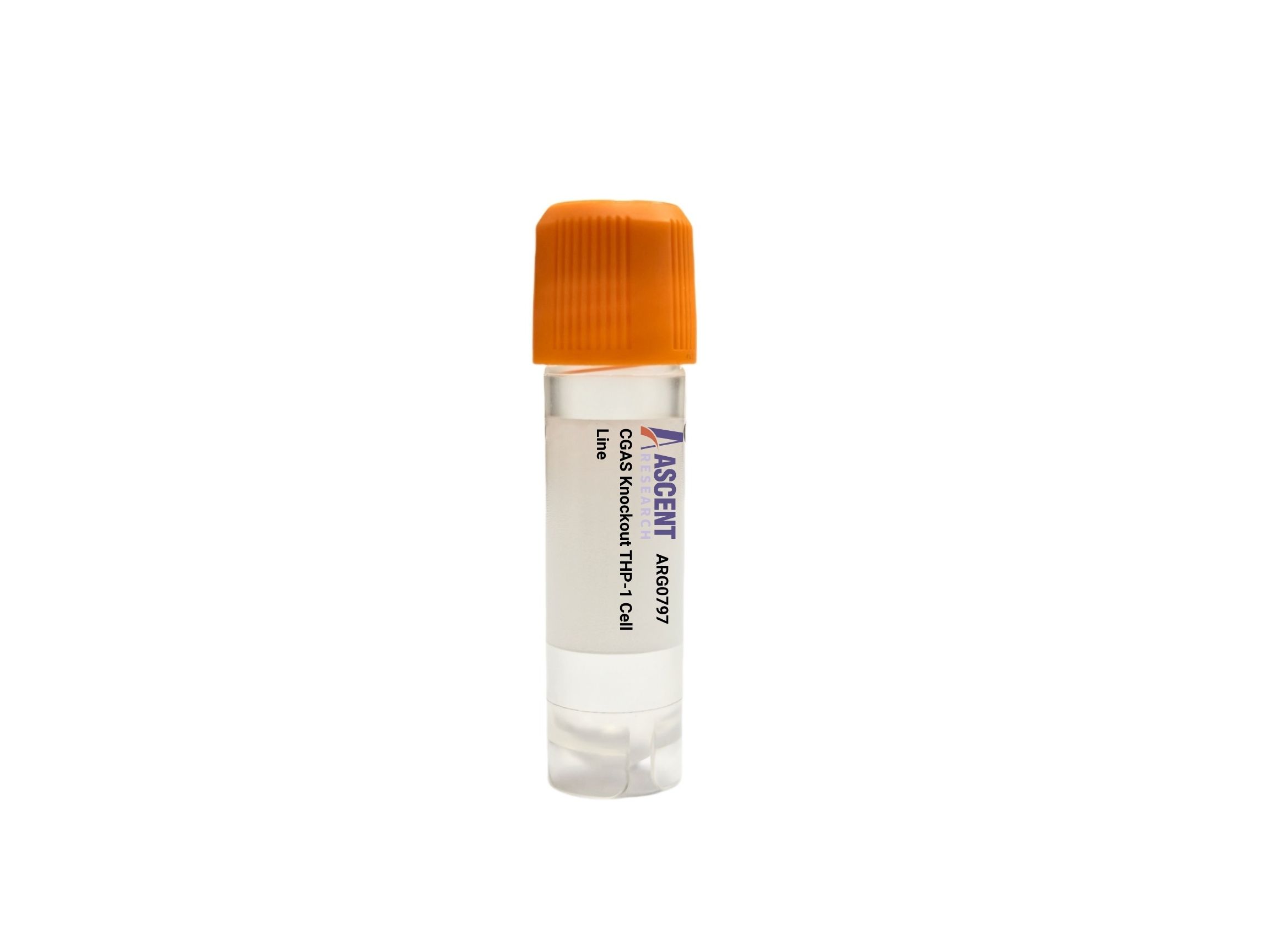
Genome-edited Cells
Blood (peripheral blood)
The CGAS Knockout THP-1 Cell Line is a CRISPR/Cas9-edited human monocytic cell line with targeted disruption of CGAS, the cytosolic DNA sensor. Derived from THP-1 acute monocytic leukemia cells, this suspension line can be differentiated into macrophage-like cells, providing a versatile platform for innate immunity research. CGAS catalyzes cGAMP production, activating STING and downstream TBK1-IRF3 signaling to induce type I interferons and inflammatory cytokines such as TNF and IL-6. This knockout model enables dissection of cGAS-STING pathway contributions to autoimmunity, antiviral responses, and cancer immunotherapy, and is compatible with assays for phospho-TBK1, cGAMP quantification, and ISRE-luciferase reporter activity.
 CALM3 Knockout HEK293T Polyclonal Cells
Cat. No. ARG37900
NFIX Knockout jurkat Polyclonal Cells
Cat. No. ARG13808
KIF13B Knockout A2780 Polyclonal Cells
Cat. No. ARG29309
EME1 Knockout MES-OV Polyclonal Cells
Cat. No. ARG6170
PCYT2 Knockout MES-OV Polyclonal Cells
Cat. No. ARG5878
CNNM3 Knockout 786-O Polyclonal Cells
Cat. No. ARG4888
CALM3 Knockout HEK293T Polyclonal Cells
Cat. No. ARG37900
NFIX Knockout jurkat Polyclonal Cells
Cat. No. ARG13808
KIF13B Knockout A2780 Polyclonal Cells
Cat. No. ARG29309
EME1 Knockout MES-OV Polyclonal Cells
Cat. No. ARG6170
PCYT2 Knockout MES-OV Polyclonal Cells
Cat. No. ARG5878
CNNM3 Knockout 786-O Polyclonal Cells
Cat. No. ARG4888
The CGAS Knockout THP-1 Cell Line is a CRISPR/Cas9-edited knockout cell line providing a loss-of-function model for the cytosolic DNA sensor CGAS in a human monocytic background. This product features THP-1 cells with targeted gene disruption, eliminating functional CGAS expression and enabling precise dissection of innate immune pathways. The stable cell line is suitable for biochemical, pharmacological, and cell-based assays investigating cGAS-dependent DNA sensing.
THP-1 is a human monocytic leukemia cell line derived from the peripheral blood of a 1-year-old male with acute monocytic leukemia. It grows in suspension and can be differentiated into macrophage-like cells with phorbol esters, offering a versatile model for monocyte and macrophage biology. THP-1 cells are extensively used to study inflammatory cytokine production, innate immune responses, and signal transduction, and they are amenable to genetic engineering and high-throughput screening.
CGAS serves as a primary sensor for cytosolic double-stranded DNA from sources such as DNA viruses, damaged mitochondria, or retrotransposons. Upon DNA binding, CGAS catalyzes the synthesis of cGAMP, which activates STING on the endoplasmic reticulum. STING then recruits and activates TBK1, which phosphorylates IRF3, leading to its nuclear translocation and transcriptional induction of type I interferons (IFN-??, IFN-??) and ISGs. Parallel NF-??B activation drives expression of inflammatory cytokines like TNF and IL-6. Key interacting partners include TBK1, IRF3, MAVS, and OAS1. Disruption of CGAS blocks this signaling cascade, preventing cGAMP production and downstream immune activation.
In THP-1 cells, CGAS knockout abrogates responses to cytosolic DNA, making the model essential for studying cGAS-STING-dependent innate immunity. The differentiation capacity allows analysis of DNA sensing in both monocytic and macrophage-like states. This knockout line is particularly relevant for autoimmune disease research, including Aicardi-Gouti??res syndrome and systemic lupus erythematosus, where aberrant CGAS activation by self-DNA drives interferonopathies. It also supports cancer immunotherapy research, where STING pathway engagement is a therapeutic strategy.
Typical applications include stimulation with dsDNA or viral infection, followed by western blot for phospho-TBK1 and phospho-IRF3, RT-qPCR for IFNB1, ISG15, or IL6, and ELISA for cGAMP. Immunofluorescence can detect STING translocation, and flow cytometry or ISRE-luciferase reporter assays can measure interferon responses. The model is suited for drug screening targeting the cGAS-STING axis. For further details, please contact Ascent Research.