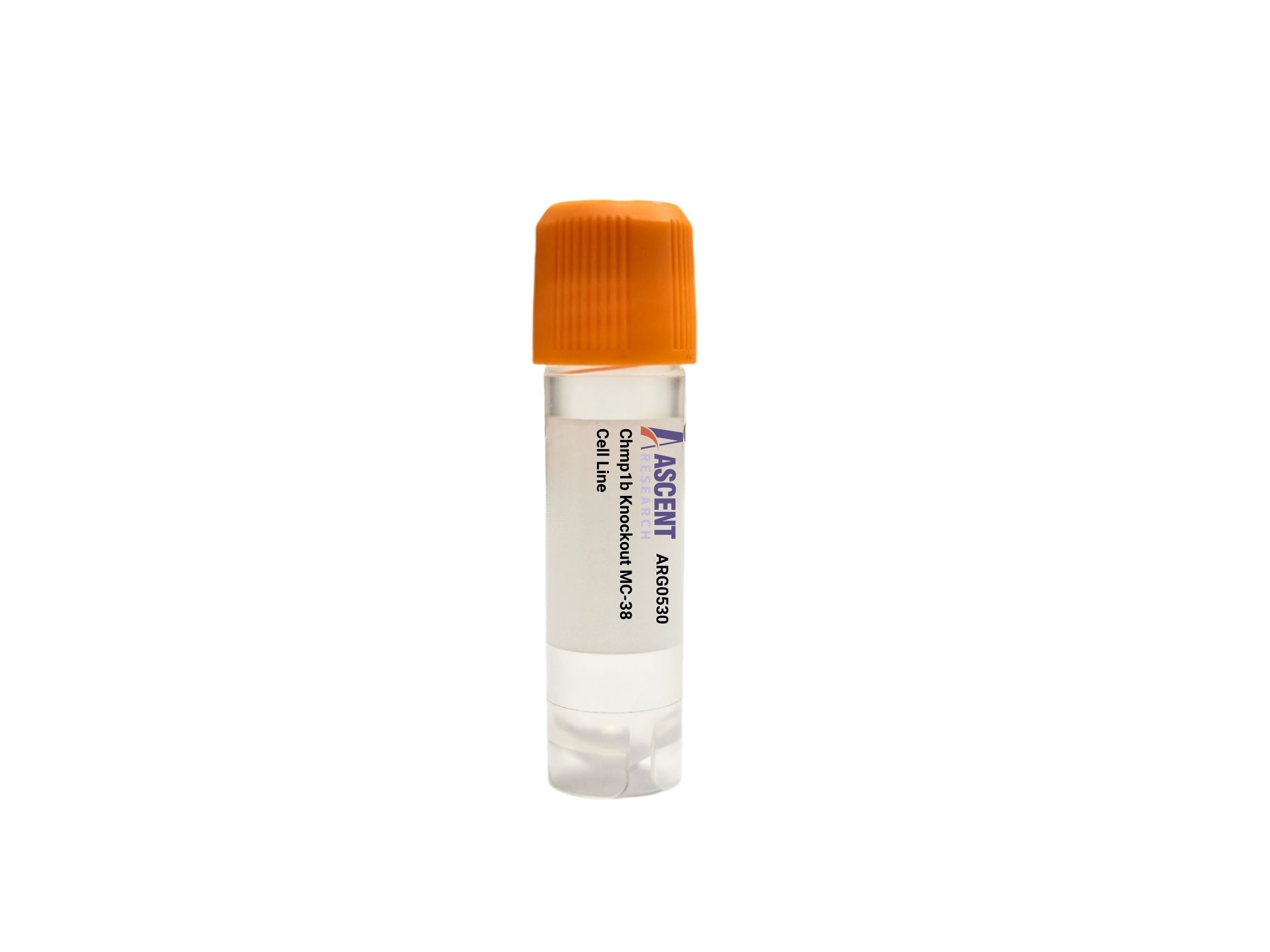
Genome-edited Cells
Large intestine (colon)
The Chmp1b Knockout MC-38 Cell Line is a CRISPR/Cas9-edited knockout cell line disrupting the ESCRT-III component CHMP1B in MC-38 murine colon adenocarcinoma cells. This model impairs membrane scission, multivesicular body formation, and endosomal sorting, affecting EGFR degradation and Notch signaling. Derived from a C57BL/6 syngeneic tumor model, this cell line is ideal for studying colorectal cancer biology, tumor microenvironment interactions, and ESCRT-dependent processes. Applications include western blotting, EGFR degradation assays, cytokinesis analysis, and migration studies, supporting research in cancer signaling and metastasis.
 RIPK2 Knockout A549 Cell Line
Cat. No. ARG44087
RIPK2 Knockout A549 Cell Line
Cat. No. ARG44087
 FAM98A Knockout NCI-H1299 Polyclonal Cells
Cat. No. ARG18052
MAPK11 Knockout HEK293 Polyclonal Cells
Cat. No. ARG12655
Gnai1 Knockout Hela Polyclonal Cells
Cat. No. ARG37341
BRCA1 Knockout MDA-MB-231 Polyclonal Cells
Cat. No. ARG38610
EML1 Knockout Raji Polyclonal Cells
Cat. No. ARG1984
FAM98A Knockout NCI-H1299 Polyclonal Cells
Cat. No. ARG18052
MAPK11 Knockout HEK293 Polyclonal Cells
Cat. No. ARG12655
Gnai1 Knockout Hela Polyclonal Cells
Cat. No. ARG37341
BRCA1 Knockout MDA-MB-231 Polyclonal Cells
Cat. No. ARG38610
EML1 Knockout Raji Polyclonal Cells
Cat. No. ARG1984
The Chmp1b Knockout MC-38 Cell Line is a CRISPR/Cas9-edited knockout cell line featuring targeted disruption of the Chmp1b gene in MC-38 murine colon adenocarcinoma epithelial cells. This model enables loss-of-function studies of CHMP1B, a component of the ESCRT-III complex, to dissect its roles in membrane scission, multivesicular body formation, and cytokinesis within a colorectal cancer context.
MC-38 cells originate from a C57BL/6 mouse colorectal adenocarcinoma and serve as a widely used syngeneic tumor model for immunology and oncology research. These epithelial cells retain key tumor characteristics, making them ideal for investigating colorectal cancer biology, tumor-host interactions, and immune responses in an immunocompetent microenvironment.
CHMP1B is a core ESCRT-III subunit that mediates membrane scission in processes such as endosomal sorting and cytokinetic abscission. Its activity is regulated by cellular stress and growth factor signaling, and it forms functional complexes with CHMP2A, CHMP4B, VPS4 ATPase, and IST1. Downstream, CHMP1B governs EGFR degradation, Notch signaling, and autophagic flux. Thus, Chmp1b knockout disrupts endosomal trafficking, altering receptor turnover and membrane dynamics that impact cell proliferation and homeostasis.
In the context of MC-38 colorectal cancer cells, loss of Chmp1b impairs ESCRT-III-dependent pathways critical for oncogenic signaling. Sustained EGFR activity due to reduced degradation, along with dysregulated Notch and autophagy, can influence tumor cell survival, migration, and metastasis. This knockout model provides a platform to study how membrane trafficking defects reshape tumor cell behavior and the tumor microenvironment, offering insights into colorectal cancer progression.
Research applications include ESCRT biology, endosomal trafficking, cancer signaling, and tumor microenvironment studies. The cell line supports biochemical assays (western blotting, immunofluorescence, flow cytometry) and functional analyses (EGFR degradation assay, cytokinesis assessment, migration assay). By enabling precise genetic dissection in a syngeneic model, it facilitates investigation of CHMP1B-dependent mechanisms in colorectal cancer. For additional information or technical support, please contact Ascent Research.