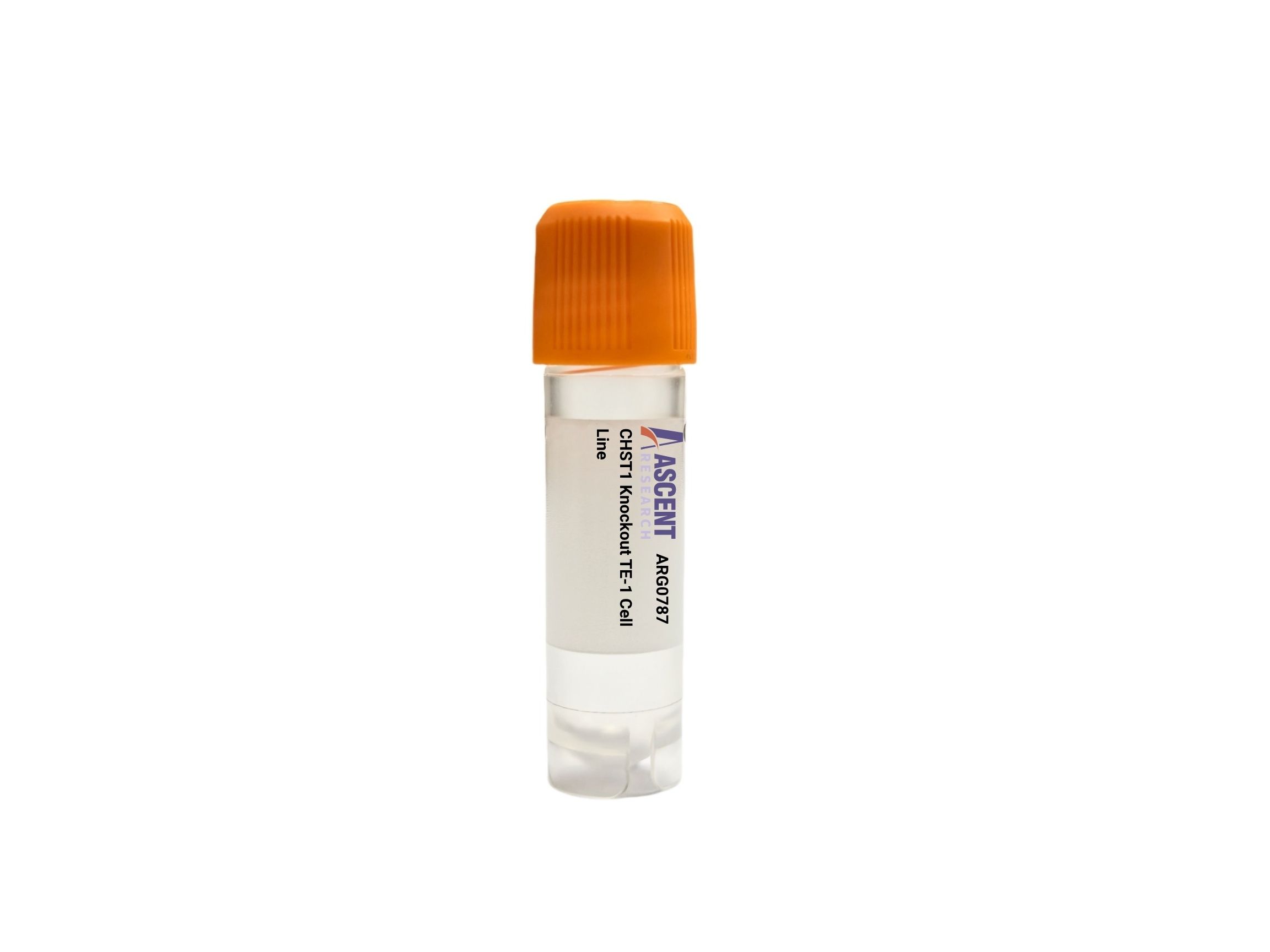
Genome-edited Cells
Esophagus
The CHST1 Knockout TE-1 Cell Line is a CRISPR/Cas9-edited knockout model derived from the human esophageal squamous cell carcinoma TE-1 line, designed for functional analysis of the sulfotransferase CHST1. This enzyme catalyzes 6-O-sulfation of galactose in keratan sulfate, regulating ECM structure and cell-ECM interactions, and is influenced by TGF-?? and EGF signaling. This line supports studies on invasion, migration, and ECM remodeling, with applications including sulfotransferase assays, scratch and Boyden chamber assays, and keratan sulfate detection. It is suitable for validating CHST1 as a therapeutic target and screening sulfation pathway inhibitors.
 CANX Knockout SK-HEP-1 Polyclonal Cells
Cat. No. ARG32455
LACTB2 Knockout A2780 Polyclonal Cells
Cat. No. ARG29330
ACTR1B Knockout CaSki Polyclonal Cells
Cat. No. ARG35411
DHCR7 Knockout PATU8988T Polyclonal Cells
Cat. No. ARG11298
MPHOSPH6 Knockout HEK293T Polyclonal Cells
Cat. No. ARG4147
OSGEPL1 Knockout AGS Polyclonal Cells
Cat. No. ARG2755
CANX Knockout SK-HEP-1 Polyclonal Cells
Cat. No. ARG32455
LACTB2 Knockout A2780 Polyclonal Cells
Cat. No. ARG29330
ACTR1B Knockout CaSki Polyclonal Cells
Cat. No. ARG35411
DHCR7 Knockout PATU8988T Polyclonal Cells
Cat. No. ARG11298
MPHOSPH6 Knockout HEK293T Polyclonal Cells
Cat. No. ARG4147
OSGEPL1 Knockout AGS Polyclonal Cells
Cat. No. ARG2755
The CHST1 Knockout TE-1 Cell Line is a CRISPR/Cas9-edited knockout model derived from the human esophageal squamous cell carcinoma (ESCC) TE-1 cell line, providing a permanent loss-of-function disruption of the CHST1 gene. This cell line enables detailed functional studies of CHST1-dependent sulfation in cancer biology without the need for transient gene silencing.
The parental TE-1 line originates from a primary ESCC tumor and is widely adopted for investigations into tumor invasion, metastasis, and extracellular matrix (ECM) remodeling. As an epithelial cell model, TE-1 retains malignant properties of ESCC, making it a clinically relevant host for dissecting genes involved in cell-ECM interactions.
CHST1 encodes a Golgi-resident sulfotransferase that catalyzes the 6-O-sulfation of galactose residues in keratan sulfate glycosaminoglycans, using 3′-phosphoadenosine-5′-phosphosulfate (PAPS) as a sulfate donor. This activity modifies core proteoglycans such as lumican and fibromodulin, thereby regulating ECM structure and integrin-mediated cell adhesion and signaling. Upstream, CHST1 expression is controlled by transforming growth factor beta (TGF-??) and epidermal growth factor (EGF) signaling, while downstream effects include altered matrix metalloproteinase regulation and cell adhesion molecule expression.
In esophageal carcinoma, elevated CHST1 activity correlates with increased sulfation of keratan sulfate proteoglycans, promoting tumor cell migration and invasion. The CHST1 Knockout TE-1 Cell Line serves as a powerful tool to investigate how loss of this sulfotransferase affects ESCC aggressiveness, allowing researchers to assess changes in cell motility, ECM composition, and signal transduction.
Typical applications include sulfotransferase activity and scratch wound healing migration assays, Boyden chamber invasion tests, western blotting for sulfated proteins, and immunofluorescence for keratan sulfate. Transcriptomic profiling by RNA-seq reveals pathway perturbations, while proliferation assays complete phenotypic assessment. This model is ideal for target validation and sulfation inhibitor screening. For additional information or to request this cell line, please contact Ascent Research.