Genome-edited Cells
Pancreas
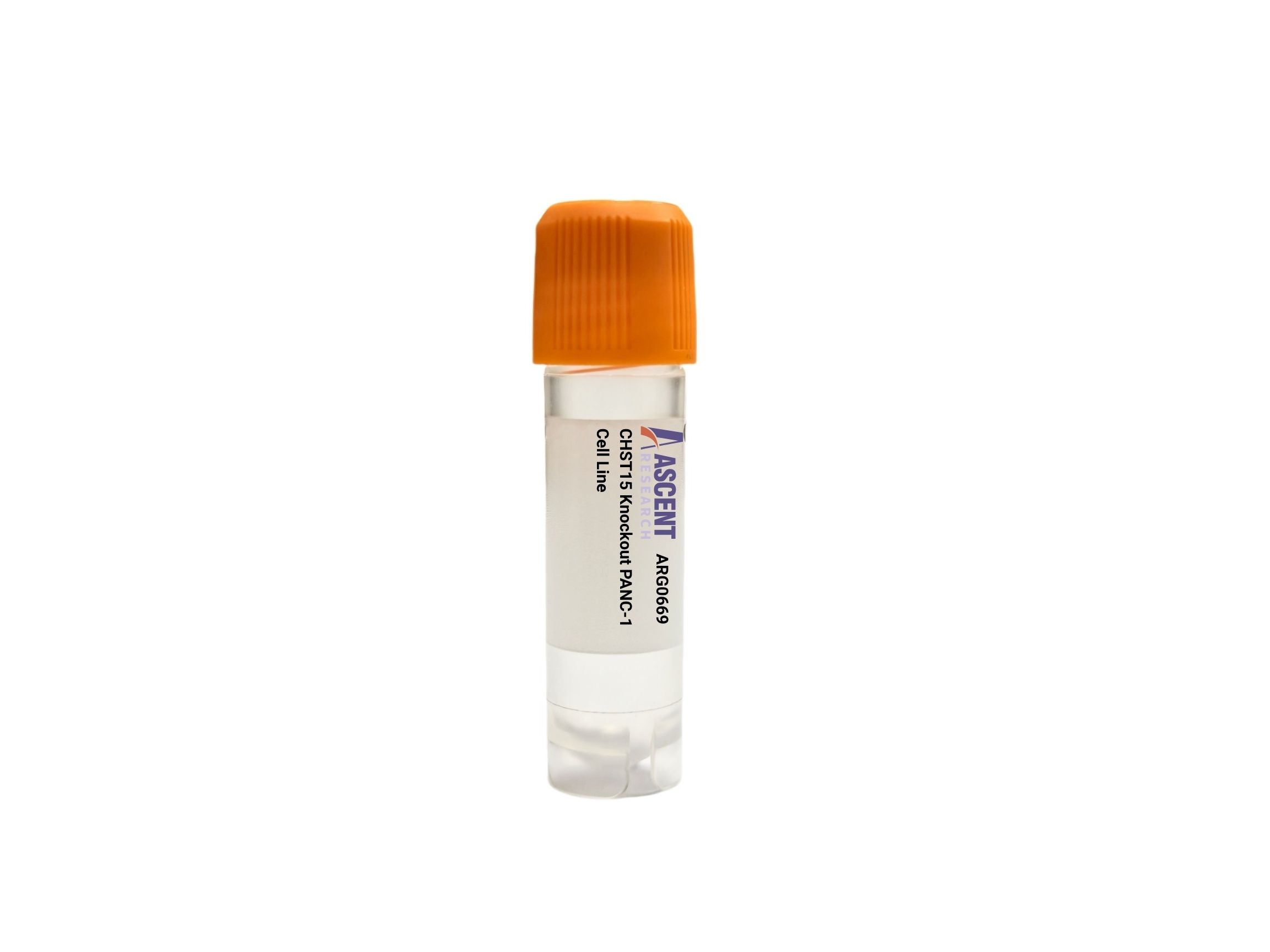
The CHST15 Knockout PANC-1 Cell Line is a CRISPR/Cas9-edited human pancreatic ductal adenocarcinoma cell line with targeted disruption of the CHST15 gene. Loss of CHST15 eliminates the synthesis of the CS-E chondroitin sulfate motif, which normally enhances binding of heparin-binding growth factors such as Wnt3a and pleiotrophin and promotes integrin ??v??3?CFAK signaling. This knockout model enables investigation of glycosaminoglycan sulfation in cancer, tumor microenvironment interactions, and pancreatic cancer progression. It is suitable for migration assays, CS-E detection, and downstream signaling analysis via western blotting and RNA-seq.
 DGKE Knockout A2780 Polyclonal Cells
Cat. No. ARG18755
NSRP1 Knockout A549 Polyclonal Cells
Cat. No. ARG10671
HERPUD1 Knockout A2780 Polyclonal Cells
Cat. No. ARG29094
KIDINS220 Knockout SK-HEP-1 Polyclonal Cells
Cat. No. ARG32754
ECE1 Knockout HEK293T Polyclonal Cells
Cat. No. ARG40303
HSPA2 Knockout huh-7 Polyclonal Cells
Cat. No. ARG28339
DGKE Knockout A2780 Polyclonal Cells
Cat. No. ARG18755
NSRP1 Knockout A549 Polyclonal Cells
Cat. No. ARG10671
HERPUD1 Knockout A2780 Polyclonal Cells
Cat. No. ARG29094
KIDINS220 Knockout SK-HEP-1 Polyclonal Cells
Cat. No. ARG32754
ECE1 Knockout HEK293T Polyclonal Cells
Cat. No. ARG40303
HSPA2 Knockout huh-7 Polyclonal Cells
Cat. No. ARG28339
The CHST15 Knockout PANC-1 Cell Line is a CRISPR/Cas9-edited knockout cell line with targeted disruption of CHST15, eliminating carbohydrate sulfotransferase 15 activity. This stable loss-of-function model enables precise investigation of chondroitin sulfate sulfation in pancreatic cancer without the limitations of transient gene silencing. By ablating the enzyme that generates the CS-E disaccharide motif, the line facilitates dissection of glycosaminoglycan-dependent signaling networks.
PANC-1 is a well-established human pancreatic ductal adenocarcinoma cell line derived from a primary tumor. It displays epithelial morphology and harbors oncogenic KRAS and TP53 mutations, making it a highly aggressive model for studying pancreatic cancer cell-autonomous processes such as invasion, chemoresistance, and stromal interactions.
CHST15 catalyzes 6-O-sulfation of N-acetylgalactosamine 4-sulfate in chondroitin sulfate to form CS-E, which avidly binds heparin-binding growth factors such as pleiotrophin, midkine, and Wnt3a. CS-E also promotes integrin ??v??3-mediated adhesion and focal adhesion kinase (FAK) phosphorylation. In PANC-1 cells, CHST15 is transcriptionally regulated by TGF-?? and the transcription factors TWIST1, SNAI1, and ??-catenin, integrating it into epithelial-mesenchymal transition and motility programs. Knockout-mediated depletion of CS-E attenuates growth factor binding, reduces integrin and FAK activation, and suppresses ??-catenin-driven transcription, thereby blunting downstream signaling cascades.
This knockout model is particularly valuable for dissecting the tumor-intrinsic roles of CS-E-modified proteoglycans such as versican and CD44 in pancreatic cancer. By eliminating CHST15, the line allows researchers to separate glycocalyx contributions from stromal influences and to examine how sulfation patterns modulate Wnt and TGF-?? pathways, which are frequently dysregulated in pancreatic ductal adenocarcinoma. Consequently, it serves as a robust platform for target validation and for screening modulators of glycosaminoglycan biosynthesis.
The cell line supports a variety of functional assays, including transwell migration and wound healing to quantify motility, CS-E ELISA and immunofluorescence for chondroitin sulfate to confirm sulfation loss, western blotting for phospho-FAK and ??-catenin to monitor signaling, and RNA-seq to profile transcriptomic responses. Additional applications include co-culture systems to study tumor-stroma crosstalk and in vivo metastasis models. For further technical details or experimental consultation, please contact Ascent Research.