Genome-edited Cells
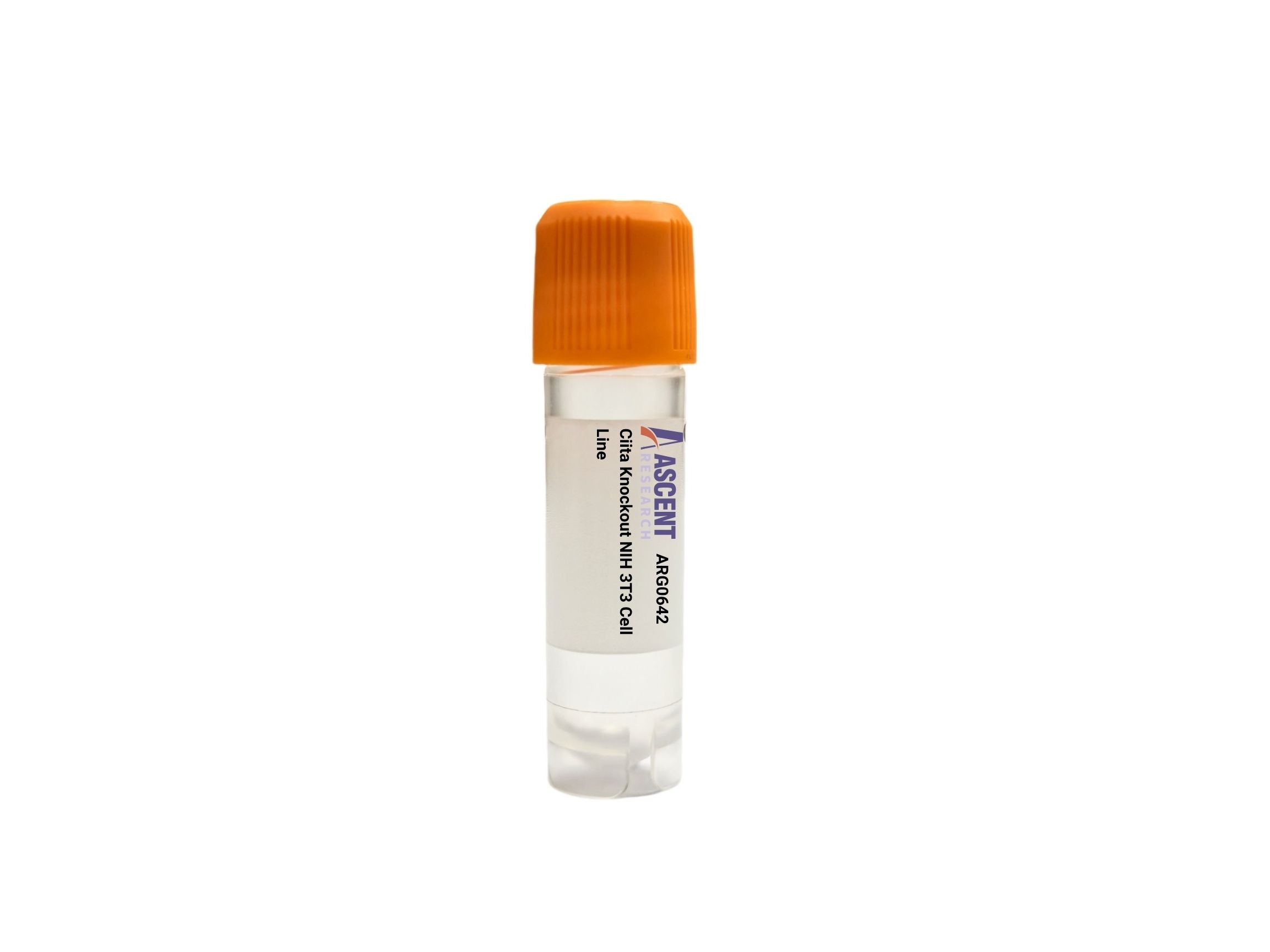
The Ciita Knockout NIH 3T3 Cell Line is a CRISPR/Cas9-edited fibroblast line lacking Ciita, the master coactivator for MHC class II genes. In NIH 3T3, CIITA is activated by IFN-?? via JAK/STAT/IRF1 and drives antigen presentation components. Its loss abrogates inducible MHC II expression, modeling bare lymphocyte syndrome. Applications include examining MHC II regulation, IFN-?? signaling, and antigen presentation using flow cytometry, RT-qPCR, and co-culture with CD4+ T cells. This tool supports immunology, autoimmunity, and tumor microenvironment studies. Inquire at Ascent Research.
 CALD1 Knockout NCI-H1975 Polyclonal Cells
Cat. No. ARG31432
CGGBP1 Knockout HT29 Polyclonal Cells
Cat. No. ARG14197
HSPB1 Knockout HAP1 Polyclonal Cells
Cat. No. ARG27583
FBXO45 Knockout A549 Polyclonal Cells
Cat. No. ARG10140
NUDT15 Knockout MES-OV Polyclonal Cells
Cat. No. ARG6350
CALD1 Knockout NCI-H1975 Polyclonal Cells
Cat. No. ARG31432
CGGBP1 Knockout HT29 Polyclonal Cells
Cat. No. ARG14197
HSPB1 Knockout HAP1 Polyclonal Cells
Cat. No. ARG27583
FBXO45 Knockout A549 Polyclonal Cells
Cat. No. ARG10140
NUDT15 Knockout MES-OV Polyclonal Cells
Cat. No. ARG6350
 Mouse Umbilical Vein Endothelial Cell Medium
Cat. No. ARM0660
Mouse Umbilical Vein Endothelial Cell Medium
Cat. No. ARM0660
The Ciita Knockout NIH 3T3 Cell Line is a CRISPR/Cas9-edited knockout cell line derived from the mouse embryonic fibroblast line NIH 3T3. This engineered model disrupts the Ciita gene, encoding the class II transactivator, a master transcriptional coactivator essential for major histocompatibility complex (MHC) class II gene expression. By introducing targeted gene disruption, the cell line provides a loss-of-function platform to investigate CIITA-dependent transcriptional regulation and antigen presentation processes in a fibroblast context.
The NIH 3T3 host cell line is a spontaneously immortalized mouse embryonic fibroblast line. As stromal fibroblasts, NIH 3T3 cells produce extracellular matrix components and participate in wound healing. Their robust growth and genetic tractability make them a standard model for studying fibroblast biology, signal transduction, and gene regulation. While fibroblasts typically lack MHC class II expression under basal conditions, they can be induced to express these molecules upon interferon-gamma (IFN-??) stimulation, making them relevant for examining CIITA-mediated immune activation.
CIITA functions as a master coactivator that is activated by the JAK-STAT signaling cascade downstream of IFN-??. Upon IFN-?? binding, JAK1/JAK2 kinases phosphorylate STAT1, which dimerizes and activates the transcription factor IRF1. IRF1, together with STAT1, induces CIITA expression. CIITA does not bind DNA directly but interacts with promoter-bound transcription factors such as the RFX complex and NF-Y, recruiting coactivators like CBP/p300 and the BRG1 chromatin remodeling complex to MHC class II promoters. This orchestrated assembly drives transcription of MHC class II genes, including H2-A and H2-E, as well as the invariant chain CD74 and HLA-DM, thereby sustaining antigen processing and presentation to CD4+ T cells.
Disruption of Ciita in NIH 3T3 cells abrogates inducible MHC class II expression, mimicking features of bare lymphocyte syndrome type II, a severe human immunodeficiency caused by CIITA mutations. This knockout cell line enables dissection of CIITA-dependent versus -independent pathways in fibroblast immune functions. Given the role of MHC class II in CD4+ T cell activation, the model is valuable for studying defective antigen presentation and its impact on adaptive immunity. Moreover, it allows investigation of how stromal fibroblasts contribute to immune surveillance and inflammation, with implications for autoimmunity and tumor microenvironment research.
Researchers can employ the Ciita Knockout NIH 3T3 Cell Line in a variety of experimental settings. Representative applications include IFN-?? stimulation assays coupled with flow cytometric analysis of MHC class II surface expression, western blotting of CIITA and downstream targets, and RT-qPCR quantification of MHC class II transcripts. Reporter gene assays can map CIITA-responsive promoter elements, while co-culture experiments with CD4+ T cells assess functional antigen presentation. The engineered line thus supports studies in immunology, signal transduction, and gene regulation. For additional technical details, please contact Ascent Research.