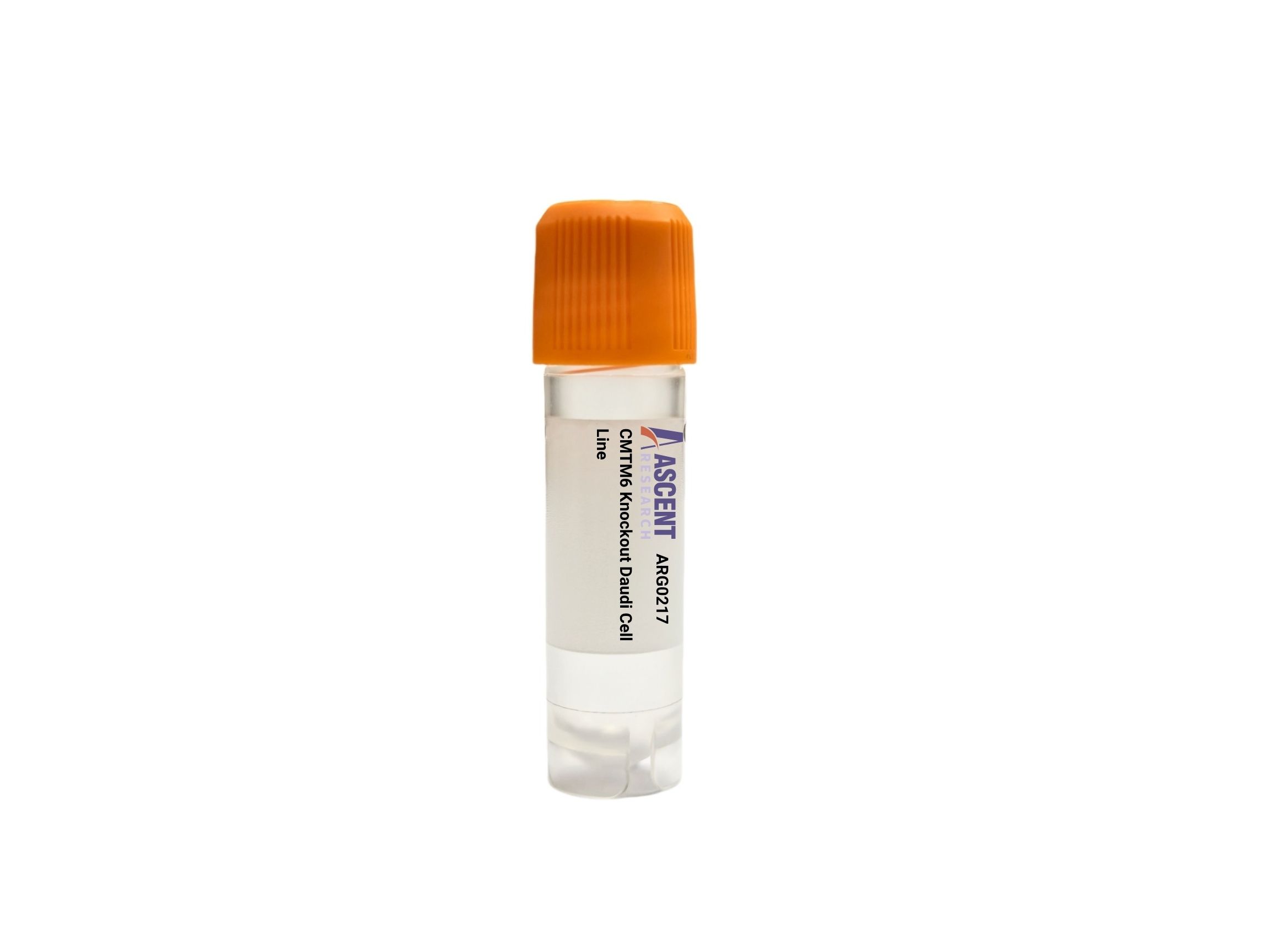
Genome-edited Cells
Blood (peripheral blood)
The CMTM6 Knockout Daudi Cell Line is a CRISPR/Cas9-edited knockout cell line based on human Daudi B lymphoblastoid cells, designed for loss-of-function studies of CMTM6. CMTM6 binds PD-L1 (CD274) and protects it from STUB1-mediated ubiquitination and degradation, sustaining surface PD-L1 to potentiate PD-1/PD-L1 immune checkpoint signaling and T cell suppression. This model offers a defined system for investigating CMTM6-dependent PD-L1 regulation in a Burkitt lymphoma-derived background, with key applications in immune checkpoint research, cancer immunotherapy development, and mechanistic analyses using flow cytometry, Western blotting, and T cell suppression assays.
 ATXN2 Knockout HAP1 Polyclonal Cells
Cat. No. ARG22004
DHRS4 Knockout Hela Polyclonal Cells
Cat. No. ARG8189
HDAC7 Knockout HT29 Polyclonal Cells
Cat. No. ARG33325
IL1R1 Knockout KYSE150 Polyclonal Cells
Cat. No. ARG36251
Gna13 Knockout HEK293T Polyclonal Cells
Cat. No. ARG37989
ATXN2 Knockout HAP1 Polyclonal Cells
Cat. No. ARG22004
DHRS4 Knockout Hela Polyclonal Cells
Cat. No. ARG8189
HDAC7 Knockout HT29 Polyclonal Cells
Cat. No. ARG33325
IL1R1 Knockout KYSE150 Polyclonal Cells
Cat. No. ARG36251
Gna13 Knockout HEK293T Polyclonal Cells
Cat. No. ARG37989
 Sheep Leydig Cells
Cat. No. ARP0946
Sheep Leydig Cells
Cat. No. ARP0946
The CMTM6 Knockout Daudi Cell Line is a CRISPR/Cas9-edited knockout cell line derived from the human Daudi B lymphoblastoid line, engineered to disrupt CMTM6 gene expression. This stable loss-of-function model enables precise investigation of CMTM6-mediated regulatory mechanisms within an immunologically relevant neoplastic B lymphocyte background, providing researchers with a defined system for dissecting immune checkpoint control and tumor-intrinsic pathways of immune evasion.
Established from a Burkitt lymphoma patient, the parental Daudi cell line is a widely utilized model of B lymphoblastoid malignancies. These cells endogenously express CD274 (PD-L1) and other components of the PD-1/PD-L1 immune checkpoint pathway, alongside characteristic features of transformed B cells. Their constitutive expression profile and well-characterized signaling networks make Daudi cells an ideal host for studying CMTM6 function in a cancer-relevant context, particularly for interrogating how tumor cells modulate PD-L1 to suppress anti-tumor immunity.
CMTM6 critically stabilizes PD-L1 at the plasma membrane by direct binding, protecting it from STUB1 (CHIP)-mediated ubiquitination and subsequent lysosomal degradation. This interaction maintains elevated surface PD-L1 levels, facilitating engagement with PDCD1 (PD-1) on T cells and recruitment of phosphatases such as SHP2, which attenuate T cell receptor signaling. The related transmembrane protein CMTM4 cooperates with CMTM6 to reinforce PD-L1 protection. CMTM6 expression is largely constitutive but may be modulated by inflammatory stimuli; its activity converges on enhanced T cell suppression and immune evasion, positioning it as a pivotal node in the regulation of adaptive immune resistance in cancer cells.
In the Daudi lymphoma model, disruption of CMTM6 profoundly reduces PD-L1 surface expression by unleashing STUB1-dependent degradation, thereby impairing the capacity of malignant B cells to inhibit T cell activity. This knockout cell line allows direct measurement of CMTM6??s contribution to PD-L1 stability and its functional impact on the PD-1/PD-L1 signaling axis. Given the association of PD-L1 upregulation with poor prognosis in B-cell malignancies, the model holds particular significance for studying lymphomagenesis mechanisms and for evaluating the determinants of response to immune checkpoint blockade therapies.
Researchers can employ the CMTM6 Knockout Daudi Cell Line in a spectrum of advanced assays, including flow cytometry for quantifying PD-L1 surface levels, Western blot analysis of PD-L1 and STUB1 protein abundance, and RT-qPCR profiling of checkpoint-related transcripts. Functional co-culture experiments with primary T cells enable assessment of T cell suppression capacity, while anti-PD-L1 antibody sensitivity assays test therapeutic responsiveness. High-content immunofluorescence can further illuminate PD-L1 trafficking dynamics. For further information about this product, please contact Ascent Research.