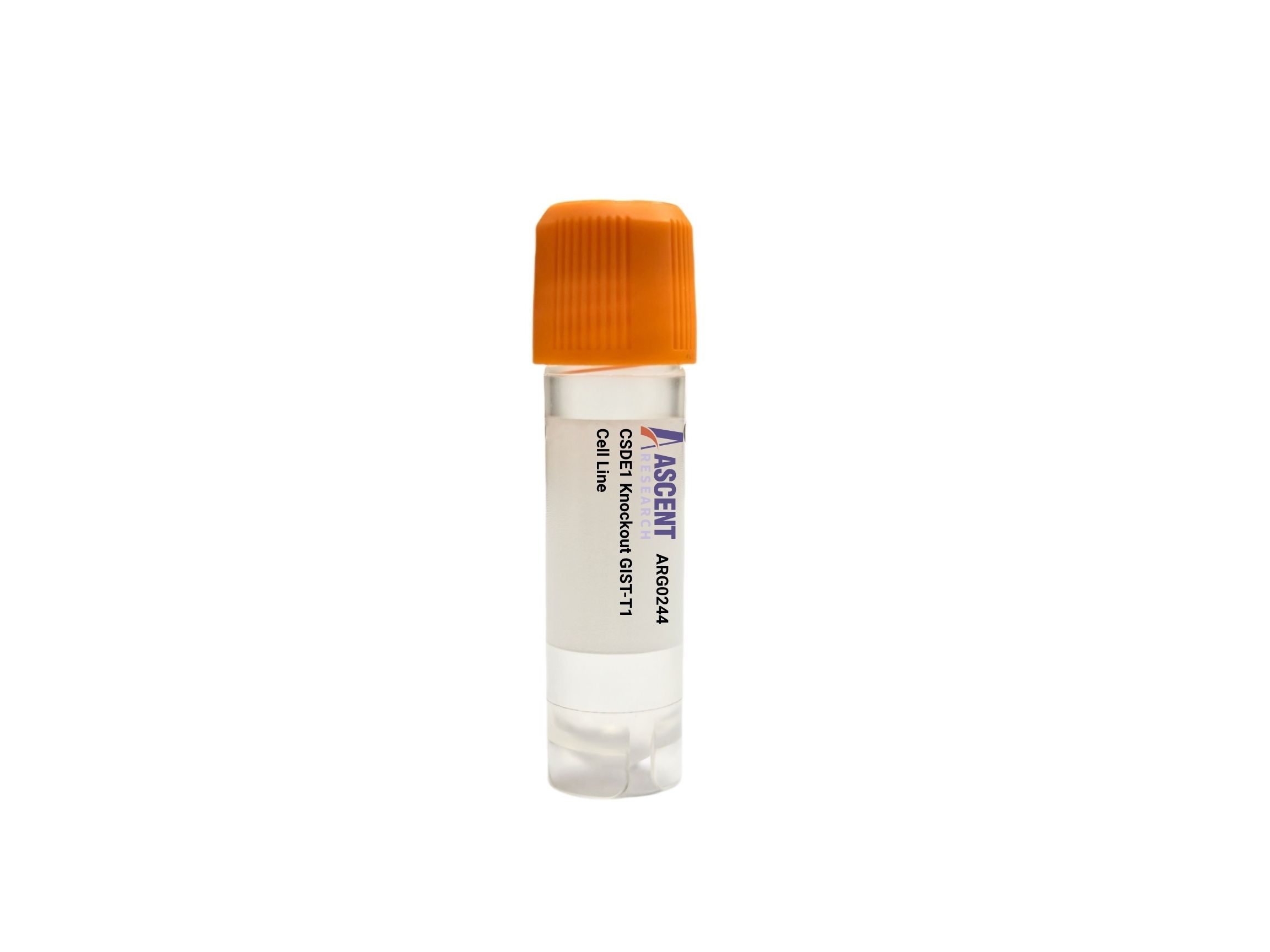
Genome-edited Cells
Gastrointestinal (GI) tract
The CSDE1 Knockout GIST-T1 Cell Line is a CRISPR/Cas9-edited knockout cell line from the GIST-T1 cell line, a human gastrointestinal stromal tumor model with a KIT exon 11 deletion. It disrupts the CSDE1 RNA-binding protein, which modulates targets including c-FOS and PTEN mRNAs and interacts with UPF1 and PABP, linking it to MAPK/ERK and PI3K/AKT pathways. This knockout cell line is ideal for investigating post-transcriptional regulation in cancer, assessing proliferation and apoptosis, and performing assays such as Western blotting, RT-qPCR, RIP, and dual-luciferase reporter assays. It supports studies on GIST tumor biology, drug screening, and RNA regulatory mechanisms.
 AHSG Knockout HAP1 Polyclonal Cells
Cat. No. ARG21748
AP4B1 Knockout HT29 Polyclonal Cells
Cat. No. ARG32976
IFI30 Knockout A549 Polyclonal Cells
Cat. No. ARG34043
IRGQ Knockout MCF7 Polyclonal Cells
Cat. No. ARG36458
AHSG Knockout HAP1 Polyclonal Cells
Cat. No. ARG21748
AP4B1 Knockout HT29 Polyclonal Cells
Cat. No. ARG32976
IFI30 Knockout A549 Polyclonal Cells
Cat. No. ARG34043
IRGQ Knockout MCF7 Polyclonal Cells
Cat. No. ARG36458
 Rabbit Tracheal Smooth Muscle Cells
Cat. No. ARP0667
Rabbit Tracheal Smooth Muscle Cells
Cat. No. ARP0667
 Mouse Colonic Smooth Muscle Cells
Cat. No. ARP0471
Mouse Colonic Smooth Muscle Cells
Cat. No. ARP0471
The CSDE1 Knockout GIST-T1 Cell Line is a CRISPR/Cas9-edited knockout cell line derived from the GIST-T1 human gastrointestinal stromal tumor (GIST) cell line. It features a loss-of-function mutation in the CSDE1 gene, generated via CRISPR/Cas9-mediated gene disruption. This model enables functional studies of the CSDE1 RNA-binding protein in a KIT-mutant, tumorigenic mesenchymal background, providing a platform to investigate post-transcriptional regulatory mechanisms in cancer.
GIST-T1 is an established cell line from a human GIST harboring an activating KIT exon 11 deletion (V560_Y578del), driving constitutive MAPK/ERK and PI3K/AKT signaling. Widely used in GIST research, these cells recapitulate the oncogenic properties of the disease and serve as a relevant host for examining the impact of CSDE1 knockout on KIT-dependent pathways.
CSDE1 (UNR) is an RNA-binding protein that interacts with PABP, UPF1, eIF4G, and PAIP1 to regulate mRNA stability and translation. It acts as a translational repressor or activator and participates in nonsense-mediated mRNA decay and IRES-mediated translation. CSDE1 is regulated by AKT phosphorylation and the MAPK/ERK pathway, with miR-125b modulating its expression. It controls key targets including c-FOS, c-JUN, PTEN, and BCL2 mRNAs, linking it to cell proliferation, apoptosis, and cell cycle progression.
In GIST-T1 cells, where KIT mutation aberrantly activates downstream signaling, CSDE1 knockout may disrupt post-transcriptional control of oncogenes and tumor suppressors. Altered expression of targets such as c-FOS and PTEN can impact MAPK/ERK and PI3K/AKT network output, influencing proliferation and survival. This model thus allows dissection of how RNA-binding protein function intersects with kinase-driven oncogenesis in GIST.
This cell line is suitable for target validation by Western blotting and RT-qPCR, protein?CRNA interaction studies via RIP, IRES activity analysis using dual-luciferase reporters, and functional assays including MTT/BrdU proliferation and annexin V apoptosis measurements. It also supports co-immunoprecipitation with UPF1 and PABP, and RNA-seq transcriptome profiling. These applications address roles of CSDE1 in GIST tumorigenesis, post-transcriptional regulation, and drug target screening. For additional information, contact Ascent Research.