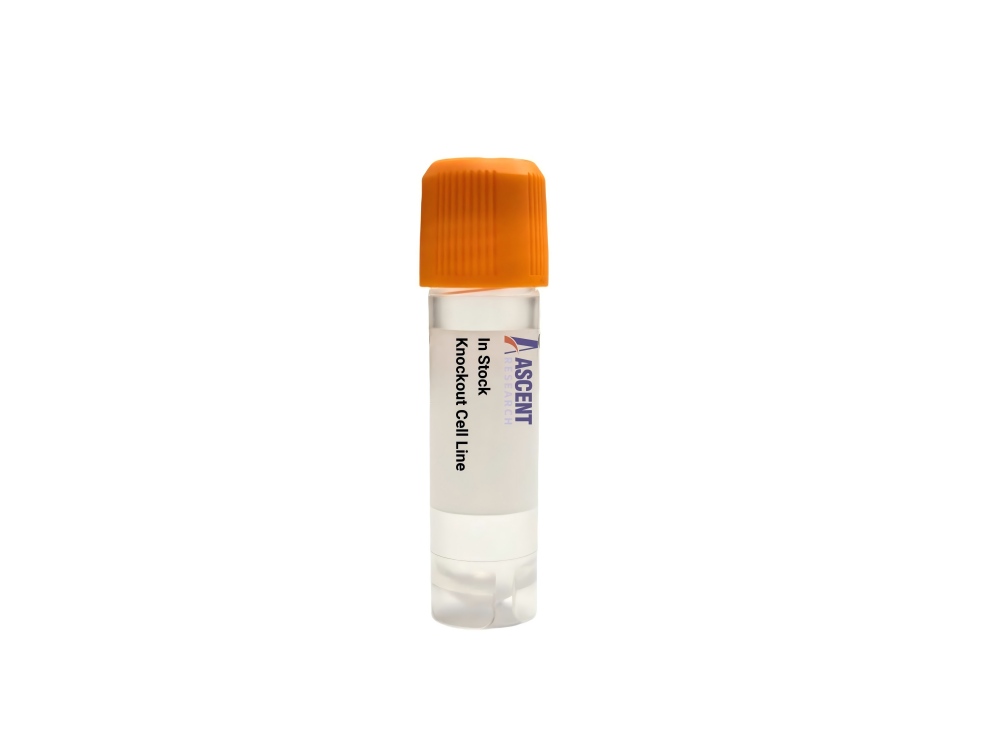
In Stock Cell Lines
The CTNNBIP1 Knockout HK-2 Cell Line is a CRISPR/Cas9-edited knockout cell line targeting the CTNNBIP1 gene in human proximal tubule epithelial HK-2 cells. CTNNBIP1 encodes ICAT, a negative regulator of canonical Wnt/??-catenin signaling that binds ??-catenin (CTNNB1) and disrupts ??-catenin/TCF complex formation with transcription factors TCF7L2 and LEF1, thereby repressing Wnt target genes such as MYC and CCND1. This model enables enhanced ??-catenin/TCF transcriptional activity and is ideal for Wnt pathway analysis, EMT studies, renal fibrosis research, and drug discovery targeting Wnt/??-catenin in a renal context.
 CA13 Knockout HCT116 Polyclonal Cells
Cat. No. ARG34770
NPC2 Knockout K562 Polyclonal Cells
Cat. No. ARG19440
MMAA Knockout NCI-H1975 Polyclonal Cells
Cat. No. ARG16706
ITSN2 Knockout 786-O Polyclonal Cells
Cat. No. ARG25386
KDM3B Knockout AGS Polyclonal Cells
Cat. No. ARG27107
ITGA6 Knockout AGS Polyclonal Cells
Cat. No. ARG27066
CA13 Knockout HCT116 Polyclonal Cells
Cat. No. ARG34770
NPC2 Knockout K562 Polyclonal Cells
Cat. No. ARG19440
MMAA Knockout NCI-H1975 Polyclonal Cells
Cat. No. ARG16706
ITSN2 Knockout 786-O Polyclonal Cells
Cat. No. ARG25386
KDM3B Knockout AGS Polyclonal Cells
Cat. No. ARG27107
ITGA6 Knockout AGS Polyclonal Cells
Cat. No. ARG27066
CTNNBIP1 Knockout HK-2 Cell Line is a CRISPR/Cas9-edited knockout cell line engineered to disrupt the CTNNBIP1 gene in the HK-2 human proximal tubule epithelial cell background. This model provides a loss-of-function system for investigating the role of ICAT (inhibitor of ??-catenin and TCF), a key negative regulator of canonical Wnt/??-catenin signaling. By abolishing ICAT expression, researchers can study derepressed ??-catenin/TCF transcriptional activity and its downstream effects in a renal epithelial context.
The HK-2 cell line is an immortalized human kidney proximal tubule epithelial cell line derived from normal adult renal tissue. These cells retain morphological and functional characteristics of proximal tubular epithelium, including polarized transport, expression of brush border enzymes, and responsiveness to nephrotoxic agents. HK-2 cells are widely used as an in vitro model for studying renal tubular physiology, drug-induced nephrotoxicity, and mechanisms of kidney injury and repair.
CTNNBIP1 encodes ICAT, a protein that directly interacts with ??-catenin (CTNNB1) and competes with TCF/LEF transcription factors such as TCF7L2 and LEF1 to inhibit ??-catenin/TCF complex formation. In the canonical Wnt pathway, WNT3A stimulation stabilizes ??-catenin, enabling its nuclear accumulation and partnership with TCF7L2/LEF1 to activate downstream targets including MYC, CCND1, AXIN2, and MMP7. ICAT functions as a negative regulator that fine-tunes this signaling by binding ??-catenin and disrupting transcriptional complexes, thereby repressing Wnt target gene expression.
In the HK-2 renal proximal tubule epithelial context, CRISPR/Cas9-mediated disruption of CTNNBIP1 eliminates ICAT-mediated inhibition of ??-catenin, resulting in constitutive or enhanced ??-catenin/TCF transcriptional activity. This aberrant activation upregulates proliferative genes (MYC, CCND1) and matrix-remodeling factors (MMP7), promoting cellular proliferation and possibly epithelial-mesenchymal transition (EMT). Such phenotypic changes are directly relevant to pathogenic mechanisms of renal interstitial fibrosis, where sustained Wnt pathway activation drives myofibroblast differentiation and extracellular matrix deposition, as well as to renal cell carcinoma progression.
This knockout cell line enables detailed analysis of Wnt signaling in proximal tubule cells. Key applications include TCF/LEF reporter assays to quantify transcriptional activity, RT-qPCR and Western blotting for target gene expression, and immunofluorescence for ??-catenin localization. The model is ideal for renal fibrosis studies, EMT evaluation via wound healing assays, and nephrotoxicity screening where Wnt modulation intersects with tubular injury. It also supports drug discovery targeting the Wnt/??-catenin pathway. For additional details, please contact Ascent Research.