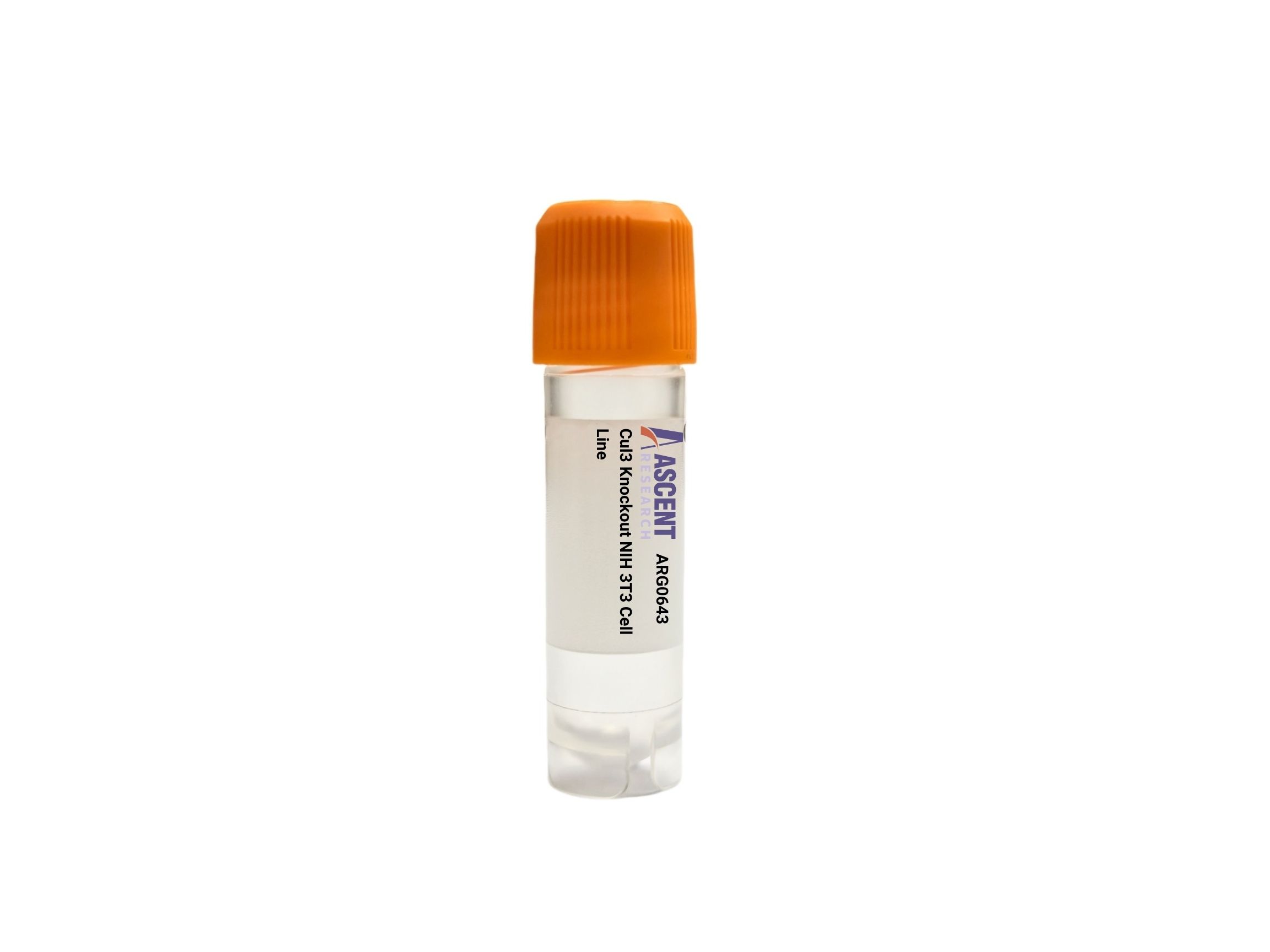
Genome-edited Cells
The Cul3 Knockout NIH 3T3 Cell Line offers a CRISPR/Cas9-edited loss-of-function model for Cullin-3, a scaffold protein in the CRL3 E3 ubiquitin ligase complex. Hosted in NIH 3T3 mouse embryonic fibroblasts, this cell line disrupts CUL3-dependent ubiquitination of substrates like NRF2 and DAXX, influencing oxidative stress response, cell cycle control, and cytoskeleton dynamics. It is an essential tool for studying KEAP1-NRF2 signaling, ubiquitin-proteasome pathways, and cancer biology, supporting assays from Western blotting to functional complementation. This knockout line enables precise interrogation of CUL3??s role in cell adhesion, motility, and signaling, advancing research in oxidative stress disorders and oncogenic transformation.
 MICU1 Knockout SK-HEP-1 Polyclonal Cells
Cat. No. ARG16012
COMMD10 Knockout jurkat Polyclonal Cells
Cat. No. ARG13202
HECW2 Knockout HAP1 Polyclonal Cells
Cat. No. ARG22482
HSDL2 Knockout Hela Polyclonal Cells
Cat. No. ARG25943
ILVBL Knockout NCI-H1299 Polyclonal Cells
Cat. No. ARG30820
NCOA3 Knockout Raji Polyclonal Cells
Cat. No. ARG1598
MICU1 Knockout SK-HEP-1 Polyclonal Cells
Cat. No. ARG16012
COMMD10 Knockout jurkat Polyclonal Cells
Cat. No. ARG13202
HECW2 Knockout HAP1 Polyclonal Cells
Cat. No. ARG22482
HSDL2 Knockout Hela Polyclonal Cells
Cat. No. ARG25943
ILVBL Knockout NCI-H1299 Polyclonal Cells
Cat. No. ARG30820
NCOA3 Knockout Raji Polyclonal Cells
Cat. No. ARG1598
The Cul3 Knockout NIH 3T3 Cell Line provides a CRISPR/Cas9-mediated gene disruption of Cul3 in the widely used NIH 3T3 mouse embryonic fibroblast cell line. This knockout cell line serves as a powerful loss-of-function model for dissecting the role of Cullin-3 in the ubiquitin-proteasome system and its regulatory impact on cell signaling, adhesion, and motility.
The parental NIH 3T3 cells are immortalized fibroblasts derived from NIH Swiss mouse embryos, known for their contact-inhibited growth and extensive use in studies of cell adhesion, migration, and signal transduction. Their genetic stability and ease of culture make them an ideal host for generating a stable CRISPR-edited knockout line, enabling reproducible and physiologically relevant experiments.
CUL3 functions as a core scaffold in the Cullin-RING E3 ubiquitin ligase (CRL3) complex, where it assembles with the RING protein RBX1/ROC1 and a variable BTB domain adaptor such as KEAP1, SPOP, or KLHL3 to target specific substrates for ubiquitination and proteasomal degradation. Key substrates include the transcription factor NRF2, the apoptotic protein DAXX, the kinase PLK1, the mTOR inhibitor DEPTOR, and the WNK kinases. CUL3 activity is dynamically regulated by NEDD8 modification, which activates the complex, and by CAND1, which facilitates adaptor exchange. Through these interactions, CUL3 governs critical signaling pathways including the KEAP1-NRF2 oxidative stress response, NF-??B signaling, cell cycle progression, cytoskeletal remodeling, and Wnt signaling. This central role makes CUL3 essential for maintaining cellular homeostasis and responding to environmental cues.
In the NIH 3T3 fibroblast context, disruption of CUL3 leads to dysregulation of these ubiquitin-dependent processes, providing an invaluable model to study how CUL3 controls cell adhesion, migration, and contact inhibition. The knockout line allows researchers to investigate the molecular mechanisms by which CUL3-mediated degradation influences fibroblast motility and cytoskeletal organization, contributing to insights in cancer metastasis, tissue fibrosis, and wound healing.
This cell line supports a broad range of research applications, including investigation of the ubiquitin-proteasome system, dissection of CUL3 substrate interactions, and analysis of the KEAP1-NRF2 oxidative stress pathway. It is suitable for cancer research, drug screening targeting the ubiquitin system, and functional complementation assays to validate CUL3-dependent phenotypes. Representative assays include Western blotting, RT-qPCR, immunofluorescence, flow cytometry, co-immunoprecipitation, and in vivo ubiquitination assays. For additional product details and technical support, please contact Ascent Research.