Genome-edited Cells
Lung
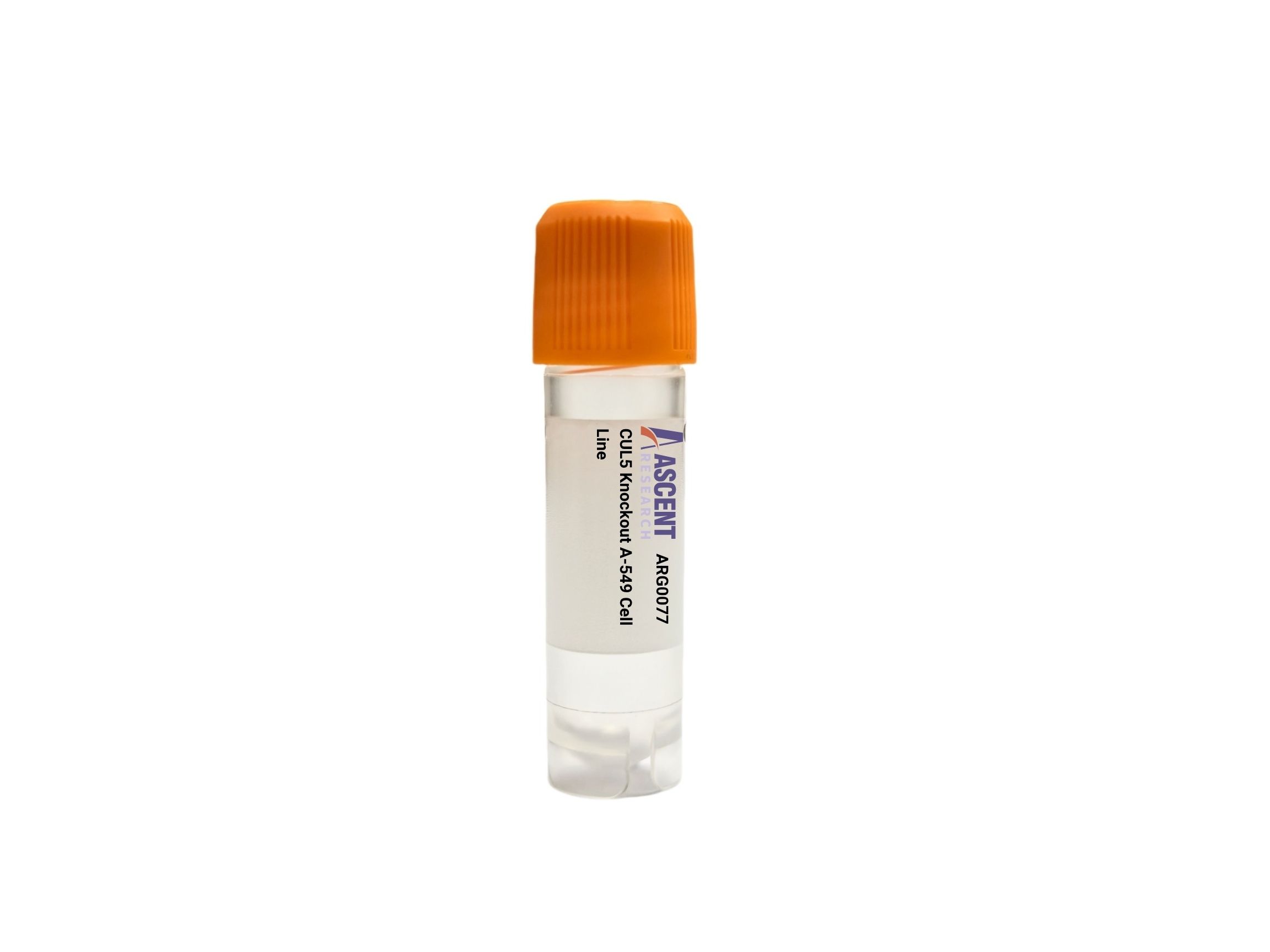
CUL5 Knockout A-549 is a human CRISPR/Cas9-edited lung adenocarcinoma cell line with disruption of the CUL5 gene in an alveolar basal epithelial tumor background. CUL5 encodes the scaffold of CRL5 ubiquitin ligase complexes that interact with RBX2/RNF7, Elongin B/C, and SOCS-box adaptors to regulate proteasomal turnover, cytokine-JAK-STAT negative feedback, and hypoxia-associated signaling. In A-549 cells, this model supports studies of phospho-JAK1/JAK2-STAT3 signaling, HIF1A and NOXA/PMAIP1 regulation, apoptosis, proliferation, migration, invasion, substrate identification, and drug response using assays such as western blotting, RNA-seq, ubiquitination analysis, and functional phenotyping.
 NTHL1 Knockout SK-HEP-1 Polyclonal Cells
Cat. No. ARG16246
PAIP1 Knockout HT29 Polyclonal Cells
Cat. No. ARG14062
CST3 Knockout A549 Polyclonal Cells
Cat. No. ARG10940
MCTP2 Knockout Hela Polyclonal Cells
Cat. No. ARG8458
BAIAP2 Knockout SK-HEP-1 Polyclonal Cells
Cat. No. ARG32325
DSG4 Knockout HAP1 Polyclonal Cells
Cat. No. ARG39838
NTHL1 Knockout SK-HEP-1 Polyclonal Cells
Cat. No. ARG16246
PAIP1 Knockout HT29 Polyclonal Cells
Cat. No. ARG14062
CST3 Knockout A549 Polyclonal Cells
Cat. No. ARG10940
MCTP2 Knockout Hela Polyclonal Cells
Cat. No. ARG8458
BAIAP2 Knockout SK-HEP-1 Polyclonal Cells
Cat. No. ARG32325
DSG4 Knockout HAP1 Polyclonal Cells
Cat. No. ARG39838
The CUL5 Knockout A-549 Cell Line is a human CRISPR/Cas9-engineered knockout model in which the CUL5 gene has been disrupted to eliminate functional cullin-5 expression. This stable gene-edited cell line is generated in A-549 cells, a human alveolar basal epithelial adenocarcinoma background, and provides an in vitro system for investigating the consequences of impaired CUL5-dependent ubiquitin ligase activity. The model is suited for mechanistic studies of cullin-RING ligase biology, signal transduction, and tumor-associated stress responses in a lung cancer-relevant epithelial context.
A-549 is a human lung adenocarcinoma-derived epithelial cell line widely used as a model of non-small cell lung cancer. It retains features associated with type II alveolar epithelial cells and is routinely applied to studies of lung tumor biology, cytokine responsiveness, proliferation control, and therapeutic response. Because A-549 cells are experimentally tractable and broadly characterized, they are frequently used to evaluate pathway perturbation, transcriptional remodeling, apoptosis susceptibility, and migratory behavior in epithelial cancer cells. This makes the line a practical host background for defining how loss of a ubiquitin ligase scaffold alters signaling and phenotype in lung adenocarcinoma research.
CUL5 encodes cullin-5, the core scaffold of CRL5 ubiquitin ligase complexes. CUL5 forms complexes with RBX2/RNF7, Elongin B, Elongin C, and SOCS-box adaptor proteins including SOCS1, SOCS3, ASB family proteins, and WSB1 to mediate ubiquitination of selected substrates for proteasomal degradation. CRL5 activity is regulated by the neddylation pathway, including NEDD8 and the E2 enzyme UBE2F, and is further controlled by CAND1 and the COP9 signalosome, including CSN5, which modulate cullin assembly state and deneddylation. Through these interactions, CUL5 functions downstream of cytokine-induced JAK-STAT signaling and contributes to negative feedback affecting phosphorylated JAK1, phosphorylated JAK2, and STAT3 signaling output. CUL5-linked proteostasis has also been associated with regulation of HIF1A, NOXA/PMAIP1, apoptosis and stress response pathways, and phenotypes relevant to tumor progression, metastasis, and viral exploitation of host ubiquitin ligases.
In the A-549 background, CUL5 loss provides a relevant system for examining how disruption of CRL5-dependent protein turnover reshapes oncogenic and stress-responsive signaling networks in lung epithelial tumor cells. This context is particularly useful for studying pathway dependency in non-small cell lung cancer, including altered cytokine-JAK-STAT feedback, hypoxia signaling, apoptotic threshold, proliferation dynamics, and migration or invasion phenotypes. The model can also support investigation of how impaired cullin neddylation-dependent signaling intersects with drug response and adaptive resistance mechanisms in lung adenocarcinoma cells.
This knockout cell line can be applied in western blot and phospho-protein analyses to assess JAK1, JAK2, or STAT3 pathway activity; in RT-qPCR and RNA-seq experiments to profile transcriptional consequences of CUL5 loss; and in co-immunoprecipitation, ubiquitination assays, and cycloheximide chase studies to identify CRL5-associated substrates or evaluate substrate stability. Researchers may also use the model in immunofluorescence and hypoxia-response reporter assays to examine HIF1A-associated responses, in flow cytometry and apoptosis assays to quantify stress-induced cell death, and in proliferation, colony formation, migration, and invasion assays to characterize tumor cell behavior. The line is additionally relevant for drug sensitivity studies and synthetic lethality screening aimed at defining vulnerabilities created by disruption of CUL5-mediated ubiquitin signaling. Researchers may contact Ascent Research for additional technical information, product details, or related gene-edited cell models.