Genome-edited Cells
Blood (peripheral blood)
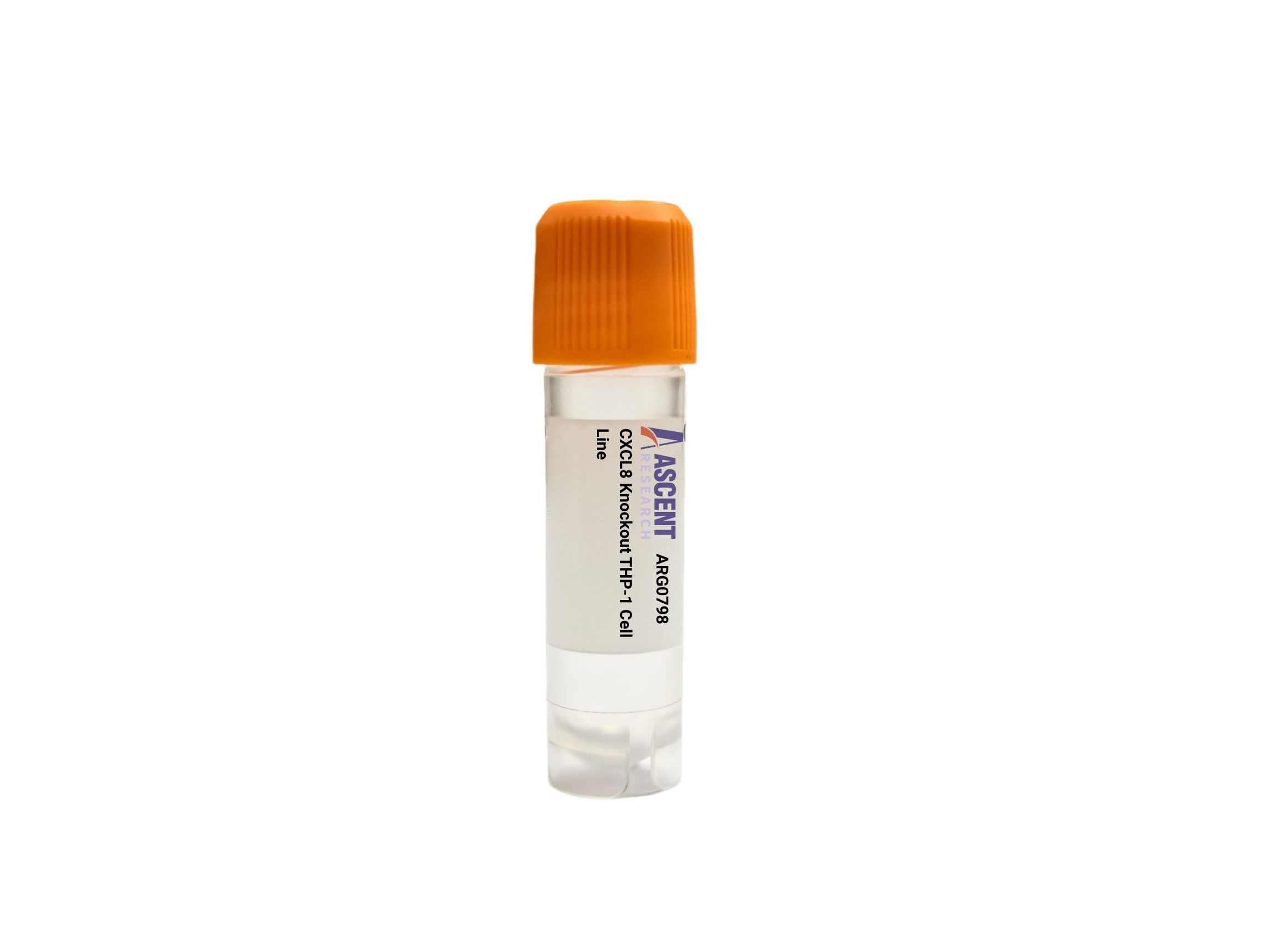
The CXCL8 Knockout THP-1 Cell Line provides a genetically disrupted interleukin-8 locus in the human monocytic leukemia THP-1 background. As a suspension line capable of macrophage differentiation, it allows precise functional studies of CXCL8, a chemokine that activates CXCR1/CXCR2 and downstream MAPK and PI3K/Akt signaling to mediate neutrophil recruitment and tumor angiogenesis. Applications include inflammation and cancer studies, chemotaxis and ELISA assays, pathway analysis via western blotting for phospho-ERK and Akt, and drug screening for CXCR1/2 antagonists. This model is valuable for investigating COPD, psoriasis, rheumatoid arthritis, and multiple cancer types.
 FGD6 Knockout A2780 Polyclonal Cells
Cat. No. ARG18270
IFI16 Knockout AGS Polyclonal Cells
Cat. No. ARG27004
MROH1 Knockout Hela Polyclonal Cells
Cat. No. ARG7741
PDXDC1 Knockout HEK293T Polyclonal Cells
Cat. No. ARG3494
FGD6 Knockout A2780 Polyclonal Cells
Cat. No. ARG18270
IFI16 Knockout AGS Polyclonal Cells
Cat. No. ARG27004
MROH1 Knockout Hela Polyclonal Cells
Cat. No. ARG7741
PDXDC1 Knockout HEK293T Polyclonal Cells
Cat. No. ARG3494
 Mouse Dermal Fibroblasts
Cat. No. ARP0564
Mouse Dermal Fibroblasts
Cat. No. ARP0564
 NPHP3 Knockout HEK293T Cell Line
Cat. No. ARG0312
NPHP3 Knockout HEK293T Cell Line
Cat. No. ARG0312
The CXCL8 Knockout THP-1 Cell Line is a CRISPR/Cas9-edited human monocytic cell line with targeted disruption of the CXCL8 gene (interleukin-8). Derived from the THP-1 acute monocytic leukemia background, this suspension cell line can differentiate into macrophage-like cells, providing a versatile model for functional studies. The knockout eliminates endogenous CXCL8 expression, enabling clean dissection of IL-8-dependent signaling without resorting to chemical inhibitors or neutralizing antibodies. Researchers should independently validate knockout efficiency by standard methods such as qPCR or ELISA.
THP-1, originating from an AML M5 patient, is a well-established model for monocyte/macrophage function and leukemia biology. These suspension cells respond to PMA by differentiating into adherent, macrophage-like cells that exhibit phagocytosis and cytokine secretion. Consequently, the CXCL8 knockout line can be used to compare the role of IL-8 in both undifferentiated and differentiated states, mirroring monocyte versus macrophage contributions to inflammation and cancer. The parental THP-1 line expresses wild-type CXCL8, offering a direct comparator.
CXCL8 is a chemokine that signals through CXCR1 and CXCR2, activating G-protein cascades including PLC, PKC, and MAPK/ERK. It is transcriptionally upregulated by TNF-??, IL-1??, LPS, and IL-17 via NF-??B and AP-1, and drives neutrophil chemotaxis, degranulation, and MMP release. In cancer, CXCL8 promotes angiogenesis and tumor cell proliferation through PI3K/Akt, Src, and FAK. Thus, deleting CXCL8 removes a key mediator linking inflammatory stimuli to downstream oncogenic pathways.
In THP-1 cells, CXCL8 autocrine signaling influences survival, differentiation, and cytokine output. Knockout of CXCL8 disrupts these processes, making the line valuable for modeling inflammatory disorders like COPD, psoriasis, and rheumatoid arthritis, as well as cancer types where IL-8 is elevated. By eliminating endogenous CXCL8, researchers can study macrophage polarization and immune cell recruitment in a controlled leukemic context, shedding light on tumor microenvironment dynamics.
Applications include chemotaxis and transwell migration assays, ELISA for secreted factors, western blotting for phosphorylated ERK and Akt, and transcriptomic analyses via RT-qPCR or RNA-seq. Flow cytometry can monitor CXCR1/CXCR2 expression, and tube formation assays assess angiogenic effects. The line facilitates drug screening for CXCR1/2 antagonists and inhibitors of PI3K/Akt or MAPK pathways. For further details, please contact Ascent Research.