Genome-edited Cells
Large intestine (colon)
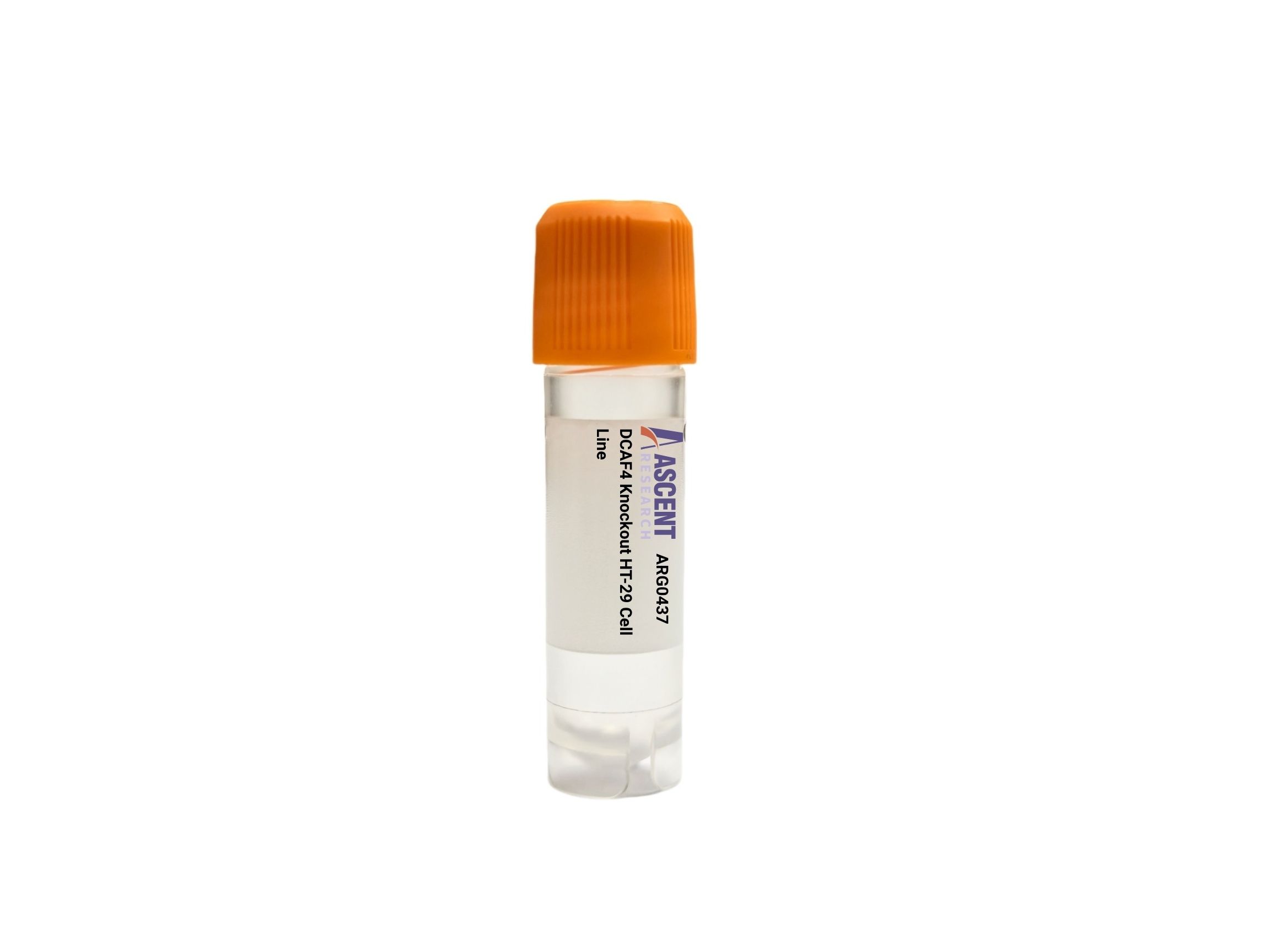
The DCAF4 Knockout HT-29 Cell Line is a CRISPR/Cas9-edited loss-of-function model eliminating DCAF4, a substrate receptor for the CUL4-DDB1 E3 ubiquitin ligase, in a human colorectal adenocarcinoma epithelial background. DCAF4 mediates ubiquitination and proteasomal degradation of targets such as p21 and CDT1, regulating DNA damage response, cell cycle progression, and apoptosis. This cell line enables investigation of ubiquitin-dependent degradation pathways in colorectal cancer, using techniques like Western blotting, ubiquitination assays, and DNA damage assays. It is suited for mechanistic studies, drug target discovery, and preclinical evaluation of ubiquitin-proteasome system modulators.
 CAB39L Knockout K562 Polyclonal Cells
Cat. No. ARG20368
FAM50B Knockout Hela Polyclonal Cells
Cat. No. ARG8351
AP5M1 Knockout 786-O Polyclonal Cells
Cat. No. ARG24934
GNS Knockout HAP1 Polyclonal Cells
Cat. No. ARG27485
MTHFD2 Knockout MES-OV Polyclonal Cells
Cat. No. ARG6832
CAB39L Knockout K562 Polyclonal Cells
Cat. No. ARG20368
FAM50B Knockout Hela Polyclonal Cells
Cat. No. ARG8351
AP5M1 Knockout 786-O Polyclonal Cells
Cat. No. ARG24934
GNS Knockout HAP1 Polyclonal Cells
Cat. No. ARG27485
MTHFD2 Knockout MES-OV Polyclonal Cells
Cat. No. ARG6832
 FGL2 Knockout U-87MG Cell Line
Cat. No. ARG0858
FGL2 Knockout U-87MG Cell Line
Cat. No. ARG0858
The DCAF4 Knockout HT-29 Cell Line is a CRISPR/Cas9-edited human colorectal adenocarcinoma epithelial cell line with disrupted DCAF4 gene expression. This loss-of-function model enables investigation of DCAF4, a substrate recognition component of the CUL4-DDB1 E3 ubiquitin ligase complex. Eliminating functional DCAF4 allows dissection of its roles in ubiquitin-dependent degradation, DNA damage signaling, and cell cycle regulation within a colorectal cancer context.
The HT-29 host cell line originated from a primary colorectal adenocarcinoma tumor of a female patient and displays adherent epithelial morphology. It serves as a widely used model for intestinal epithelial biology, colorectal cancer research, and drug response studies. HT-29 cells maintain characteristics of transformed intestinal epithelium, including differentiation capacity, making them a pertinent system for evaluating DCAF4 loss on cancer phenotypes and signaling.
DCAF4 functions as the substrate receptor for the CUL4-RBX1-DDB1-DCAF4 E3 ubiquitin ligase complex, which catalyzes ubiquitin attachment to target proteins for proteasomal degradation. It recognizes substrates including the CDK inhibitor p21 and the replication licensing factor CDT1, linking their turnover to DNA damage response and cell cycle progression. The complex is activated by upstream DNA damage signals and requires interactions with DDB1, CUL4A, CUL4B, RBX1, and the ubiquitin-like modifier NEDD8. Through ubiquitination of these targets, DCAF4 regulates DNA repair, cell cycle checkpoint activation, and apoptotic pathways, integrating genomic integrity surveillance with cell fate decisions.
In the HT-29 colorectal adenocarcinoma background, DCAF4 knockout disrupts substrate-specific ubiquitination by the CUL4-DDB1 ligase, altering degradation of key regulators. This is crucial in colorectal cancer, where ubiquitin-proteasome dysregulation promotes genomic instability and proliferation. The model enables investigation of how DCAF4 loss affects DNA damage checkpoints, apoptosis sensitivity, and cell cycle distribution, and it helps elucidate cancer cell adaptations to impaired proteolytic control of cell cycle and repair factors.
Researchers can employ the DCAF4 Knockout HT-29 Cell Line for diverse applications, including Western blotting and co-immunoprecipitation to study complex assembly, ubiquitination assays to measure enzymatic activity, and cell viability and cell cycle analyses to assess phenotypic consequences. DNA damage assays such as ??H2AX immunostaining and RT-qPCR enable evaluation of repair pathway engagement and transcriptional changes. This cell line supports mechanistic studies in colorectal cancer, drug target discovery, and preclinical testing. For further information, contact Ascent Research.