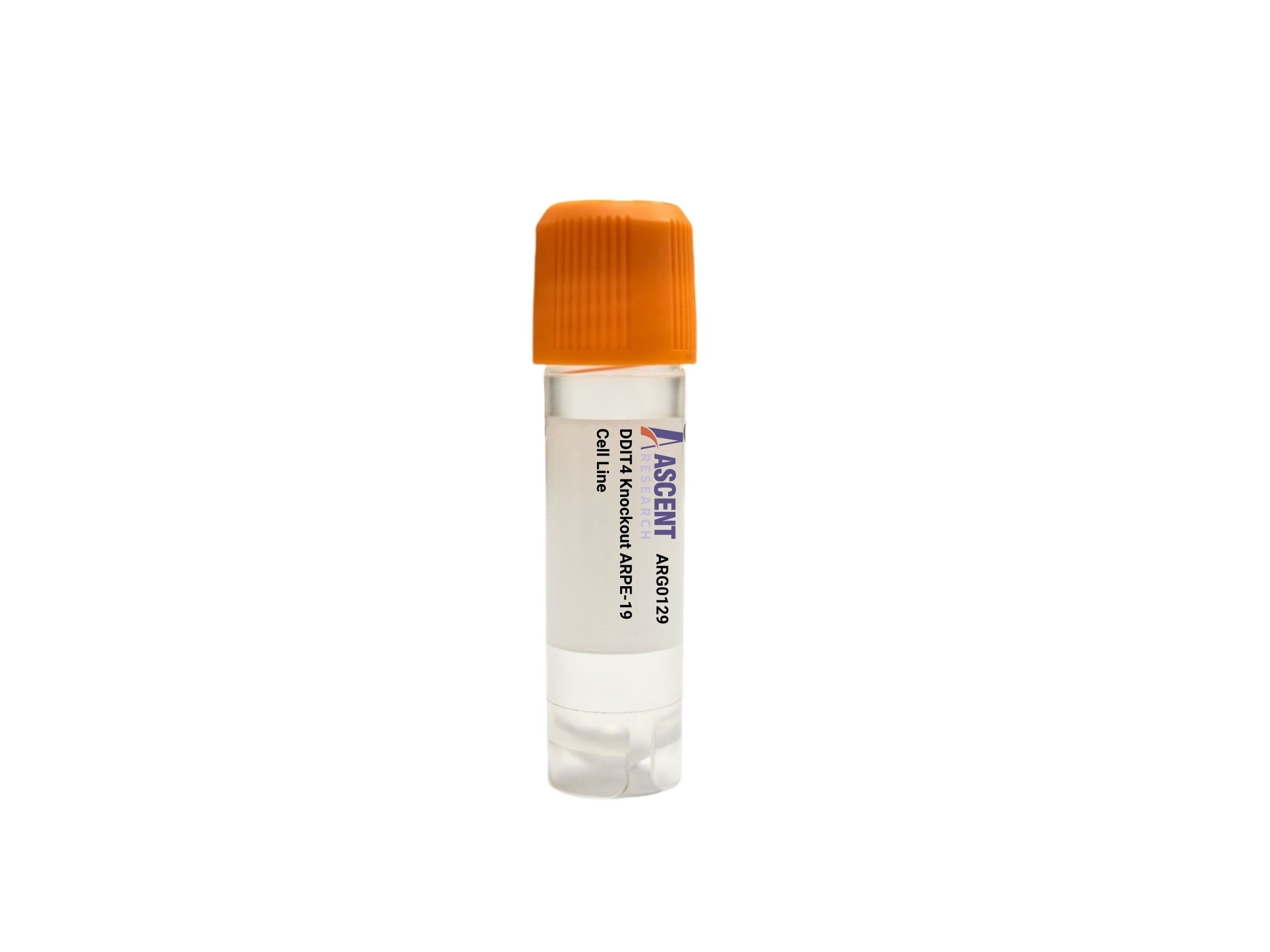
Genome-edited Cells
Eye (retina)
DDIT4 Knockout ARPE-19 is a human CRISPR/Cas9-engineered retinal pigment epithelial cell line with disruption of DDIT4, which encodes the stress-inducible mTORC1 inhibitor REDD1. In ARPE-19, a widely used model of outer blood-retinal barrier and retinal stress biology, DDIT4 loss supports analysis of stress-dependent signaling through the TSC1/TSC2-RHEB-MTOR axis, including effects on RPS6KB1/S6K and EIF4EBP1/4E-BP1 phosphorylation, protein synthesis, and autophagy. This model is useful for studies of oxidative stress, hypoxia, retinal degeneration, diabetic retinopathy, and drug response using western blotting, RNA-seq, phospho-signaling, autophagy flux, ROS, apoptosis, and barrier integrity assays.
 EXOC6 Knockout jurkat Polyclonal Cells
Cat. No. ARG13287
GRIA2 Knockout HAP1 Polyclonal Cells
Cat. No. ARG22382
ALDH4A1 Knockout HEK293T Polyclonal Cells
Cat. No. ARG25657
AKR7A2 Knockout A549 Polyclonal Cells
Cat. No. ARG31998
NFIL3 Knockout Raji Polyclonal Cells
Cat. No. ARG1186
EXOC6 Knockout jurkat Polyclonal Cells
Cat. No. ARG13287
GRIA2 Knockout HAP1 Polyclonal Cells
Cat. No. ARG22382
ALDH4A1 Knockout HEK293T Polyclonal Cells
Cat. No. ARG25657
AKR7A2 Knockout A549 Polyclonal Cells
Cat. No. ARG31998
NFIL3 Knockout Raji Polyclonal Cells
Cat. No. ARG1186
 Rat Epididymal Epithelial Cells
Cat. No. ARP0303
Rat Epididymal Epithelial Cells
Cat. No. ARP0303
The DDIT4 Knockout ARPE-19 Cell Line is a human retinal pigment epithelial CRISPR/Cas9-engineered model in which the DDIT4 gene has been disrupted to abolish functional REDD1 expression. This stable in vitro knockout system enables direct investigation of DDIT4-dependent stress signaling in a physiologically relevant epithelial background. ARPE-19 cells are derived from human retinal pigment epithelium, and the edited line preserves the utility of this established host for mechanistic studies of gene function, pathway regulation, and stress-adaptive responses in ocular and non-ocular research settings.
ARPE-19 is widely used to model retinal pigment epithelium biology because it represents a key cellular component of the outer blood-retinal barrier and supports photoreceptor homeostasis through nutrient transport, phagocytosis, and secretion of trophic and immunoregulatory factors. As a spontaneously arising human RPE cell line, ARPE-19 has become a standard platform for studying oxidative stress, inflammatory signaling, hypoxia-associated injury, and retinal degenerative disease mechanisms. Its relevance to age-related macular degeneration, diabetic retinopathy, and broader retinal stress biology makes it a practical host for dissecting how intracellular signaling nodes influence epithelial survival, metabolism, and barrier-associated phenotypes.
DDIT4 encodes REDD1, a stress-inducible inhibitor of MTORC1 signaling that functions downstream of hypoxia, DNA damage, glucocorticoid signaling, and metabolic stress. DDIT4 expression is regulated by HIF1A, TP53, FOXO3, NR3C1, and ATF4, linking environmental and genotoxic stress inputs to growth control. Mechanistically, REDD1 suppresses MTORC1 primarily through the TSC1-TSC2-RHEB axis and is functionally connected to AKT1, MTOR, RPTOR, MLST8, and 14-3-3 proteins including YWHAZ and YWHAB, with additional modulation by PP2A-associated components. Loss of DDIT4 is therefore expected to attenuate stress-mediated repression of MTORC1, altering phosphorylation of RPS6KB1/S6K and EIF4EBP1/4E-BP1, protein synthesis, autophagy induction, cell growth, and metabolic adaptation. This signaling context is directly relevant to hypoxia response, HIF1 signaling, oxidative stress pathways, and disease areas including retinal degeneration, metabolic disease, neurodegeneration, and cancer biology.
In ARPE-19 cells, DDIT4 knockout provides a targeted system for examining how stress-responsive control of mTORC1 contributes to RPE homeostasis and pathology. Because RPE cells integrate nutrient sensing, oxidative burden, and inflammatory stimuli, loss of REDD1 can be used to interrogate how diminished restraint on anabolic signaling influences survival under stress, autophagy regulation, and epithelial functional readouts relevant to retinal injury.
This model is suitable for western blot analysis of phospho-S6K, phospho-4E-BP1, ULK1, AKT1, and related pathway nodes; RT-qPCR or RNA-seq profiling of hypoxia- and stress-responsive transcriptional programs; and immunofluorescence-based assessment of subcellular pathway responses. It is also applicable to autophagy flux measurements, metabolic assays, ROS assays, apoptosis studies, and barrier integrity assays under hypoxia, oxidative stress, glucocorticoid exposure, or nutrient perturbation. In drug response experiments, the line can support evaluation of pathway dependency and pharmacologic sensitivity in settings involving MTOR modulation, metabolic stress, or inflammation-stress crosstalk. Researchers may contact Ascent Research for additional technical information, product details, or related gene-edited cell models.