Genome-edited Cells
Pancreas
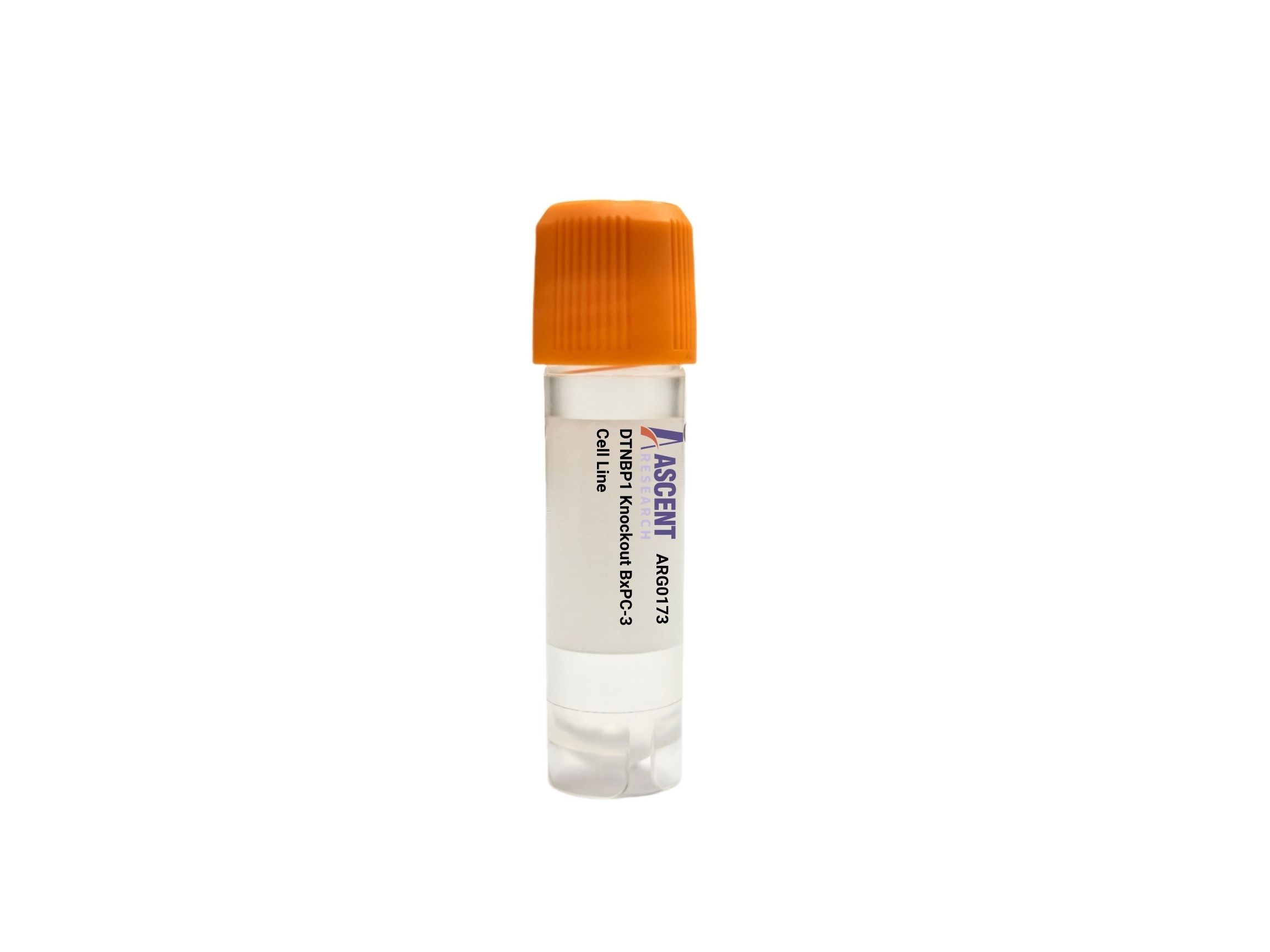
DTNBP1 Knockout BxPC-3 is a CRISPR/Cas9-edited human pancreatic adenocarcinoma epithelial cell line with disruption of DTNBP1, which encodes the BLOC-1 subunit dysbindin. In BxPC-3 cells, this model supports investigation of endosomal trafficking, receptor turnover, vesicle distribution, and autophagy-lysosome regulation involving factors such as BLOC1S8, AP3D1, RAB5, RAB7, and LAMP1. It is useful for pancreatic cancer cell biology, membrane protein sorting, lysosomal and autophagic flux studies, migration and invasion assays, and drug sensitivity experiments using approaches including western blotting, immunofluorescence, confocal microscopy, flow cytometry, and RNA-seq.
 Fbxl12 Knockout SIM-A9 Cell Line
Cat. No. ARG43851
Fbxl12 Knockout SIM-A9 Cell Line
Cat. No. ARG43851
 COMMD4 Knockout NCI-H1299 Polyclonal Cells
Cat. No. ARG17946
LAMA3 Knockout NCI-H1975 Polyclonal Cells
Cat. No. ARG17330
Maff Knockout RAW 264.7 Polyclonal Cells
Cat. No. ARG12433
AP5S1 Knockout HEK293T Polyclonal Cells
Cat. No. ARG25702
ANTXR1 Knockout jurkat Polyclonal Cells
Cat. No. ARG33842
COMMD4 Knockout NCI-H1299 Polyclonal Cells
Cat. No. ARG17946
LAMA3 Knockout NCI-H1975 Polyclonal Cells
Cat. No. ARG17330
Maff Knockout RAW 264.7 Polyclonal Cells
Cat. No. ARG12433
AP5S1 Knockout HEK293T Polyclonal Cells
Cat. No. ARG25702
ANTXR1 Knockout jurkat Polyclonal Cells
Cat. No. ARG33842
The DTNBP1 Knockout BxPC-3 Cell Line is a CRISPR/Cas9-engineered human cell model in which the DTNBP1 gene has been disrupted to eliminate functional dysbindin expression. This stable knockout line is generated in BxPC-3 cells, a human pancreatic adenocarcinoma epithelial cell line, and provides an in vitro system for studying the contribution of DTNBP1 to vesicle trafficking, membrane protein sorting, and lysosome-associated cellular processes in a pancreatic tumor context. The model is designed for mechanistic studies requiring defined gene loss in a disease-relevant epithelial background.
BxPC-3 is widely used as an experimental model for pancreatic ductal adenocarcinoma biology because it recapitulates key aspects of epithelial tumor cell behavior, including proliferation, survival, invasion, inflammatory signaling, and response to therapeutic perturbation. As a pancreatic adenocarcinoma-derived line, BxPC-3 is particularly useful for interrogating trafficking-dependent control of receptor turnover, stress adaptation, and drug sensitivity. Its established utility in cancer cell biology makes it a suitable host for examining how disruption of intracellular sorting machinery influences tumor-associated membrane dynamics and signaling outputs.
DTNBP1 encodes dysbindin, a subunit of the biogenesis of lysosome-related organelles complex-1 (BLOC-1), which forms functional complexes with factors including BLOC1S8, BLOC1S5, SNAPIN, muted, pallidin, and cappuccino. Through BLOC-1, DTNBP1 participates in endosomal trafficking, intracellular protein sorting, and vesicle-mediated transport, acting in pathways that interface with AP3 complex components such as AP3D1 and with endosomal regulators including RAB5, RAB7, EEA1, and LAMP1. DTNBP1 is regulated by transcriptional control, cellular stress, vesicle trafficking state, and lysosomal homeostasis. Loss of DTNBP1 is expected to alter endosomal cargo sorting, receptor surface expression and turnover, lysosomal delivery of membrane proteins, autophagic flux, and vesicle distribution, with pathway-level consequences measurable through LC3B- and SQSTM1-associated autophagy readouts.
In the BxPC-3 background, DTNBP1 knockout enables investigation of how defective BLOC-1-dependent trafficking intersects with pancreatic cancer cell signaling and behavior. Because pancreatic tumor cells depend on coordinated receptor recycling, membrane composition, and lysosomal homeostasis for growth and adaptation, this model is relevant for analyzing migration-related membrane dynamics, invasive phenotypes, and responses to pharmacologic stress. It is also applicable to broader studies linking lysosome trafficking dysfunction to disease mechanisms relevant to Hermansky-Pudlak syndrome-related biology, neuropsychiatric disease research, and cancer cell drug response.
This knockout cell line can be applied in western blotting, RT-qPCR, and RNA-seq workflows to assess DTNBP1-dependent transcriptional and protein-level changes; in immunofluorescence and confocal microscopy to quantify EEA1-, RAB5-, RAB7-, and LAMP1-positive compartments; and in co-immunoprecipitation studies to examine BLOC-1-associated interactions. It is also suitable for flow cytometry-based analysis of cell-surface receptor turnover, autophagic flux assays using LC3B and SQSTM1, lysosomal staining assays, and functional migration, invasion, apoptosis, and drug sensitivity studies in pancreatic cancer cells. Researchers may contact Ascent Research for additional technical information, product details, or related gene-edited cell models.