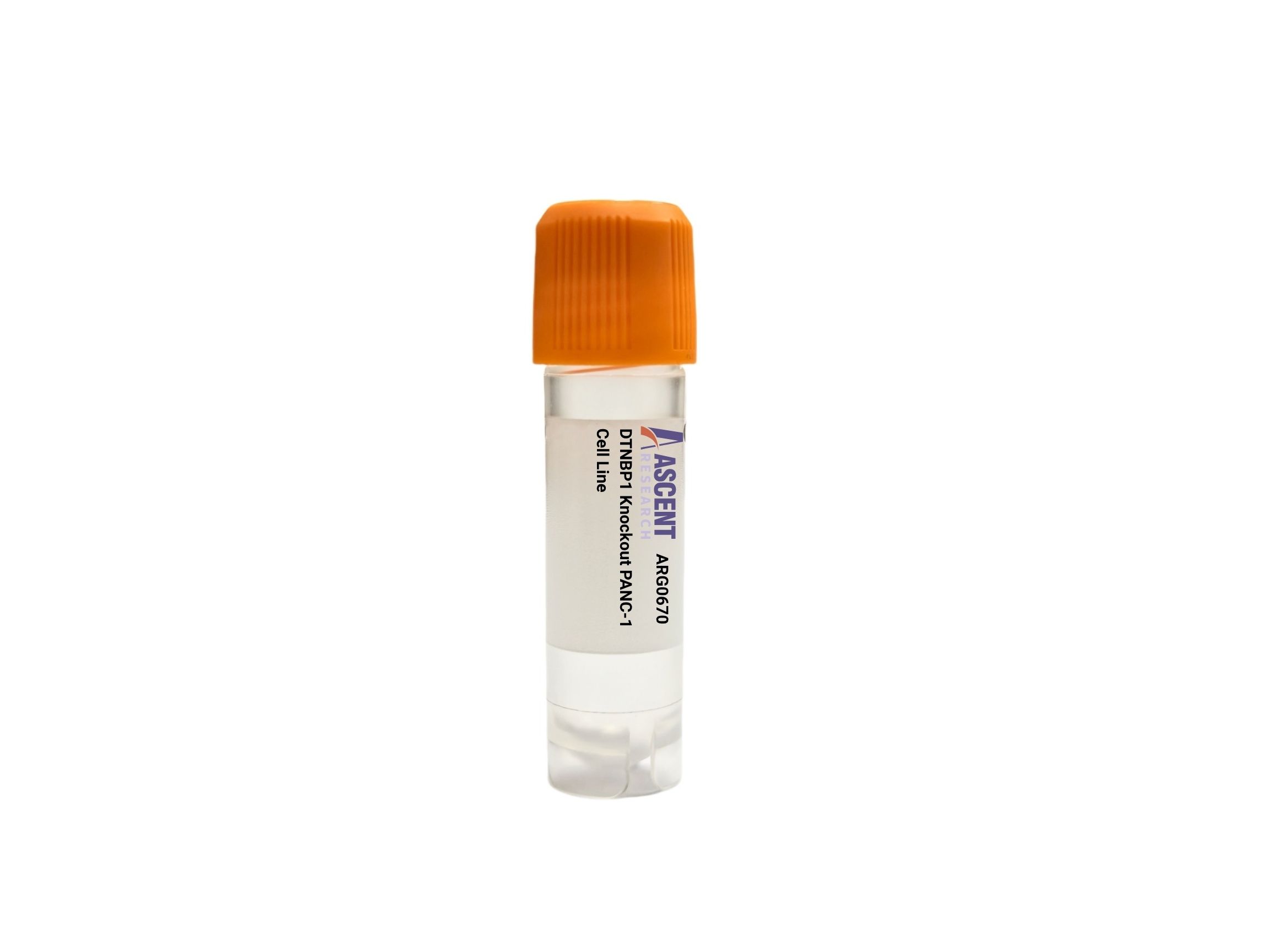
Genome-edited Cells
Pancreas
The DTNBP1 Knockout PANC-1 Cell Line is a CRISPR/Cas9-edited knockout cell model in which the DTNBP1 gene, encoding the BLOC-1 subunit dysbindin, has been disrupted. This stable loss-of-function model uses human PANC-1 pancreatic ductal adenocarcinoma cells to study lysosomal trafficking, autophagy, and exocytosis, as dysbindin interacts with dystrobrevin, BLOC1S1, and SNARE proteins. Researchers can apply this cell line to investigate pancreatic cancer biology, lysosomal dysfunction, and drug sensitivity, employing assays such as autophagy flux measurement, immunofluorescence for LAMP1, and western blotting. The knockout model is particularly suited for dissecting dysbindin-dependent signaling in cancer and neurobiology-related contexts.
 MNX1 Knockout Hela Polyclonal Cells
Cat. No. ARG8662
HECA Knockout Raji Polyclonal Cells
Cat. No. ARG23679
ARSA Knockout A2780 Polyclonal Cells
Cat. No. ARG28804
GPHN Knockout jurkat Polyclonal Cells
Cat. No. ARG34184
DOCK2 Knockout HT29 Polyclonal Cells
Cat. No. ARG39565
MDM2 Knockout THP-1 Polyclonal Cells
Cat. No. ARG7366
MNX1 Knockout Hela Polyclonal Cells
Cat. No. ARG8662
HECA Knockout Raji Polyclonal Cells
Cat. No. ARG23679
ARSA Knockout A2780 Polyclonal Cells
Cat. No. ARG28804
GPHN Knockout jurkat Polyclonal Cells
Cat. No. ARG34184
DOCK2 Knockout HT29 Polyclonal Cells
Cat. No. ARG39565
MDM2 Knockout THP-1 Polyclonal Cells
Cat. No. ARG7366
The DTNBP1 Knockout PANC-1 Cell Line is a genetically modified human pancreatic cancer cell model generated by CRISPR/Cas9-mediated disruption of the DTNBP1 gene. This knockout cell line provides a stable loss-of-function system for studying the roles of dysbindin, the protein product of DTNBP1, in cellular processes. The engineered PANC-1 cells enable researchers to dissect dysbindin-dependent mechanisms without relying on transient knockdown methods, offering a consistent and defined genetic background for functional assays.
PANC-1 is an epithelial cell line originally derived from a 56-year-old Caucasian male with pancreatic ductal adenocarcinoma. These cells exhibit an epithelioid morphology and serve as a widely used model for pancreatic cancer biology, including tumor cell signaling, metabolism, and therapeutic resistance. The PANC-1 line retains key mutations and signaling pathway alterations characteristic of pancreatic ductal adenocarcinoma, making it a relevant host for probing gene functions in cancer progression.
DTNBP1 encodes dysbindin, a core component of the biogenesis of lysosome-related organelles complex 1 (BLOC-1). Dysbindin interacts with dystrobrevin alpha and beta, BLOC1S1, BLOC1S2, and SNARE proteins such as SNAP-25 and syntaxin-1 to regulate lysosomal trafficking, autophagy, and exocytosis. Upstream signals involve dystrobrevin, the SNARE complex, and BDNF/TrkB signaling, while downstream effects include modulation of glutamate receptor trafficking and lysosomal enzyme secretion. Through its scaffolding role in BLOC-1, dysbindin coordinates cargo delivery to lysosomes and lysosome-related organelles, influencing cellular homeostasis.
In the PANC-1 pancreatic cancer context, DTNBP1 knockout eliminates dysbindin expression, impairing BLOC-1-dependent lysosomal biogenesis and function. This disruption is expected to alter autophagy flux, lysosomal pH, and secretory pathways, potentially affecting cancer cell growth, survival, and drug sensitivity. The model enables investigation of how lysosomal dysfunction contributes to pancreatic cancer pathogenesis and may reveal vulnerabilities that can be targeted therapeutically.
This cell line is suitable for a range of experimental applications, including analysis of lysosomal trafficking and pH homeostasis using lysotracker dyes or pH-sensitive probes, autophagy flux assays with LC3 turnover or p62 degradation, and immunofluorescence localization of lysosomal markers such as LAMP1. It also supports drug sensitivity screening, cell proliferation assays, and western blotting for dysbindin network proteins. Typical research areas include cancer cell biology, autophagy regulation, and the study of schizophrenia-related pathways that intersect with lysosomal function. For additional details or to place an order, contact Ascent Research.