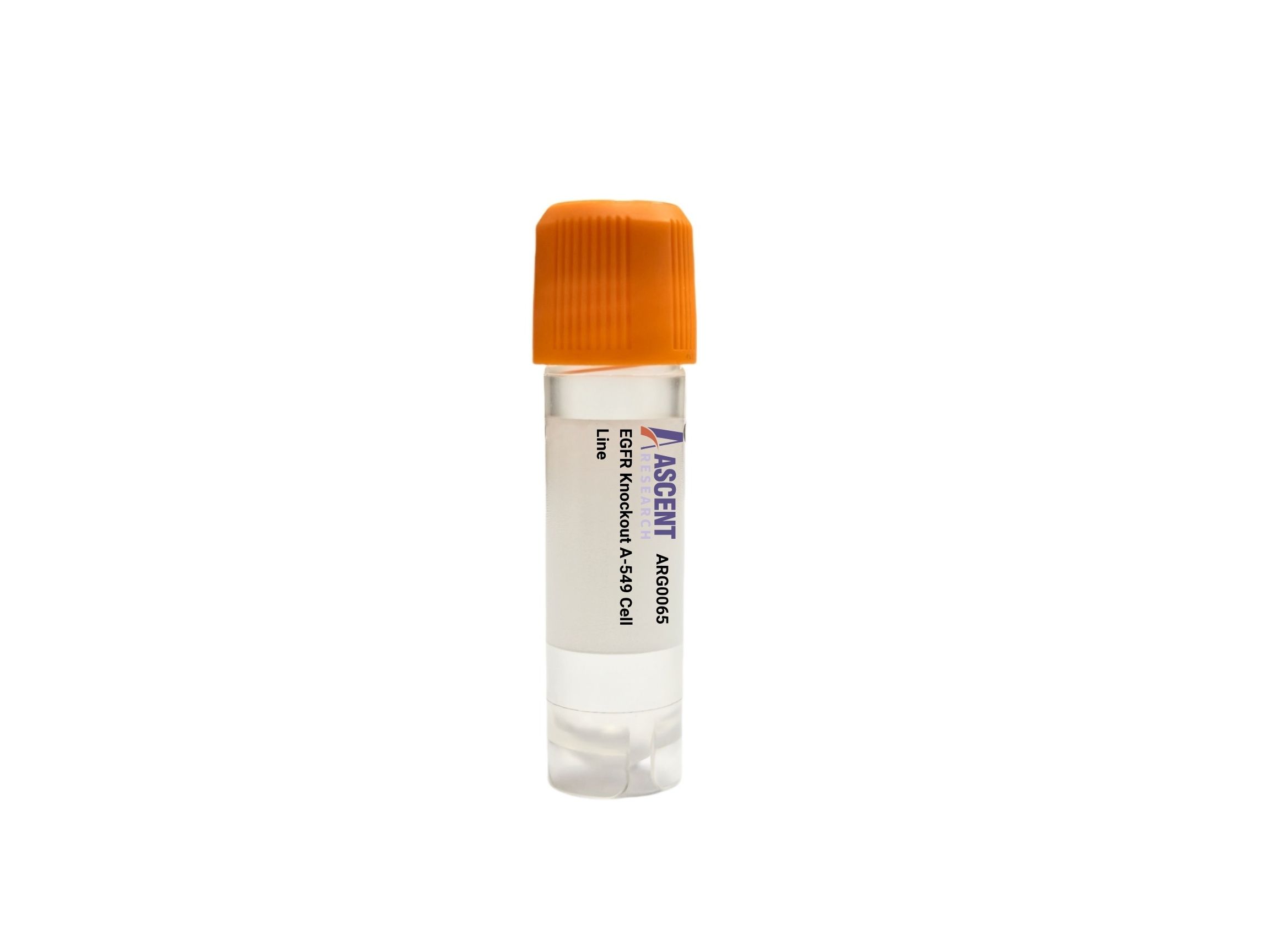
Genome-edited Cells
Lung
EGFR Knockout A-549 is a human CRISPR/Cas9-edited lung adenocarcinoma epithelial cell line with disruption of EGFR in the widely used A-549 NSCLC model. EGFR is normally activated by ligands such as EGF and TGF-alpha and signals through GRB2-SOS1, KRAS-BRAF-MAPK, PI3K-AKT-mTOR, PLCG1, and STAT3 to regulate proliferation, survival, migration, and transcriptional responses. This knockout model supports EGFR loss-of-function studies, ERBB pathway dependency analysis, drug response and resistance research, and mechanistic assays including western blotting, RNA-seq, phospho-signaling analysis, proliferation, apoptosis, migration, invasion, and colony formation studies.
 MAT2B Knockout HT29 Polyclonal Cells
Cat. No. ARG15037
HERC5 Knockout Hela Polyclonal Cells
Cat. No. ARG25599
ATG4C Knockout A549 Polyclonal Cells
Cat. No. ARG31879
MOB2 Knockout Raji Polyclonal Cells
Cat. No. ARG1013
MAT2B Knockout HT29 Polyclonal Cells
Cat. No. ARG15037
HERC5 Knockout Hela Polyclonal Cells
Cat. No. ARG25599
ATG4C Knockout A549 Polyclonal Cells
Cat. No. ARG31879
MOB2 Knockout Raji Polyclonal Cells
Cat. No. ARG1013
 Immortalized Mouse Hepatic Stellate Cell
Cat. No. ARI0175
Immortalized Mouse Hepatic Stellate Cell
Cat. No. ARI0175
 CGAS Knockout HTR-8/Svneo Cell Line
Cat. No. ARG0442
CGAS Knockout HTR-8/Svneo Cell Line
Cat. No. ARG0442
The EGFR Knockout A-549 Cell Line is a human CRISPR/Cas9-engineered knockout model in which the EGFR gene has been disrupted to eliminate functional epidermal growth factor receptor expression. This stable edited cell line is generated in A-549 cells, a human lung adenocarcinoma epithelial cell line, and provides an in vitro system for investigating receptor tyrosine kinase loss-of-function in a clinically relevant epithelial tumor background. The model is designed for studies requiring controlled abrogation of EGFR-dependent signaling and associated phenotypic outputs.
A-549 cells are widely used as an alveolar epithelial-like tumor model for non-small cell lung cancer biology. Their epithelial characteristics, robust growth in culture, and extensive use in cancer pharmacology make them a common platform for interrogating proliferation, survival, growth factor responsiveness, and drug sensitivity. In this context, A-549 cells are particularly useful for examining how epithelial tumor cells integrate extracellular cues into transcriptional and phenotypic responses relevant to lung adenocarcinoma progression, receptor signaling, and therapeutic intervention.
EGFR encodes a ligand-activated ERBB family receptor tyrosine kinase that is activated by EGF, TGF-alpha, amphiregulin, HB-EGF, epiregulin, and betacellulin, with ligand availability further regulated by ADAM17-mediated shedding. Ligand binding promotes EGFR dimerization, including interactions with ERBB2 and ERBB3, followed by autophosphorylation and recruitment of adaptor proteins such as GRB2, SHC1, SOS1, and GAB1. These complexes engage KRAS, BRAF, MAP2K1, and MAPK1 in the RAS-RAF-MEK-ERK cascade, as well as PIK3CA, PIK3R1, AKT1, and MTOR in the PI3K-AKT-mTOR pathway. EGFR also signals through PLCG1, STAT3, and STAT1, and is regulated by factors including CBL, ERRFI1, SRC, and PTPN11 in processes linked to receptor trafficking, attenuation, and signal modulation. Through these pathways, EGFR promotes expression of growth- and survival-associated effectors such as MYC, CCND1, FOS, JUN, and BCL2L1.
Loss of EGFR in the A-549 background provides a useful system for dissecting ERBB-dependent control of epithelial tumor cell behavior. In this host-cell context, EGFR knockout is expected to attenuate canonical mitogenic and survival signaling downstream of ligand-induced receptor activation and to alter growth factor-responsive transcriptional programs, migration-related signaling, and receptor network compensation. This makes the model relevant for studying pathway dependency in lung adenocarcinoma, mechanisms of resistance to EGFR-targeted therapies, and signaling rewiring involving ERBB family members and downstream kinase cascades.
This cell line can be applied in western blot and phospho-signaling analyses to quantify changes in MAPK, AKT, PLCG1, or STAT pathway activation after stimulation with EGF-family ligands. It is suitable for RT-qPCR and RNA-seq studies of EGFR-dependent transcriptional outputs, including MYC, CCND1, FOS, and JUN-associated programs. Researchers may use immunofluorescence, flow cytometry, and receptor internalization assays to examine altered receptor trafficking and surface signaling states, and co-immunoprecipitation to evaluate effects on complexes involving GRB2, SHC1, ERBB2, or ERBB3. Functional studies may include cell proliferation, apoptosis, colony formation, migration, invasion, and drug sensitivity assays to define EGFR pathway contributions to survival, epithelial tumor progression, and therapeutic response, as well as synthetic lethality screening in an EGFR-deficient non-small cell lung cancer model. Researchers may contact Ascent Research for additional technical information, product details, or related gene-edited cell models.