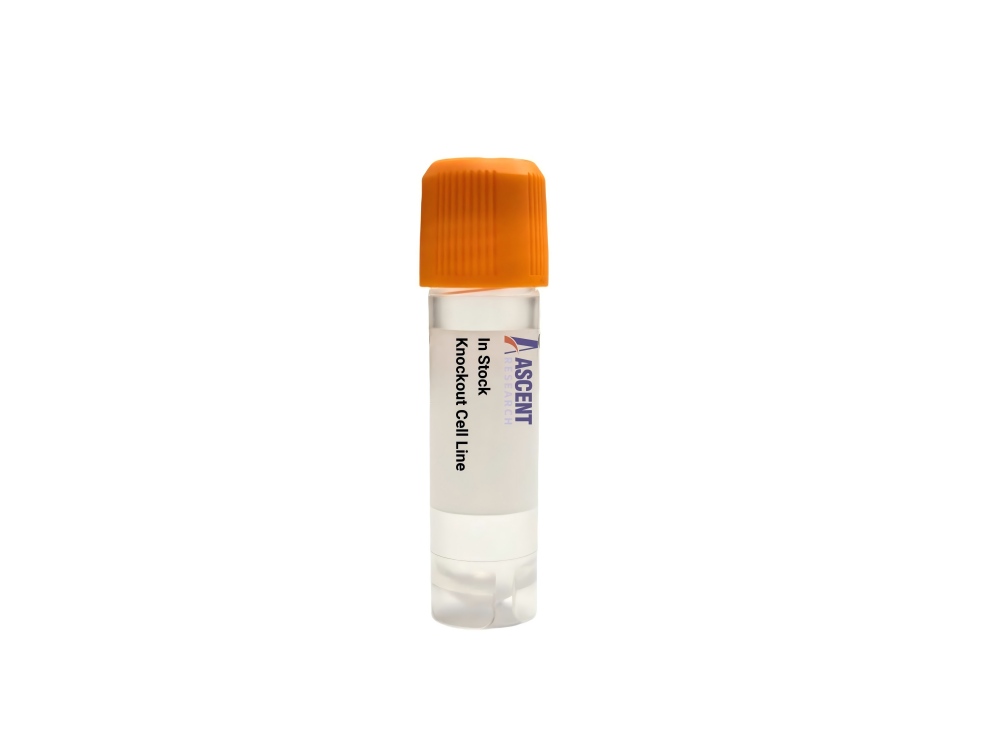
In Stock Cell Lines
Homo sapiens (Human)
Brain (parietal lobe)
Adherent
The ELAVL1 Knockout U-251MG Cell Line is a CRISPR/Cas9-edited knockout cell line with disrupted ELAVL1 (HuR) expression in human glioblastoma U-251MG cells. ELAVL1 is an RNA-binding protein that stabilizes AU-rich element-containing mRNAs, controlling proliferation, survival, inflammation, and stress responses. It is frequently overexpressed in glioblastoma and associated with tumor aggressiveness. This loss-of-function model enables investigation of post-transcriptional gene regulation and signaling pathways such as p38 MAPK and NF-??B. Target genes include CCND1, BCL2, and VEGFA. Applications include RNA immunoprecipitation, RT-qPCR, western blotting, proliferation, apoptosis, migration, and drug sensitivity assays.
 DGCR6L Knockout NCI-H1299 Polyclonal Cells
Cat. No. ARG18034
NEU3 Knockout HT29 Polyclonal Cells
Cat. No. ARG14214
FADS3 Knockout HT29 Polyclonal Cells
Cat. No. ARG13857
PAK4 Knockout jurkat Polyclonal Cells
Cat. No. ARG13366
AFP Knockout A549 Polyclonal Cells
Cat. No. ARG26129
CUEDC2 Knockout Raji Polyclonal Cells
Cat. No. ARG1760
DGCR6L Knockout NCI-H1299 Polyclonal Cells
Cat. No. ARG18034
NEU3 Knockout HT29 Polyclonal Cells
Cat. No. ARG14214
FADS3 Knockout HT29 Polyclonal Cells
Cat. No. ARG13857
PAK4 Knockout jurkat Polyclonal Cells
Cat. No. ARG13366
AFP Knockout A549 Polyclonal Cells
Cat. No. ARG26129
CUEDC2 Knockout Raji Polyclonal Cells
Cat. No. ARG1760
The ELAVL1 Knockout U-251MG Cell Line is a CRISPR/Cas9-edited knockout cell line in which the ELAVL1 (HuR) gene has been disrupted, creating a stable loss-of-function model. It enables research into post-transcriptional regulation by the ARE-binding protein ELAVL1 within a glioblastoma context.
U-251MG is a human glioblastoma cell line derived from a malignant glioma, widely used as a model of glioblastoma multiforme (GBM). It exhibits rapid proliferation, invasive potential, and apoptosis resistance, and carries mutations in TP53 and PTEN. These features make it highly relevant for studying GBM tumor biology, oncogenic signaling, and therapeutic responses, and it is frequently employed in drug sensitivity and resistance studies.
ELAVL1 encodes the RNA-binding protein HuR, which binds AU-rich elements in the 3?? UTR of target mRNAs to stabilize them and enhance translation. Its key targets include CCND1, BCL2, VEGFA, PTGS2, MMP9, MYC, and CDKN1A. Activity is regulated by phosphorylation via p38 MAPK/MK2, PKC, and AMPK, and by stress stimuli including UV radiation, hypoxia, TNF-??, and IL-1??. ELAVL1 interacts with ARE-binding proteins AUF1 and TTP, and its nucleocytoplasmic shuttling relies on CRM1 and importin-??, with 14-3-3 proteins modulating localization. Thus, ELAVL1 integrates signals to control inflammation, proliferation, survival, and stress responses, influencing pathways such as NF-??B and PI3K/Akt.
In glioblastoma, ELAVL1 is often upregulated and associated with poor prognosis, driving aggressive tumor phenotypes through stabilization of oncogenic and angiogenic transcripts. The ELAVL1 knockout in U-251MG cells provides a powerful tool to dissect the contribution of HuR to GBM cell proliferation, migration, apoptosis resistance, and drug susceptibility. This model aids in validating ELAVL1 as a therapeutic target and elucidating its role in pathways such as p38 MAPK, NF-??B, and PI3K/Akt.
Researchers can employ this knockout cell line for RNA immunoprecipitation to assess mRNA target occupancy, RT-qPCR and western blotting to measure target gene expression (e.g., CCND1, BCL2, VEGFA), luciferase reporter assays for ARE-dependent regulation, and immunofluorescence to track subcellular localization. Functional assays include apoptosis (caspase activation), proliferation (BrdU, MTT), and migration (wound healing, transwell) studies. Drug sensitivity testing and stress-response experiments (e.g., hypoxia, cytokine treatment) are also well-suited. For further information, contact Ascent Research.