Genome-edited Cells
Blood (peripheral blood)
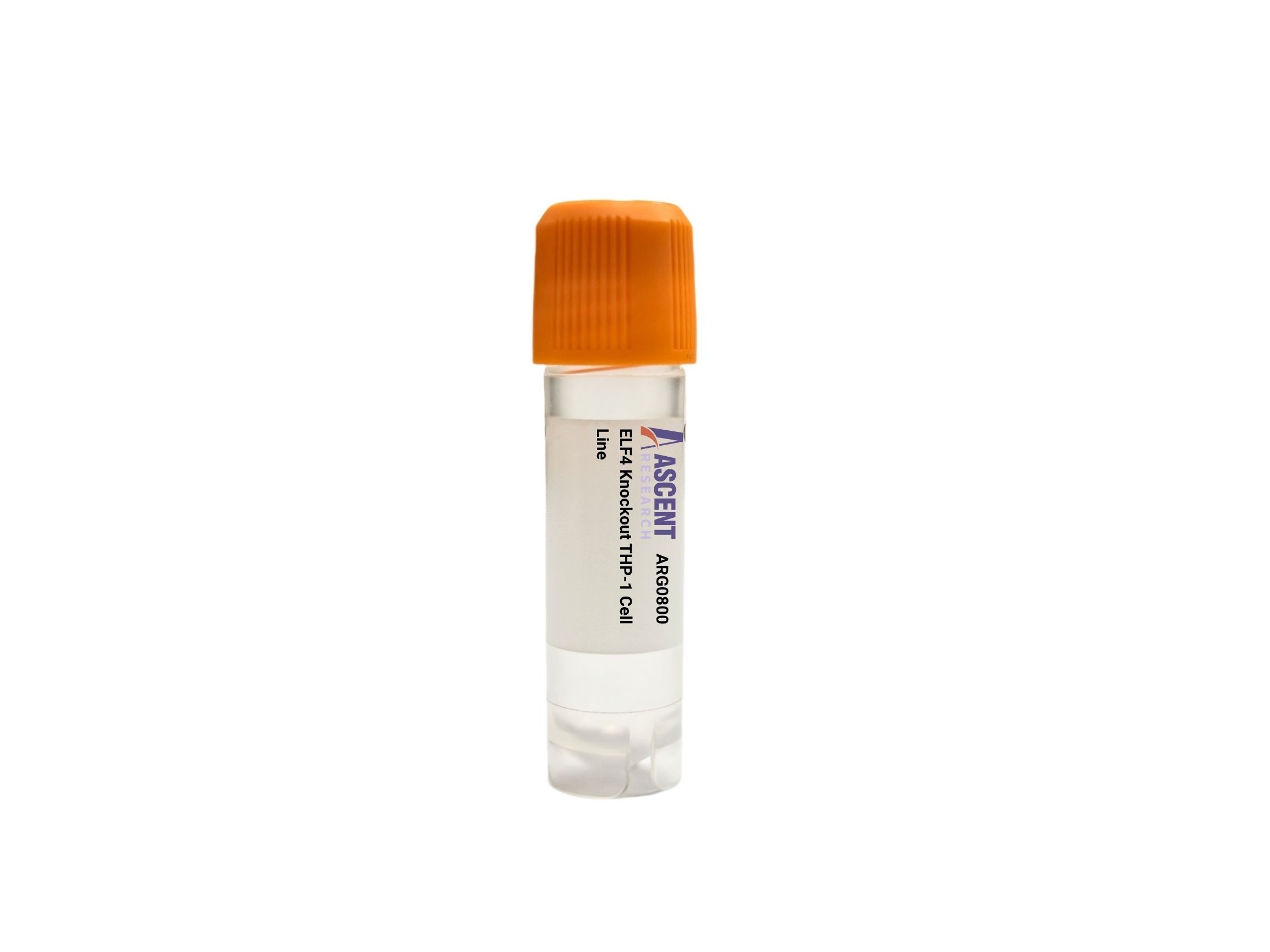
CRISPR/Cas9-mediated knockout of ELF4 in THP-1 monocytic leukemia cells. ELF4, an ETS transcription factor, is crucial for innate antiviral responses and type I interferon signaling, acting downstream of TLR4/TLR3 to regulate IFNB1 and ISGs through IRF3, NF-??B, and CBP/p300. This model facilitates studies of monocyte activation and antiviral immunity. Key applications: RT-qPCR, luciferase assays, western blot, flow cytometry, RNA-seq, and ChIP-qPCR to investigate TLR/RIG-I signaling and effector functions. Ideal for research on leukemia biology and immunodeficiency.
 ETFDH Knockout NCI-H1975 Polyclonal Cells
Cat. No. ARG16519
HAT1 Knockout A2780 Polyclonal Cells
Cat. No. ARG29103
ARL6IP1 Knockout SK-HEP-1 Polyclonal Cells
Cat. No. ARG32263
GPT2 Knockout HT29 Polyclonal Cells
Cat. No. ARG33284
GORASP2 Knockout huh-7 Polyclonal Cells
Cat. No. ARG28212
ETFDH Knockout NCI-H1975 Polyclonal Cells
Cat. No. ARG16519
HAT1 Knockout A2780 Polyclonal Cells
Cat. No. ARG29103
ARL6IP1 Knockout SK-HEP-1 Polyclonal Cells
Cat. No. ARG32263
GPT2 Knockout HT29 Polyclonal Cells
Cat. No. ARG33284
GORASP2 Knockout huh-7 Polyclonal Cells
Cat. No. ARG28212
 Human Bronchial Epithelial Cell Medium
Cat. No. ARM0138
Human Bronchial Epithelial Cell Medium
Cat. No. ARM0138
The ELF4 Knockout THP-1 Cell Line is a CRISPR/Cas9-mediated gene disruption model of the E74-like factor 4 (ELF4) locus in the human THP-1 monocytic leukemia cell line. This knockout cell line enables loss-of-function analysis of ELF4, a transcription factor essential for innate antiviral responses.
THP-1 is a well-characterized cell line derived from an acute monocytic leukemia patient, widely used to study monocyte differentiation, inflammation, and immune signaling pathways, particularly those involving Toll-like receptors (TLRs).
ELF4 is an ETS family transcription factor activated downstream of TLR4 and TLR3 through the TRIF?CTBK1?CIRF3 axis. ELF4 cooperates with IRF3, NF-??B, and the coactivator CBP/p300 to transcriptionally induce IFNB1 and interferon-stimulated genes (ISGs) such as ISG15 and OAS1. It also controls perforin and granzyme B expression. Upon TLR stimulation, ELF4 is recruited to target promoters and interacts with NF-??B and IRF3, as well as the histone acetyltransferase CBP/p300, to drive IFNB1 expression. Subsequently, type I interferon signaling through IFNAR leads to STAT1/STAT2 phosphorylation and formation of the ISGF3 complex (STAT1/STAT2/IRF9), which sustains ISG transcription, a process facilitated by ELF4. Disruption of ELF4 therefore blocks critical transcriptional programs governing type I interferon production and antiviral defense.
In the THP-1 monocytic context, ELF4 knockout impairs TLR-dependent and RIG-I-like receptor-dependent type I interferon responses, disrupting monocyte activation and antiviral restriction. This knockout cell line provides a clean genetic background to dissect ELF4-specific contributions to monocyte function, as THP-1 cells natively express TLR4, TLR3, and RIG-I. By ablating ELF4, researchers can uncouple the transcription factor from upstream signaling, revealing its role in the regulation of antiviral effectors and the establishment of an antiviral state. Moreover, because THP-1 is a leukemia-derived line, the knockout serves as a platform to study the crosstalk between innate immunity and leukemic transformation.
Typical experiments include RT-qPCR for interferon-stimulated genes (ISGs) such as ISG15 and OAS1, interferon-?? luciferase reporter assays to measure transcriptional activity at the IFNB1 promoter, and western blotting for phosphorylated STAT1 as a readout of JAK-STAT pathway activation. Flow cytometry for CD14 and CD11b monitors monocyte-to-macrophage differentiation, while RNA-seq provides a global view of transcriptional reprogramming. ChIP-qPCR assays targeting ELF4-binding motifs allow validation of direct transcriptional targets. Infection with Sendai virus or influenza A virus challenges the knockout cells, revealing defects in viral clearance and interferon production. Apoptosis assays further characterize cell death mechanisms. For further information or technical support, please contact Ascent Research.