Genome-edited Cells
Blood (peripheral blood)
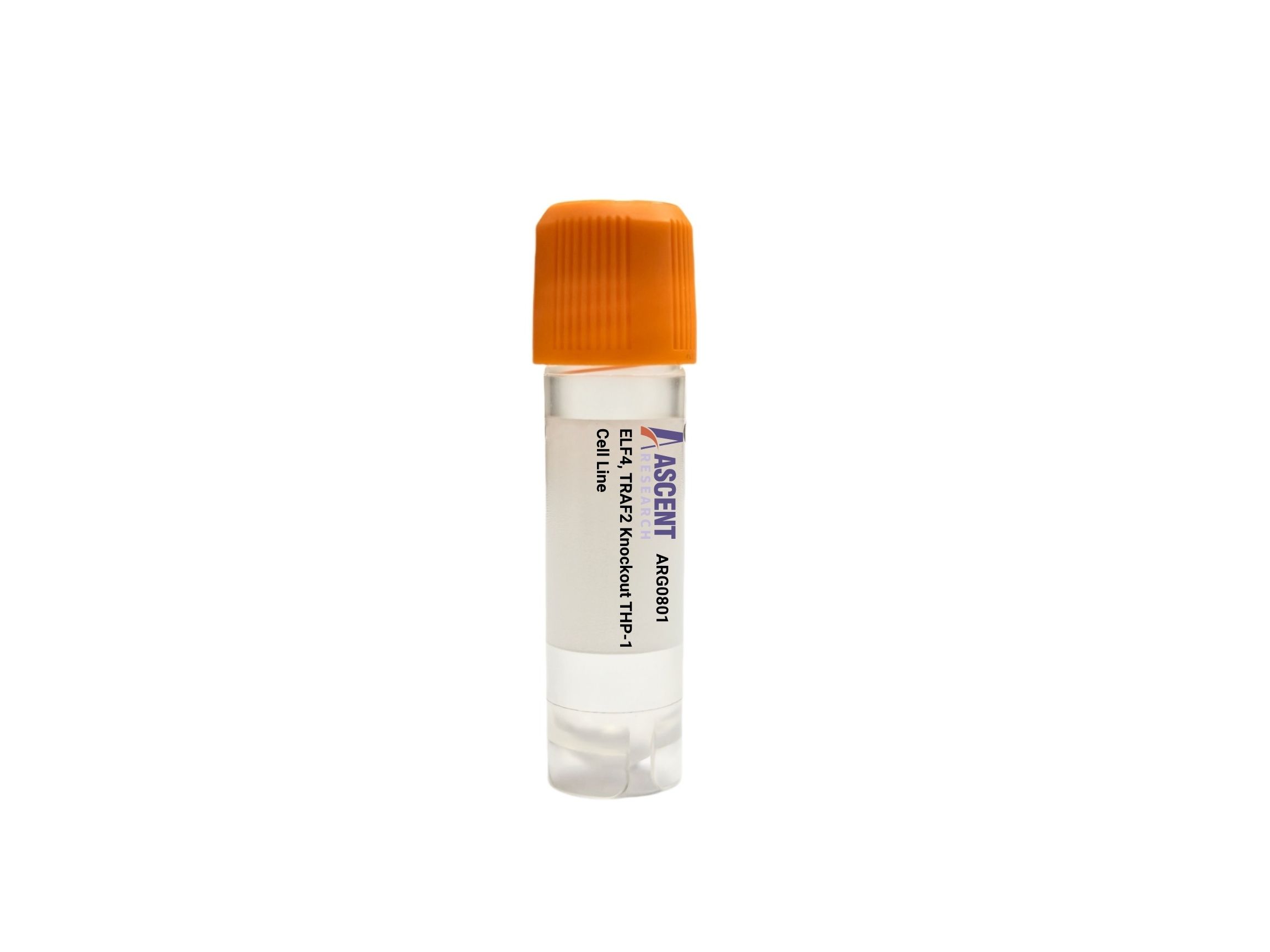
The ELF4, TRAF2 Knockout THP-1 Cell Line is a CRISPR/Cas9-edited dual knockout line derived from THP-1 human monocytic leukemia cells. Combined disruption of ELF4 and TRAF2 abrogates TNF-??-mediated NF-??B and JNK activation, involving key adaptors TRADD and RIPK1, and suppresses downstream targets such as IL-8 and CSF2. This model is used to dissect TNF signaling, NF-??B pathway biology, and monocyte-to-macrophage differentiation. Typical assays include phospho-IKK/JNK western blotting, NF-??B luciferase reporters, ELISA, and PMA-driven differentiation experiments in inflammation and AML research.
 FBXL18 Knockout SK-HEP-1 Polyclonal Cells
Cat. No. ARG15512
ABHD12 Knockout HGC-27 Polyclonal Cells
Cat. No. ARG29371
BCL2L11 Knockout jurkat Polyclonal Cells
Cat. No. ARG33992
ALDH1B1 Knockout SKOV3 Polyclonal Cells
Cat. No. ARG36701
KCTD12 Knockout HAP1 Polyclonal Cells
Cat. No. ARG27663
GOLPH3 Knockout HAP1 Polyclonal Cells
Cat. No. ARG27490
FBXL18 Knockout SK-HEP-1 Polyclonal Cells
Cat. No. ARG15512
ABHD12 Knockout HGC-27 Polyclonal Cells
Cat. No. ARG29371
BCL2L11 Knockout jurkat Polyclonal Cells
Cat. No. ARG33992
ALDH1B1 Knockout SKOV3 Polyclonal Cells
Cat. No. ARG36701
KCTD12 Knockout HAP1 Polyclonal Cells
Cat. No. ARG27663
GOLPH3 Knockout HAP1 Polyclonal Cells
Cat. No. ARG27490
The ELF4, TRAF2 Knockout THP-1 Cell Line is a CRISPR/Cas9-edited knockout cell line disrupting both ELF4 and TRAF2 genes. This dual loss-of-function reagent enables studies of signaling and transcriptional networks in immune cells. The stable knockout model is generated via CRISPR/Cas9-mediated gene disruption, providing a consistent system for biochemical and functional analyses.
The parental THP-1 cell line is an immortalized human monocytic line derived from an infant with acute monocytic leukemia (AML M5). It is widely used to investigate monocyte and macrophage biology, including differentiation, phagocytosis, and inflammatory responses. THP-1 cells can be further matured into macrophage-like cells by PMA treatment, upregulating markers such as CD14 and CD68.
ELF4 encodes an ETS transcription factor regulating immune development and expression of IL-8, CSF2, and LYZ. TRAF2 is an adaptor downstream of TNFR1 that, together with TRADD and RIPK1, recruits signaling complexes to activate the IKK complex and JNK kinase cascades, leading to NF-??B and AP-1 activation. TRAF2 also interacts with cIAP1/2 and NIK. Dual knockout disrupts TNF-??-induced NF-??B and JNK signaling and dampens transcriptional activation of inflammatory mediators.
In THP-1 cells, combined ELF4 and TRAF2 knockout impairs responses to TNF-??, LPS, and PMA, resulting in reduced IKK and JNK phosphorylation and diminished expression of NF-??B targets. This model enables dissection of how TRAF2-mediated signaling and ELF4-driven transcription cooperate to control monocyte survival, differentiation, and inflammatory gene programs in a leukemia background.
Applications include TNF signaling and NF-??B pathway analysis using phospho-IKK/JNK western blotting and NF-??B luciferase reporters. RT-qPCR and ELISA detect IL-8 and CSF2. Flow cytometry monitors CD14/CD68, and PMA-driven differentiation assays assess macrophage commitment. Co-immunoprecipitation can map altered signaling complexes. This cell line also supports drug screening in inflammatory diseases and AML. For inquiries, contact Ascent Research.