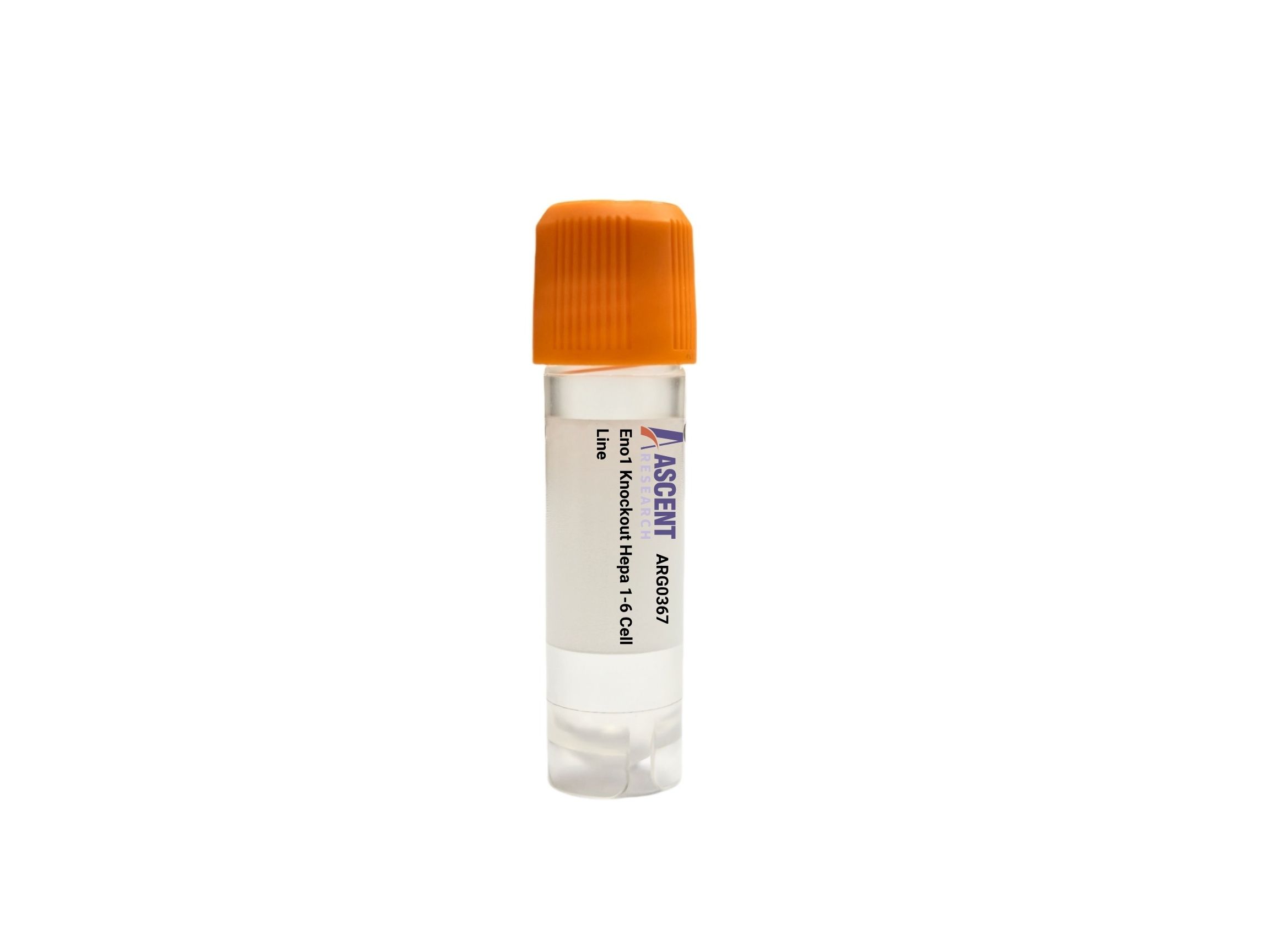
Genome-edited Cells
Liver
The Eno1 Knockout Hepa 1-6 Cell Line is a CRISPR/Cas9-edited mouse hepatoma cell line with targeted disruption of Eno1, encoding alpha-enolase. This enzyme catalyzes the conversion of 2-phosphoglycerate to phosphoenolpyruvate in glycolysis and functions as a plasminogen receptor promoting cell migration, while its MBP-1 isoform represses c-Myc transcription to link metabolism and proliferation. Derived from the Hepa 1-6 hepatocellular carcinoma model, this knockout enables study of ENO1-dependent glycolysis, HIF-1?? and MYC regulation, and invasion. It supports cancer metabolism research, drug sensitivity testing with glycolysis inhibitors, and plasminogen activation assays.
 ATF3 Knockout BEAS-2B Cell Line
Cat. No. ARG43732
ATF3 Knockout BEAS-2B Cell Line
Cat. No. ARG43732
 ESPN Knockout HT29 Polyclonal Cells
Cat. No. ARG13939
ARHGAP36 Knockout FTC-133 Polyclonal Cells
Cat. No. ARG28517
KIF1C Knockout NCI-H1299 Polyclonal Cells
Cat. No. ARG30920
C2orf69 Knockout Hela Polyclonal Cells
Cat. No. ARG41414
CDKN1A Knockout Raji Polyclonal Cells
Cat. No. ARG1586
ESPN Knockout HT29 Polyclonal Cells
Cat. No. ARG13939
ARHGAP36 Knockout FTC-133 Polyclonal Cells
Cat. No. ARG28517
KIF1C Knockout NCI-H1299 Polyclonal Cells
Cat. No. ARG30920
C2orf69 Knockout Hela Polyclonal Cells
Cat. No. ARG41414
CDKN1A Knockout Raji Polyclonal Cells
Cat. No. ARG1586
The Eno1 Knockout Hepa 1-6 Cell Line is a CRISPR/Cas9-edited knockout cell line derived from the Hepa 1-6 mouse hepatoma line, engineered for stable disruption of the Eno1 gene. Eno1 encodes alpha-enolase, a key glycolytic enzyme that also functions as a plasminogen receptor and transcriptional regulator. This knockout model provides a powerful tool for investigating Eno1-dependent processes in metabolism, signaling, and tumor biology within a relevant liver cancer context.
Hepa 1-6 is a well-established mouse hepatoma cell line originating from the BW7756 tumor in C57L mice. It exhibits hepatocyte-like characteristics and is widely used as a model for hepatocellular carcinoma (HCC) research, recapitulating many molecular features of liver cancer. The cell line is responsive to metabolic and oncogenic pathway perturbations, making it an appropriate host for studying gene function in hepatocarcinogenesis.
Alpha-enolase (ENO1) catalyzes the conversion of 2-phosphoglycerate to phosphoenolpyruvate in glycolysis. Beyond its enzymatic role, ENO1 acts as a cell-surface plasminogen receptor, binding plasminogen and promoting its activation to plasmin for extracellular matrix degradation and cell migration. Its alternative translation product, MBP-1, localizes to the nucleus and represses c-Myc transcription, linking glycolytic activity to growth control. ENO1 expression is upregulated by HIF-1?? under hypoxia and by MYC in proliferative states, and is modulated by insulin and AMPK signaling. It interacts with cytoskeletal proteins tubulin and actin, and with the glycolytic enzyme PKM2, functioning within a network that includes hexokinase 2 (HK2) and lactate dehydrogenase A (LDHA) to coordinate metabolism and tumor progression.
In the Hepa 1-6 hepatoma context, Eno1 knockout disrupts a critical metabolic and signaling hub. Hepatocellular carcinoma cells rely on enhanced glycolysis and HIF-1??-mediated adaptation to hypoxia, processes dependent on ENO1. Loss of ENO1 permits dissection of its contributions to glycolytic flux, lactate production, proliferation, and plasminogen receptor-mediated invasion. The MBP-1?Cc-Myc axis provides a direct link between metabolism and oncogene regulation, enabling studies of metabolism-driven gene expression changes in liver cancer.
Researchers can utilize this knockout cell line for applications including cancer metabolism studies via metabolic profiling and glycolytic flux assays, hypoxia response research, and drug sensitivity testing with glycolysis inhibitors such as 2-DG. It supports migration and invasion assays, co-immunoprecipitation with plasminogen, and immunofluorescence. For further information, please contact Ascent Research.