Genome-edited Cells
Ascites
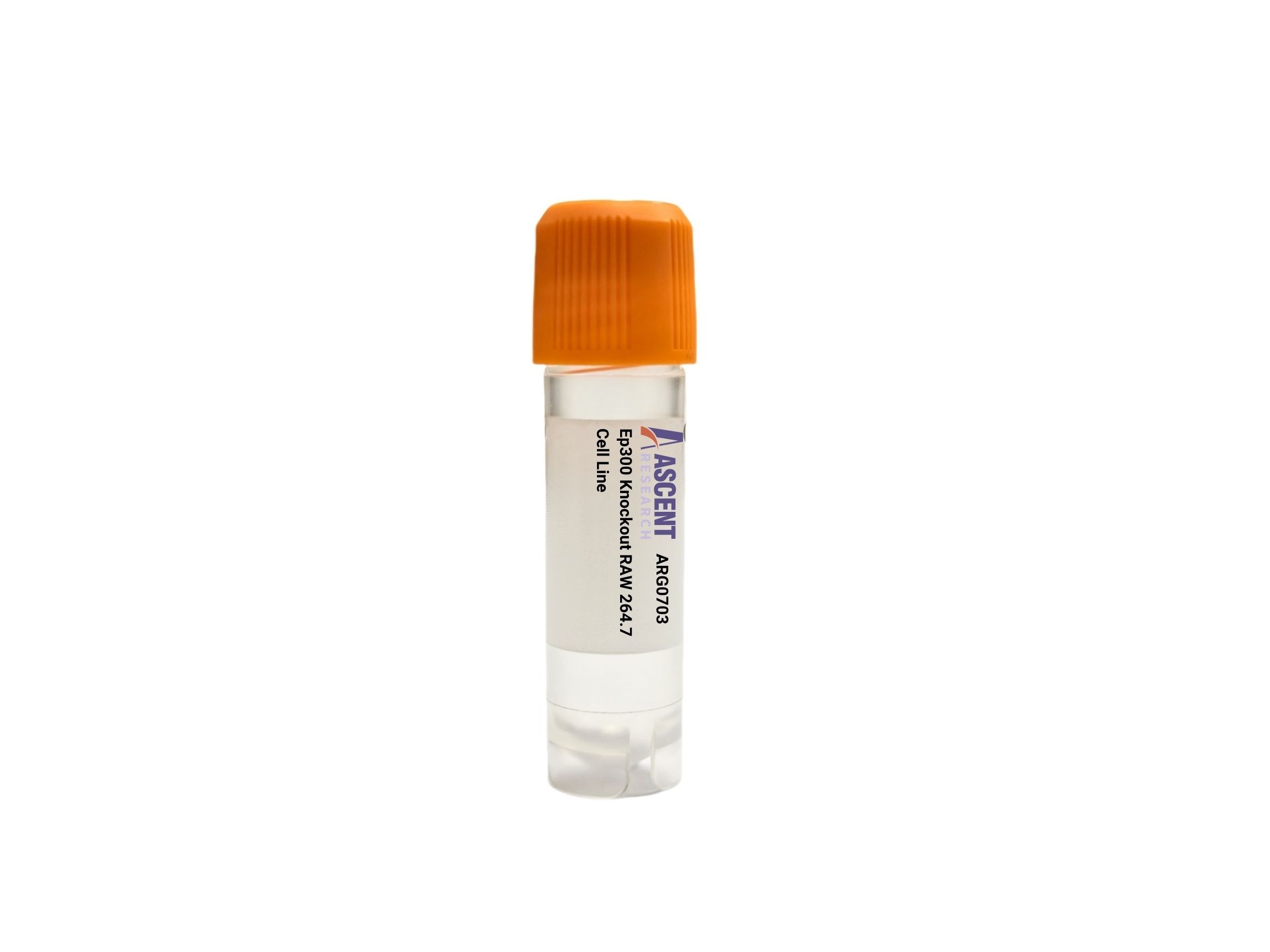
The Ep300 Knockout RAW 264.7 Cell Line is a CRISPR/Cas9-edited mouse macrophage cell line with targeted disruption of the Ep300 gene, encoding the histone acetyltransferase and transcriptional co-activator p300. p300 integrates signals from pathways such as Wnt/??-catenin, NF-??B, p53, and TGF-?? by interacting with transcription factors including p65, ??-catenin, and p53 to regulate gene expression. This knockout model is a robust tool for investigating epigenetic control of inflammatory responses, macrophage function, and cancer-related transcriptional programs, supporting assays like RNA-seq, ChIP, luciferase reporters, and cytokine profiling. For more details, contact Ascent Research.
The Ep300 Knockout RAW 264.7 Cell Line is a CRISPR/Cas9-edited murine macrophage cell line featuring targeted disruption of the Ep300 gene, which encodes the transcriptional co-activator and histone acetyltransferase p300. This knockout model provides a stable loss-of-function system for investigating p300-dependent gene regulation and chromatin remodeling in a well-characterized immune cell background. The gene disruption is generated using CRISPR/Cas9 technology.
The parental RAW 264.7 cell line originates from BALB/c mouse macrophages transformed with Abelson leukemia virus, maintaining key features of monocyte/macrophage lineage, including robust phagocytic activity and the ability to mount inflammatory responses. These cells are widely utilized as a model system for studying macrophage biology, innate immunity, and signal transduction pathways. They respond to a variety of stimuli, making them ideal for dissecting transcriptional networks.
p300 functions as a critical histone acetyltransferase and transcriptional co-activator, acetylating histones and non-histone proteins to relax chromatin and recruit the basal transcription machinery. It serves as an integrative node for multiple signaling cascades, including Notch, Wnt/??-catenin, TGF-??, p53, NF-??B, cAMP, and Hippo pathways. p300 is activated by upstream signals such as growth factor receptors (EGFR, PDGFR), DNA damage response kinases (ATM/ATR), and kinases AKT, PKC, and MAPK. It interacts with transcription factors like p53, NF-??B (p65), STAT3, SMAD2/3, ??-catenin, GATA1, MyoD, CBP, and PCAF, and co-activates downstream targets including p53 target genes (CDKN1A, BAX), NF-??B target genes (IL6, TNF), and FOXO target genes. Through these interactions, p300 bridges signal-activated transcription factors with the transcriptional apparatus, modulating gene expression programs essential for cell cycle control, apoptosis, and immune responses.
In RAW 264.7 macrophages, p300 is essential for proper transcriptional responses to inflammatory stimuli. Knockout of Ep300 impairs the activation of NF-??B-dependent gene expression, reducing production of pro-inflammatory cytokines such as TNF-?? and IL-6, and attenuates the expression of p53-regulated genes involved in stress responses. This loss-of-function model thus allows dissection of p300??s specific contributions to macrophage polarization, phagocytosis, and proliferation, revealing how epigenetic regulation finely tunes innate immune functions.
Researchers can employ this cell line in diverse experimental settings, including epigenetic regulation studies, inflammation research, cancer biology, drug target validation, and macrophage polarization assays. Representative techniques include Western blotting, RT-qPCR, RNA-seq for transcriptome analysis, ChIP-qPCR to assess histone acetylation, NF-??B luciferase reporter assays to monitor transcriptional activity, ELISA for cytokine quantification, flow cytometry, and phagocytosis assays. The Ep300 Knockout RAW 264.7 Cell Line offers a powerful tool for advancing understanding of p300-dependent gene control. For further information, please contact Ascent Research.