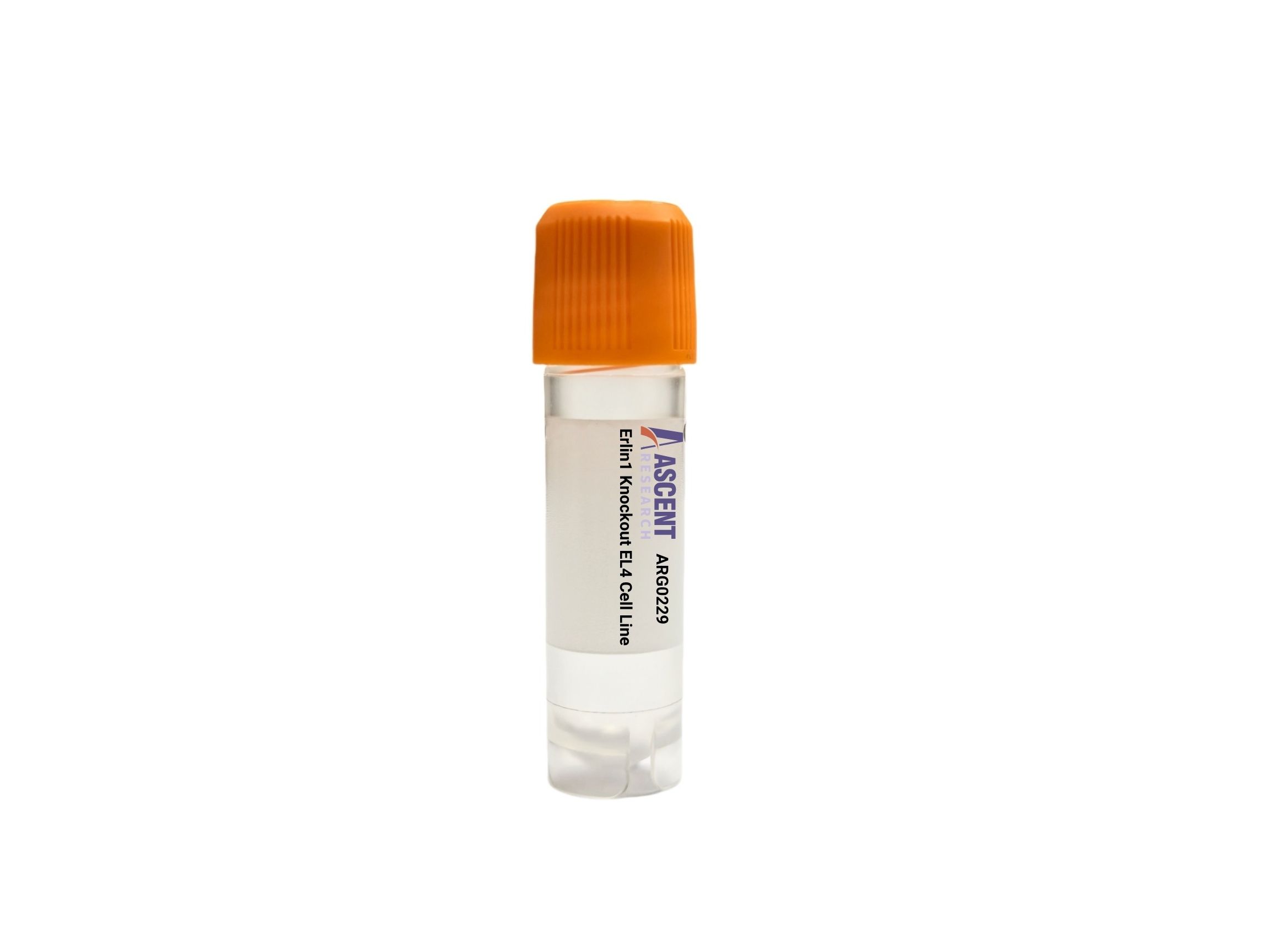
Genome-edited Cells
Ascites
The Erlin1 Knockout EL4 Cell Line is a CRISPR/Cas9-edited knockout cell line derived from the mouse T lymphoma EL4 line. Disruption of Erlin1, which encodes an ER membrane protein that forms complexes with Erlin2, provides a loss-of-function model to study ER-associated degradation, cholesterol homeostasis, and NLRP3 inflammasome regulation. This line enables investigation of ER stress responses and inflammasome signaling in T lymphocyte biology. Suitable applications include functional assays such as IL-1?? ELISA, caspase-1 activity measurements, and cholesterol efflux analysis, as well as gene expression profiling and drug screening. The model supports research into inflammatory disorders and neurological diseases linked to Erlin1 dysfunction.
 MBP Knockout Raji Polyclonal Cells
Cat. No. ARG0940
CH25H Knockout Hela Polyclonal Cells
Cat. No. ARG8514
HRAS Knockout Hela Polyclonal Cells
Cat. No. ARG25938
AKR1E2 Knockout HAP1 Polyclonal Cells
Cat. No. ARG27241
IFT172 Knockout HAP1 Polyclonal Cells
Cat. No. ARG34578
ERP44 Knockout Raji Polyclonal Cells
Cat. No. ARG2023
MBP Knockout Raji Polyclonal Cells
Cat. No. ARG0940
CH25H Knockout Hela Polyclonal Cells
Cat. No. ARG8514
HRAS Knockout Hela Polyclonal Cells
Cat. No. ARG25938
AKR1E2 Knockout HAP1 Polyclonal Cells
Cat. No. ARG27241
IFT172 Knockout HAP1 Polyclonal Cells
Cat. No. ARG34578
ERP44 Knockout Raji Polyclonal Cells
Cat. No. ARG2023
The Erlin1 Knockout EL4 Cell Line is a CRISPR/Cas9-edited knockout cell line engineered for targeted disruption of the Erlin1 gene. This loss-of-function model enables investigation of Erlin1 function in a mouse T lymphocyte lymphoma background. The product is provided as a live cell line and is intended for use in molecular, biochemical, and cellular assays to dissect the roles of Erlin1 in endoplasmic reticulum biology and immune signaling pathways.
The host EL4 cell line is a well-characterized suspension cell line derived from a chemically-induced T cell lymphoma in C57BL/6 mice. These cells maintain T lymphocyte characteristics and are extensively employed in immunological research, including studies of T cell receptor signaling, cytokine responses, and lymphoma biology. Their rapid growth and responsiveness to a range of stimuli make them a robust platform for investigating gene function in a lymphocytic context.
Erlin1 encodes an endoplasmic reticulum membrane protein that assembles into oligomeric complexes with Erlin2, functioning as a scaffold for ER-associated degradation (ERAD) of misfolded substrates and for the regulation of cholesterol homeostasis. Erlin1 negatively regulates NLRP3 inflammasome activation by interacting with NLRP3 and influencing its stability. The protein acts downstream of ER stress transducers such as PERK, IRE1??, and ATF6, and is transcriptionally regulated by SREBP2 and XBP1. Key interacting partners include UBXD8, the AAA-ATPase VCP/p97, and E3 ubiquitin ligases like gp78, which together mediate substrate retrotranslocation and proteasomal degradation. Erlin1 loss may impair ERAD efficiency and alter cholesterol metabolic pathways, including the expression of ABCA1 and LDLR, while potentiating NLRP3-dependent caspase-1 activation and IL-1?? release.
In the EL4 T lymphoma background, Erlin1 knockout offers a physiologically relevant model to examine the intersection of ER stress, cholesterol metabolism, and inflammasome signaling in lymphocyte biology. T lymphocytes rely on precise cholesterol flux for membrane integrity and signaling, and dysregulation of ERAD can lead to unresolved unfolded protein responses affecting cell survival or malignant transformation. By disrupting Erlin1, researchers can probe how the Erlin1?CErlin2 complex influences T cell lymphoma cell fitness, apoptotic thresholds, and inflammatory cytokine production, potentially revealing vulnerabilities relevant to lymphoid malignancies or inflammatory conditions.
This knockout cell line is suited for a variety of research applications, including mechanistic dissection of NLRP3 inflammasome regulation in T lymphoma, analysis of ERAD efficiency using pulse-chase assays, and evaluation of cholesterol efflux via ABCA1. Functional assays such as Western blotting for Erlin1 and ER stress markers (BiP, CHOP), RT-qPCR for downstream targets, IL-1?? ELISA, and caspase-1 activity measurements can be readily performed. Furthermore, the line can be utilized in compound screening platforms aimed at modulators of ER stress, inflammasome activity, or cholesterol homeostasis. For further technical details, please contact Ascent Research.