Genome-edited Cells
Ascites
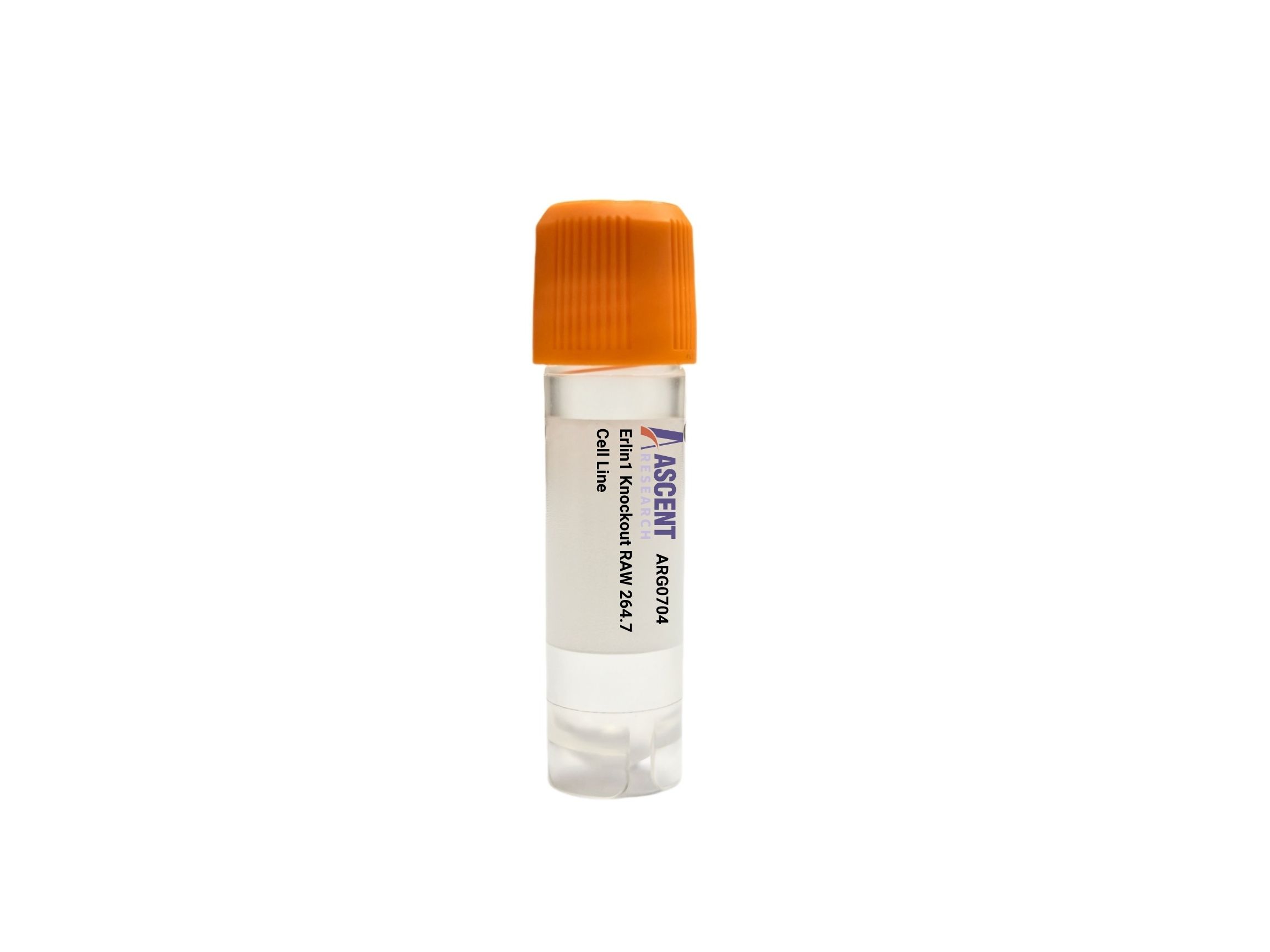
The Erlin1 Knockout RAW 264.7 Cell Line is a CRISPR/Cas9-edited macrophage model with targeted disruption of Erlin1, providing a stable loss-of-function system for studying ER-associated degradation (ERAD) and calcium homeostasis. Derived from the BALB/c-derived RAW 264.7 monocyte/macrophage line, these cells retain key innate immune properties such as phagocytosis and LPS responsiveness. Erlin1 forms a complex with Erlin2 to degrade IP3R1, interacting with Derlin-1, VCP/p97, and RNF170. This knockout line is ideal for investigating macrophage inflammation, ER stress signaling, and neurodegeneration-related pathways, and is compatible with cytokine ELISA, calcium imaging, and co-immunoprecipitation assays.
 IRAK3 Knockout HEK293 Polyclonal Cells
Cat. No. ARG23265
DNAJB11 Knockout NCI-H1299 Polyclonal Cells
Cat. No. ARG39088
ARHGAP11A Knockout HEK293T Polyclonal Cells
Cat. No. ARG38199
NAMPT Knockout HCT116 Polyclonal Cells
Cat. No. ARG7210
IRAK3 Knockout HEK293 Polyclonal Cells
Cat. No. ARG23265
DNAJB11 Knockout NCI-H1299 Polyclonal Cells
Cat. No. ARG39088
ARHGAP11A Knockout HEK293T Polyclonal Cells
Cat. No. ARG38199
NAMPT Knockout HCT116 Polyclonal Cells
Cat. No. ARG7210
 Rabbit Renal Pericyte Medium
Cat. No. ARM0748
Rabbit Renal Pericyte Medium
Cat. No. ARM0748
 SV-HUC-1
Cat. No. ARI0109
SV-HUC-1
Cat. No. ARI0109
The Erlin1 Knockout RAW 264.7 Cell Line is a CRISPR/Cas9-edited mouse macrophage cell line engineered to disrupt the endogenous Erlin1 gene, generating a stable loss-of-function model. This product offers researchers a renewable resource for studying Erlin1-dependent processes, avoiding the limitations of transient gene silencing. CRISPR/Cas9-mediated gene disruption abrogates Erlin1 expression, enabling functional studies in a well-characterized innate immune cell background.
The parental RAW 264.7 cell line, derived from BALB/c mouse monocytes transformed by Abelson murine leukemia virus, is a widely used macrophage model. These cells display adherent growth, active phagocytic activity, and robust responses to inflammatory stimuli such as lipopolysaccharide (LPS). They serve as a powerful platform for investigating innate immunity, pathogen recognition, and signal transduction.
Erlin1 is an ER lipid raft protein that hetero-oligomerizes with Erlin2 to form a complex involved in ER-associated degradation (ERAD). This complex facilitates ubiquitin-dependent proteasomal degradation of substrates, notably the IP3R1 calcium channel, through interactions with Derlin-1, VCP/p97, and RNF170. By regulating IP3R1 turnover, Erlin1 controls ER calcium release and protects against ER stress-induced apoptosis, partly via TMBIM6/BI-1. Erlin1 is also implicated in cholesterol homeostasis and is modulated by the ER stress sensors IRE1??, ATF6, and PERK, as well as the transcription factor XBP1.
In RAW 264.7 macrophages, Erlin1’s role in ERAD and calcium signaling is integral to immune functions. Erlin1 disruption may impact phagocytosis, cytokine production, and the unfolded protein response triggered by microbial products. This knockout model can help elucidate how ER lipid raft components regulate macrophage activation and may provide insights into diseases associated with Erlin1 dysfunction, such as hereditary spastic paraplegia and certain cancers where Erlin1 expression is altered.
Key research applications include phagocytosis assays, LPS-induced cytokine secretion measured by ELISA, qPCR for inflammatory gene expression, and Western blotting for ER stress markers such as BiP and CHOP. The knockout line supports calcium imaging to assess store-operated calcium entry and co-immunoprecipitation to confirm disruption of Erlin1/2 complex formation. It is also well-suited for high-throughput screening of small-molecule modulators of ERAD or calcium signaling pathways, and for apoptosis studies. For additional technical data or ordering inquiries, please contact Ascent Research.