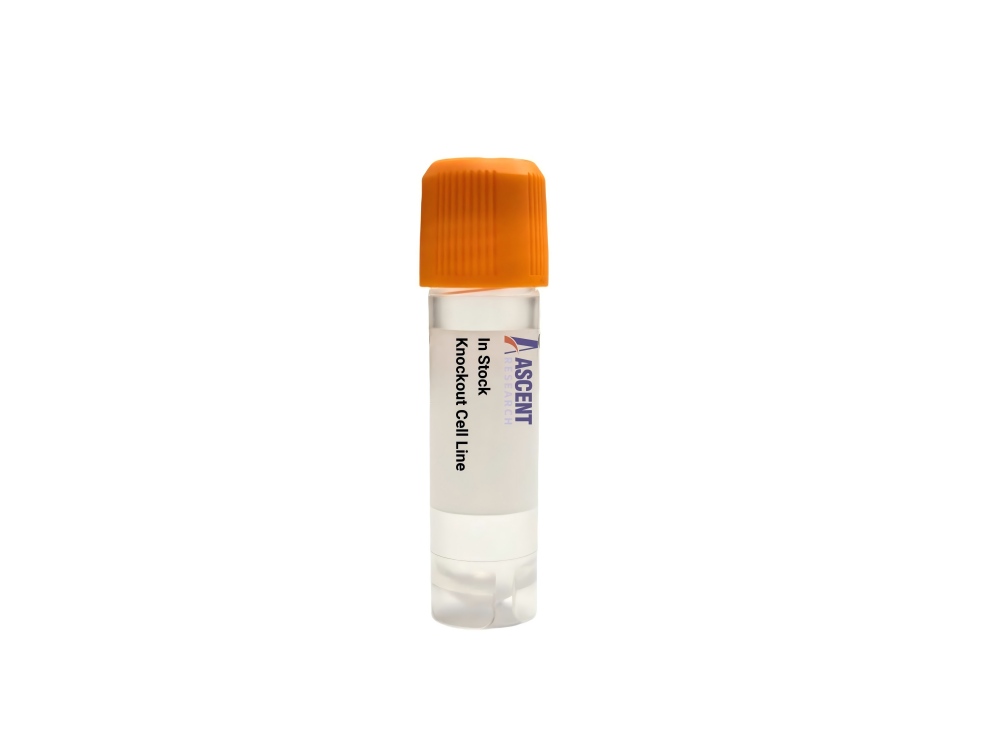
In Stock Cell Lines
Homo sapiens (Human)
Liver
Adherent
The EYA2 Knockout Huh-7 Cell Line is a CRISPR/Cas9-edited knockout derivative of the Huh-7 human hepatocellular carcinoma cell line, providing a loss-of-function model for studying the protein tyrosine phosphatase and transcriptional coactivator EYA2. EYA2 functions in DNA damage repair by dephosphorylating H2AX and cooperates with SIX1 to drive oncogenic transcription of targets such as MYC and CCND1. In the Huh-7 liver cancer model, EYA2 knockout impairs DNA repair and SIX1-mediated proliferation, enabling investigation of EYA2-dependent pathways and therapeutic targeting. Applications include western blotting, proliferation assays, apoptosis analysis, and drug screening to evaluate EYA2 inhibitors and study hepatocellular carcinoma biology.
 IFI30 Knockout K562 Polyclonal Cells
Cat. No. ARG20631
ABR Knockout Hela Polyclonal Cells
Cat. No. ARG20363
KAT2B Knockout THP-1 Polyclonal Cells
Cat. No. ARG23494
ARL6IP1 Knockout HT29 Polyclonal Cells
Cat. No. ARG33041
ALPP Knockout HAP1 Polyclonal Cells
Cat. No. ARG34869
IFI30 Knockout K562 Polyclonal Cells
Cat. No. ARG20631
ABR Knockout Hela Polyclonal Cells
Cat. No. ARG20363
KAT2B Knockout THP-1 Polyclonal Cells
Cat. No. ARG23494
ARL6IP1 Knockout HT29 Polyclonal Cells
Cat. No. ARG33041
ALPP Knockout HAP1 Polyclonal Cells
Cat. No. ARG34869
 MDA-MB-231
Cat. No. ARC0497
MDA-MB-231
Cat. No. ARC0497
The EYA2 Knockout Huh-7 Cell Line is a CRISPR/Cas9-edited knockout cell line derived from the Huh-7 human hepatocellular carcinoma cell line. This product provides a targeted loss-of-function model for the EYA2 gene, enabling investigation of its roles in DNA damage repair, cell proliferation, and transcriptional regulation. Created through CRISPR/Cas9-mediated gene disruption, the cell line serves as a robust experimental tool for probing EYA2-dependent signaling networks in a liver cancer context.
Huh-7 cells were originally established from a well-differentiated hepatocellular carcinoma of a 57-year-old Japanese male and have become a widely employed model for hepatocyte function, liver cancer biology, and drug metabolism studies. Retaining many hepatocytic characteristics and expressing key oncogenic signaling components, Huh-7 provides a physiologically relevant system for dissecting molecular mechanisms underlying hepatocellular carcinoma. The EYA2 knockout generated in this line thus offers a disease-relevant cellular environment for evaluating gene function.
EYA2 encodes a dual-function protein that acts as a protein tyrosine phosphatase and a transcriptional coactivator. It plays critical roles in DNA damage repair by dephosphorylating H2AX to facilitate resolution of DNA double-strand breaks, and it partners with the SIX1 transcription factor to drive expression of proliferative and anti-apoptotic genes such as MYC and CCND1. EYA2 integrates inputs from WNT/??-catenin and TGF-?? receptor pathways, as well as DNA damage?Cactivated kinases ATM and ATR. Downstream, it modulates Hippo effectors YAP, TAZ, and TEAD, and interacts with PTEN and the Ku70/Ku80 DNA repair complex. Knockout of EYA2 disrupts this network, leading to sustained H2AX phosphorylation, impaired DNA repair, reduced SIX1-mediated transactivation, and attenuated cell survival signals.
In the Huh-7 hepatocellular carcinoma model, EYA2 knockout impairs the SIX1-EYA2 transcriptional complex, which is known to promote liver tumor cell proliferation, migration, and survival. Loss of EYA2 function uncovers dependencies on EYA2 for maintaining genomic stability and proliferative capacity, and permits dissection of crosstalk with liver-enriched transcriptional programs. This cell line thus serves as a powerful platform for mechanistic studies into how EYA2 coordinates oncogenic transcription with DNA damage responses, and for validating EYA2 as a therapeutic target in liver cancer.
Researchers can employ this knockout cell line in a broad range of assays to explore EYA2 biology and therapeutic potential. Western blotting and RT-qPCR confirm EYA2 loss, while ??-H2AX immunofluorescence monitors DNA damage accumulation. Functional studies include MTT viability assays, colony formation, and Annexin V/PI apoptosis assays. Reporter gene assays elucidate SIX1-EYA2 transcriptional activity, transwell migration assays gauge invasive capacity, and drug sensitivity screens identify compounds that synergize with EYA2 loss. For further information or to inquire about custom cell engineering, please contact Ascent Research.