Genome-edited Cells
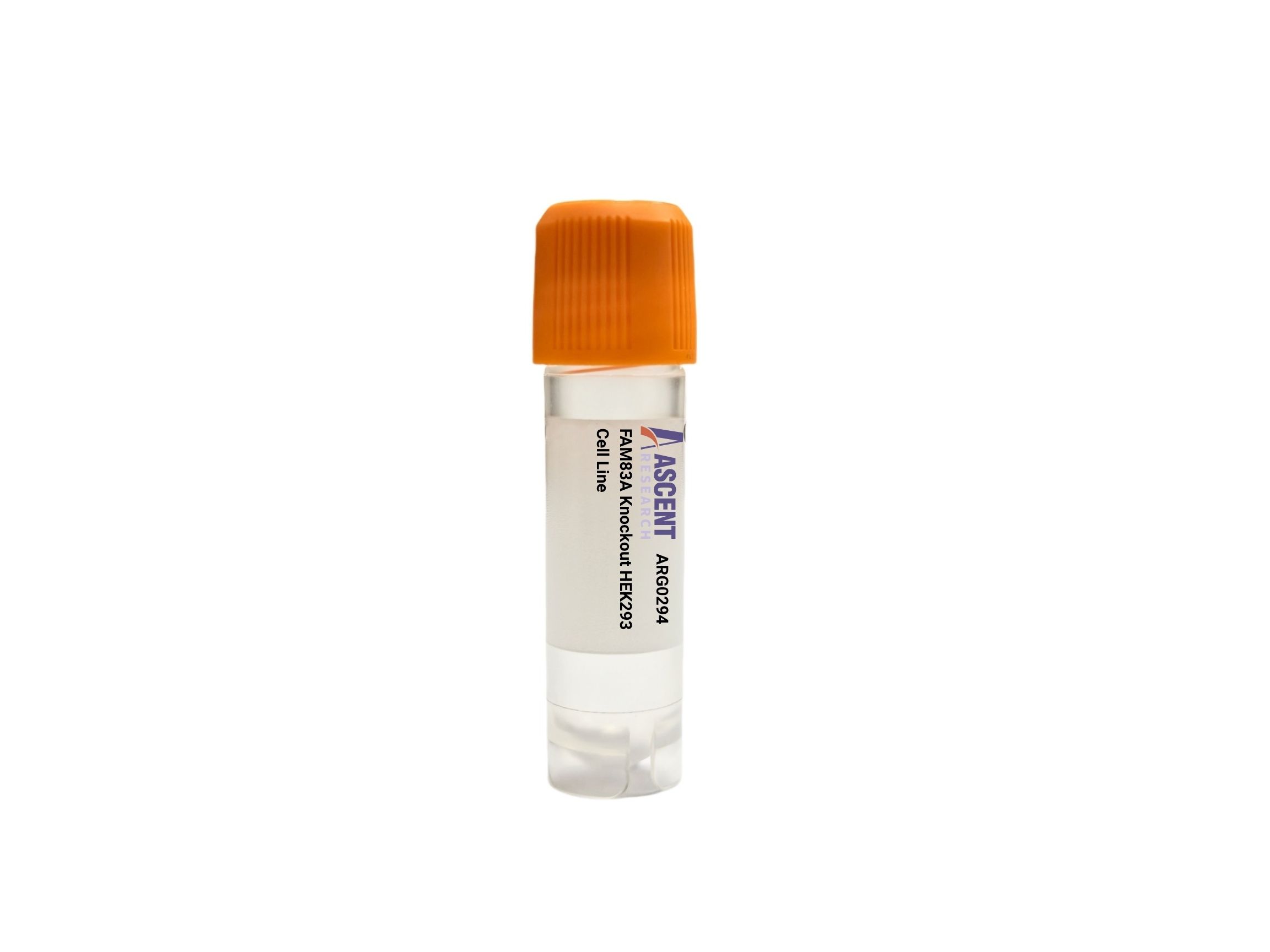
The FAM83A Knockout HEK293 Cell Line is a CRISPR/Cas9-edited knockout cell line in the human embryonic kidney HEK293 background, designed for functional studies of the scaffold protein FAM83A. FAM83A couples growth factor signals by binding EGFR and the PI3K p85 subunit, leading to sustained activation of AKT and MAPK/ERK pathways. This model is particularly relevant to cancer research, as FAM83A is implicated in lung, breast, ovarian, pancreatic, and head and neck malignancies. Typical applications include drug sensitivity profiling, proliferation and migration assays, and biochemical interrogation of EGFR?CPI3K signaling complexes.
 NEK9 Knockout A549 Polyclonal Cells
Cat. No. ARG10746
ARL14EP Knockout NCI-H1975 Polyclonal Cells
Cat. No. ARG31222
IRAK1 Knockout HCT116 Polyclonal Cells
Cat. No. ARG34736
HHLA2 Knockout THP-1 Polyclonal Cells
Cat. No. ARG34560
CALD1 Knockout Raji Polyclonal Cells
Cat. No. ARG41837
NCOA4 Knockout KYSE30 Polyclonal Cells
Cat. No. ARG9654
NEK9 Knockout A549 Polyclonal Cells
Cat. No. ARG10746
ARL14EP Knockout NCI-H1975 Polyclonal Cells
Cat. No. ARG31222
IRAK1 Knockout HCT116 Polyclonal Cells
Cat. No. ARG34736
HHLA2 Knockout THP-1 Polyclonal Cells
Cat. No. ARG34560
CALD1 Knockout Raji Polyclonal Cells
Cat. No. ARG41837
NCOA4 Knockout KYSE30 Polyclonal Cells
Cat. No. ARG9654
The FAM83A Knockout HEK293 Cell Line is a CRISPR/Cas9-edited knockout cell line in which the FAM83A gene has been disrupted to ablate expression of its encoded scaffold protein. This loss-of-function model provides a defined genetic background for investigating FAM83A-dependent signaling events in human cells. It is compatible with diverse functional assays, including proliferation, migration, and drug sensitivity studies, making it a versatile tool for oncogenic pathway analysis.
HEK293 cells are immortalized human embryonic kidney epithelial cells transformed with sheared adenovirus type 5 DNA, leading to constitutive expression of the E1A and E1B viral genes. These cells exhibit an adherent growth pattern and exceptionally high transfection efficiency, rendering them a standard platform for protein expression, protein?Cprotein interaction studies, and signal transduction research. Their epithelial origin and robust cellular machinery make them an appropriate model for studying kidney biology and cancer-related signaling.
FAM83A encodes a scaffold protein that binds EGFR and PI3K p85, stabilizing EGFR and activating downstream pathways. Upstream signals such as EGF or SOX2-driven transcription promote phosphorylation of AKT, mTOR, ERK1/2, and S6K, while interaction with CK1?? enhances Wnt/??-catenin signaling, leading to ??-catenin stabilization and TCF/LEF-dependent transcription of Cyclin D1. This integrative scaffolding function drives cell proliferation, migration, and survival.
In the HEK293 cellular context, FAM83A knockout provides a defined model to dissect its contributions to oncogenic signaling, particularly in cancers of the lung, breast, ovary, pancreas, and head and neck where FAM83A is overexpressed. Loss of FAM83A is anticipated to blunt EGFR-mediated AKT and ERK activation, reduce mTOR/S6K signaling, and impair ??-catenin transcriptional activity. The adherent, epithelial background and high transfection efficiency facilitate rescue experiments and direct comparison with the parental line, making it a powerful tool for functional validation.
Researchers can employ this cell line to explore mechanisms of drug resistance, screen targeted agents against EGFR or downstream kinases, and perform co-immunoprecipitation with PI3K or CK1??. Common assays include western blotting for phosphorylated AKT and ERK, MTT/BrdU proliferation assays, and Transwell migration/invasion readouts. RNA-seq enables transcriptome-wide profiling of FAM83A-dependent changes, while drug sensitivity testing identifies compounds with differential effects on knockout versus wild-type cells. For technical inquiries, please contact Ascent Research.