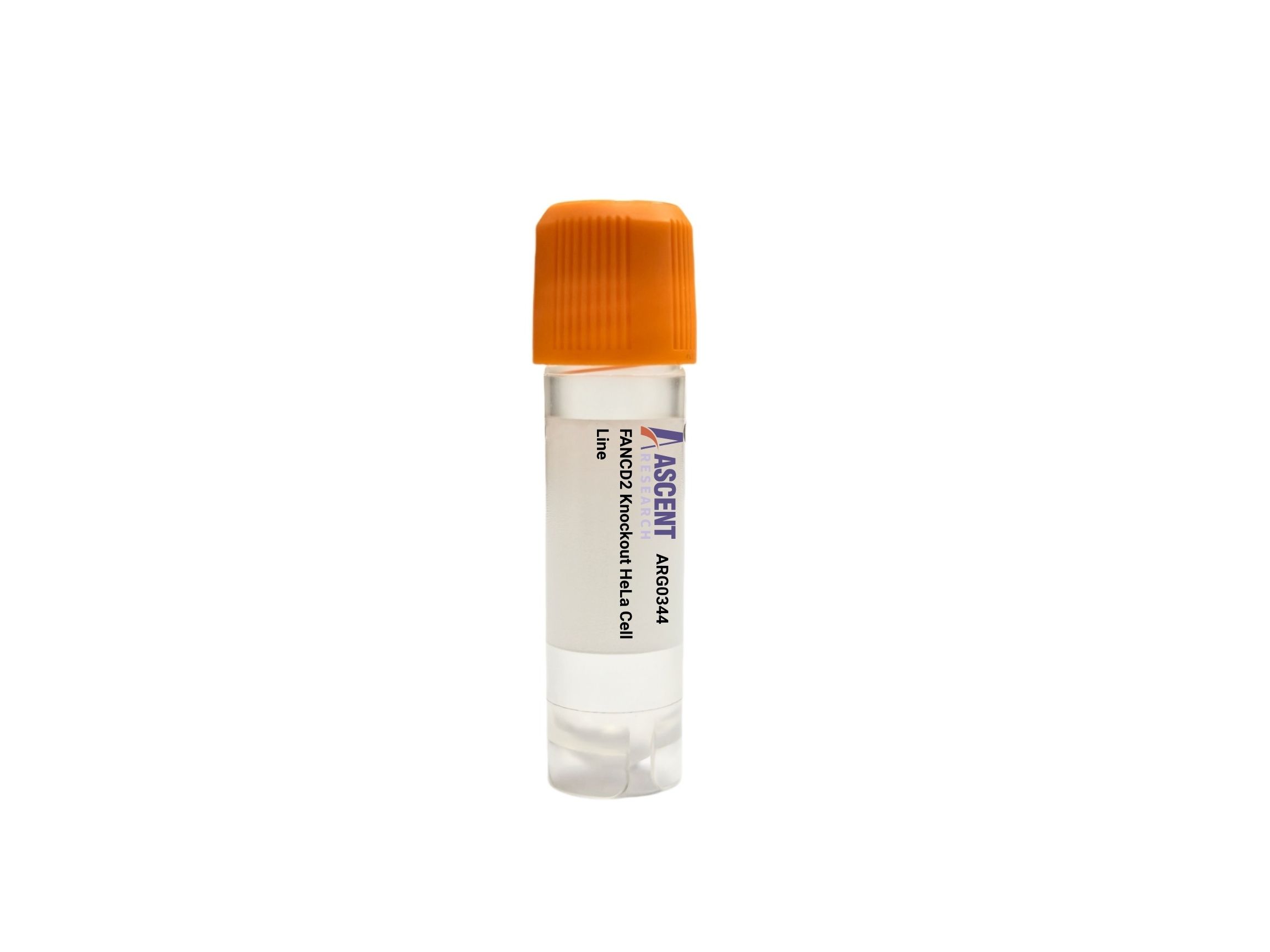
Genome-edited Cells
Uterus (cervix)
The FANCD2 Knockout HeLa Cell Line is a CRISPR/Cas9-edited cell line that ablates FANCD2, a central Fanconi anemia pathway protein mediating DNA interstrand crosslink repair. The model, from HPV18-positive HeLa cervical carcinoma cells with p53 and Rb inactivation, enables dissection of FANCD2-dependent repair and its impact on genome stability. FANCD2 acts downstream of the FA core complex and ATR kinase, undergoing monoubiquitination to recruit BRCA1 and RAD51. Key applications include Western blotting for FANCD2 ubiquitination, immunofluorescence for foci, and clonogenic survival assays with crosslinking agents, supporting DNA repair, cancer biology, and Fanconi anemia studies.
 CAPN1 Knockout 786-O Polyclonal Cells
Cat. No. ARG25157
PAX6 Knockout CAL27 Polyclonal Cells
Cat. No. ARG11656
ANTXR1 Knockout HAP1 Polyclonal Cells
Cat. No. ARG34638
NMNAT1 Knockout HEK293T Polyclonal Cells
Cat. No. ARG3564
CMBL Knockout AGS Polyclonal Cells
Cat. No. ARG2392
CAPN1 Knockout 786-O Polyclonal Cells
Cat. No. ARG25157
PAX6 Knockout CAL27 Polyclonal Cells
Cat. No. ARG11656
ANTXR1 Knockout HAP1 Polyclonal Cells
Cat. No. ARG34638
NMNAT1 Knockout HEK293T Polyclonal Cells
Cat. No. ARG3564
CMBL Knockout AGS Polyclonal Cells
Cat. No. ARG2392
 Sheep Nucleus Pulposus Cells
Cat. No. ARP0960
Sheep Nucleus Pulposus Cells
Cat. No. ARP0960
The FANCD2 Knockout HeLa Cell Line is a CRISPR/Cas9-edited knockout cell line designed for loss-of-function studies of the FANCD2 gene in human cells. This model enables investigation of the Fanconi anemia pathway and DNA interstrand crosslink repair by disrupting the central component encoded by FANCD2. The cell line is generated using CRISPR/Cas9-mediated gene disruption, providing a valuable tool for studying genome stability and cellular responses to DNA damage.
The parental HeLa cell line is an immortalized epithelial cell line derived from cervical carcinoma, widely used as a model system in cancer and molecular biology research. HeLa cells are HPV18-positive, leading to inactivation of the tumor suppressors p53 and Rb, which contributes to their transformed phenotype and high proliferative capacity. This genetic background makes HeLa cells particularly suitable for examining DNA repair pathways in a cancer-relevant context, as deficiencies in cell cycle checkpoints can influence repair outcomes.
FANCD2 encodes a pivotal protein in the Fanconi anemia pathway, which orchestrates repair of DNA interstrand crosslinks. Upon crosslink induction, the FA core complex??comprising FANCA, FANCB, FANCC, FANCE, FANCF, FANCG, and FANCL??monoubiquitinates FANCD2 at lysine 561 in an ATR-dependent manner. Monoubiquitinated FANCD2 localizes to chromatin and interacts with FANCI, forming a heterodimer that recruits downstream effectors such as BRCA1, BRCA2 (FANCD1), SLX4 (FANCP), and RAD51 to promote homologous recombination and precise lesion repair. Deubiquitination by USP1 regulates FANCD2 turnover, ensuring proper pathway dynamics. Loss of FANCD2 disrupts this signaling cascade, compromising interstrand crosslink repair and leading to genomic instability.
In the HeLa background, FANCD2 knockout accentuates the intrinsic DNA repair defects associated with p53 and Rb inactivation, creating a powerful system for dissecting tumor-specific vulnerabilities. The model facilitates exploration of how Fanconi anemia pathway dysfunction cooperates with oncogenic drivers to promote cancer development. Moreover, because HeLa cells are widely used in drug response studies, this knockout line enables precise assessment of chemosensitivity to crosslinking agents such as mitomycin C and cisplatin, linking FANCD2 status to therapeutic outcomes.
This cell line is ideally suited for a range of advanced research applications, including Western blotting to monitor FANCD2 monoubiquitination, immunofluorescence to visualize FANCD2 nuclear foci, and clonogenic survival assays to quantify sensitivity to DNA crosslinkers. Additional uses include cell cycle profiling, chromatin fractionation to examine DNA repair complex assembly, and DNA repair reporter assays to measure homologous recombination efficiency. These assays provide a comprehensive platform for investigating Fanconi anemia pathway biology and evaluating novel therapeutic strategies in DNA repair-deficient cancers. For further inquiries, please contact Ascent Research.