Genome-edited Cells
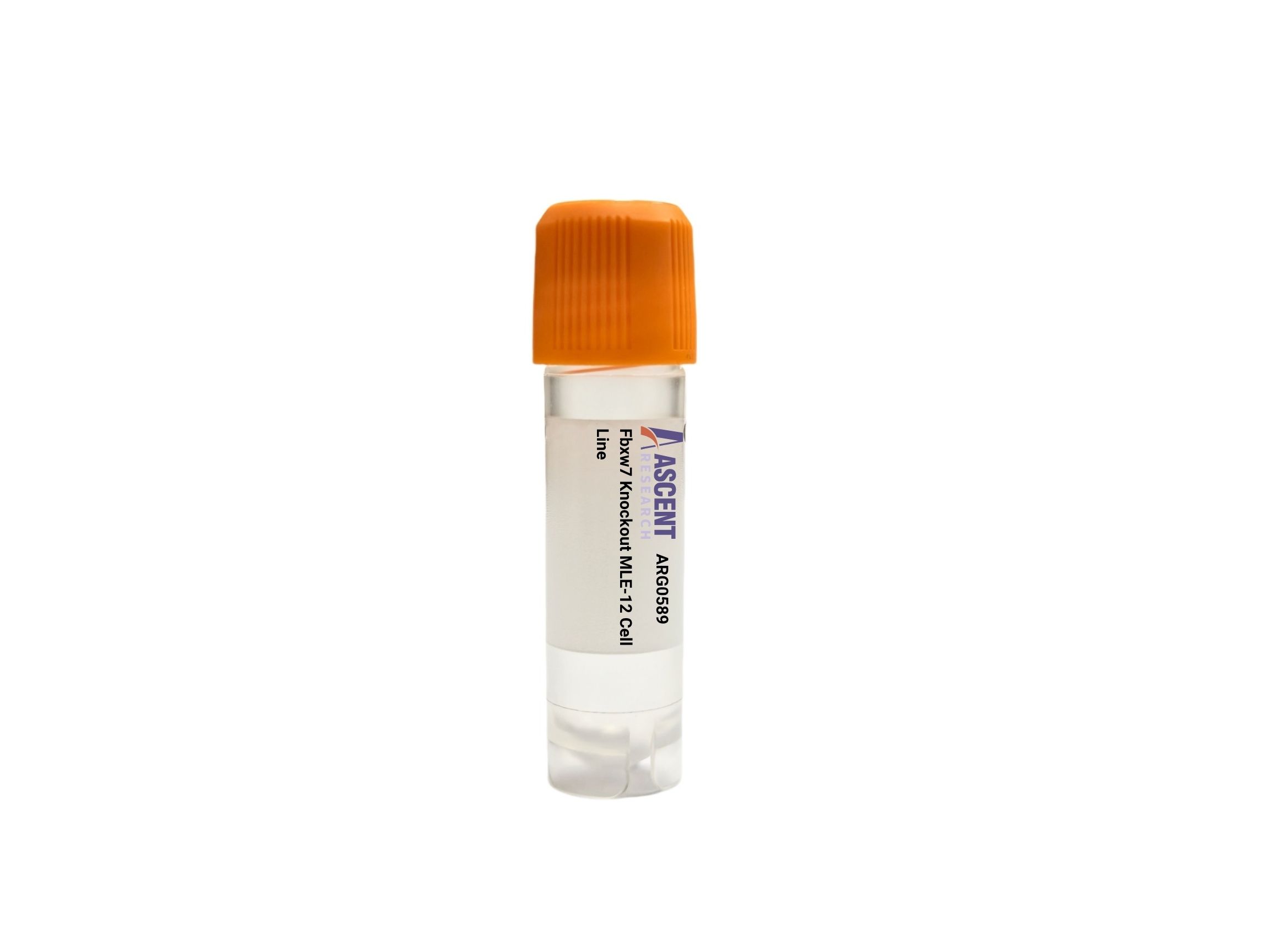
The Fbxw7 Knockout MLE-12 Cell Line is a CRISPR/Cas9-edited knockout cell line derived from mouse lung alveolar type II epithelial cells. Fbxw7 disruption ablates the substrate recognition function of the SCF E3 ligase, leading to stabilization of key oncoproteins such as c-Myc, cyclin E, and Notch1. This model is essential for dissecting tumor suppression mechanisms and signaling pathways in alveolar epithelium, supporting applications in cancer biology, cell cycle regulation, apoptosis, and lung repair. Researchers can employ Western blot, flow cytometry, and proliferation assays to characterize the functional consequences of Fbxw7 loss.
 PDGFRB Knockout Jurkat Polyclonal Cells
Cat. No. ARG13498
HCLS1 Knockout A549 Polyclonal Cells
Cat. No. ARG33625
BLMH Knockout jurkat Polyclonal Cells
Cat. No. ARG34012
MMP13 Knockout CaSki Polyclonal Cells
Cat. No. ARG9836
COBL Knockout Raji Polyclonal Cells
Cat. No. ARG1779
PDGFRB Knockout Jurkat Polyclonal Cells
Cat. No. ARG13498
HCLS1 Knockout A549 Polyclonal Cells
Cat. No. ARG33625
BLMH Knockout jurkat Polyclonal Cells
Cat. No. ARG34012
MMP13 Knockout CaSki Polyclonal Cells
Cat. No. ARG9836
COBL Knockout Raji Polyclonal Cells
Cat. No. ARG1779
 HKDC1 Knockout HGC-27 Cell Line
Cat. No. ARG0407
HKDC1 Knockout HGC-27 Cell Line
Cat. No. ARG0407
The Fbxw7 Knockout MLE-12 Cell Line is a CRISPR/Cas9-edited knockout cell line designed to disrupt the Fbxw7 gene in the immortalized mouse lung alveolar type II epithelial cell line MLE-12. This targeted gene disruption ablates the substrate recognition function of the SCF^Fbxw7 E3 ubiquitin ligase complex, providing a stable loss-of-function model for investigating tumor suppression and epithelial homeostasis.
The MLE-12 parental line was derived from SP-C/SV40 large T antigen transgenic mice and retains key features of alveolar type II pneumocytes, including surfactant protein expression and responsiveness to physiological cues. Widely used to study alveolar epithelial cell function, lung repair, and fibrosis, MLE-12 offers a genetically stable platform for probing gene function in pulmonary biology.
Fbxw7 serves as the substrate recognition subunit of the SCF ubiquitin ligase complex (comprising SKP1, CUL1, RBX1) and targets oncoproteins such as c-Myc, cyclin E, Notch1, c-Jun, Mcl-1, and mTOR for proteasomal degradation. Its activity is regulated by GSK3??-mediated phosphorylation and transcriptional control by p53 and C/EBP??, while post-transcriptional repression by miR-27a and miR-223 tunes expression. By degrading these critical factors, Fbxw7 negatively regulates cell cycle progression, apoptosis, and stem cell maintenance, directly impacting Notch, mTOR, Wnt/??-catenin, and Hippo pathways.
In MLE-12 cells, Fbxw7 knockout leads to stabilization of c-Myc, cyclin E, and Notch1, driving unchecked proliferation and survival. Accumulation of mTOR and HIF-1?? may further promote metabolic reprogramming and stress adaptation, mirroring oncogenic events in lung adenocarcinoma and squamous cell carcinoma. This model enables mechanistic dissection of substrate-specific contributions to alveolar epithelial transformation and holds potential for testing interventions that target SCF^Fbxw7-regulated pathways or restore Fbxw7 function.
This knockout cell line is suited for a variety of assays, including Western blot and RT-qPCR to measure substrate levels, proliferation assays (MTT, EdU), and flow cytometry for cell cycle and apoptosis. Immunofluorescence and co-immunoprecipitation facilitate subcellular localization and ubiquitination studies, while colony formation, migration/invasion, and RNA-seq provide functional and transcriptome-wide insights. Researchers investigating lung cancer, repair, or drug resistance can leverage this model to identify novel dependencies and evaluate therapeutic candidates. For additional information, please contact Ascent Research.