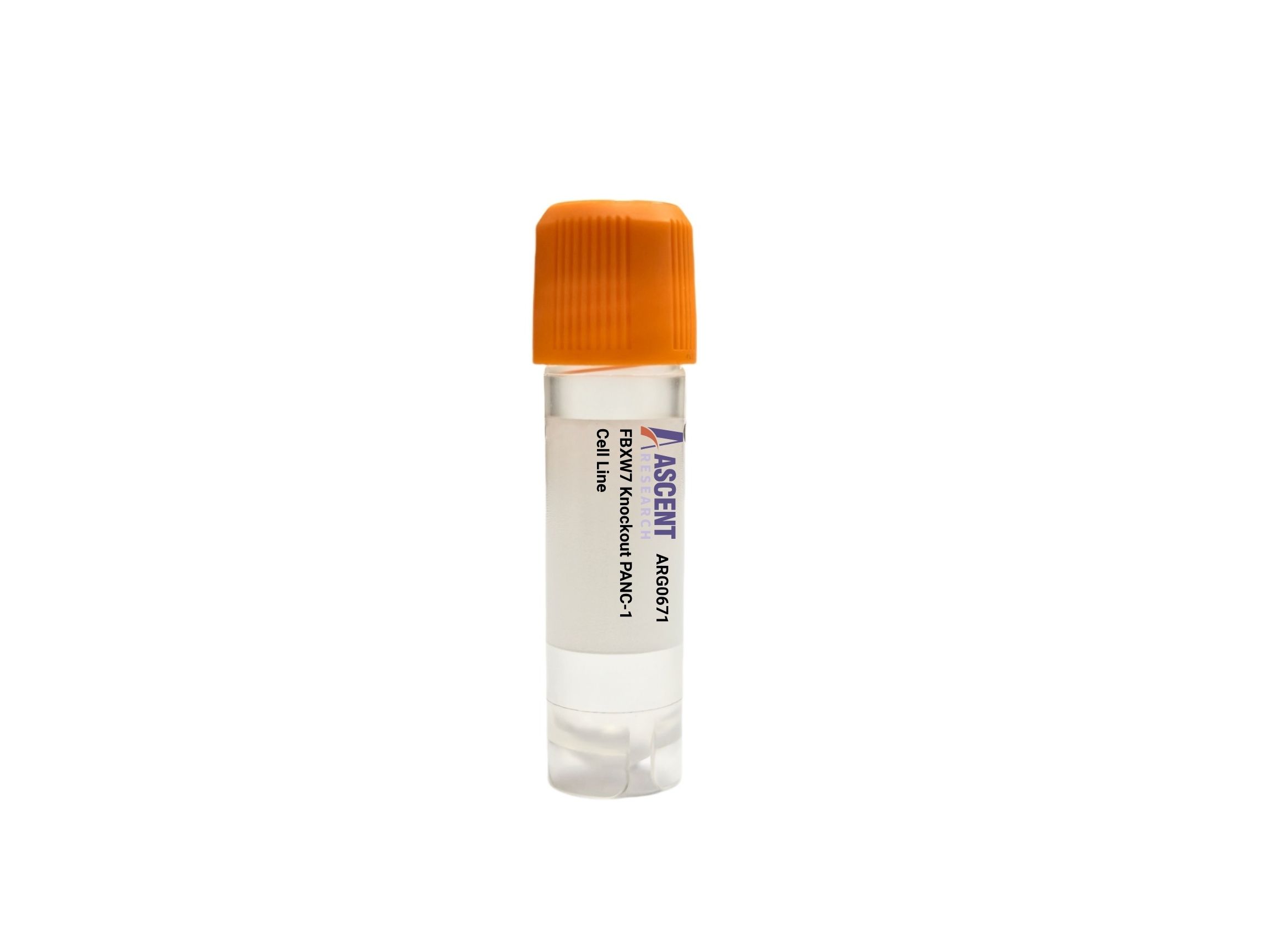
Genome-edited Cells
Pancreas
The FBXW7 Knockout PANC-1 Cell Line is a CRISPR/Cas9-edited knockout cell line derived from the human PANC-1 pancreatic ductal adenocarcinoma cell line, which carries KRAS and TP53 mutations. This model enables loss-of-function studies of the tumor suppressor FBXW7, a substrate recognition subunit of the SCF E3 ubiquitin ligase that targets oncoproteins, including cyclin E and c-Myc, for proteasomal degradation. The cell line is ideal for investigation of FBXW7-mediated regulation of Notch, mTOR, and Wnt signaling, as well as for research into drug resistance, ubiquitin-proteasome system dynamics, and pancreatic cancer modeling. Common assays include western blotting, proliferation and apoptosis analyses, migration/invasion tests, and xenograft tumor growth monitoring.
 FAR1 Knockout NCI-H1975 Polyclonal Cells
Cat. No. ARG16379
PACSIN3 Knockout Hela Polyclonal Cells
Cat. No. ARG8027
IKZF5 Knockout Raji Polyclonal Cells
Cat. No. ARG23787
IGF1R Knockout 143B Polyclonal Cells
Cat. No. ARG35058
NRAS Knockout CAL27 Polyclonal Cells
Cat. No. ARG11482
FAR1 Knockout NCI-H1975 Polyclonal Cells
Cat. No. ARG16379
PACSIN3 Knockout Hela Polyclonal Cells
Cat. No. ARG8027
IKZF5 Knockout Raji Polyclonal Cells
Cat. No. ARG23787
IGF1R Knockout 143B Polyclonal Cells
Cat. No. ARG35058
NRAS Knockout CAL27 Polyclonal Cells
Cat. No. ARG11482
 T24 Stable GFP Cell Line
Cat. No. ARG0781
T24 Stable GFP Cell Line
Cat. No. ARG0781
The FBXW7 Knockout PANC-1 Cell Line is a genetically engineered human pancreatic cancer model produced by CRISPR/Cas9-mediated disruption of the FBXW7 gene in the PANC-1 cell line. This knockout cell line provides a functional loss-of-expression system for studying the tumor-suppressive role of FBXW7 in pancreatic ductal adenocarcinoma. It is suitable for both in vitro and in vivo investigations, enabling researchers to dissect FBXW7-dependent signaling pathways in a well-characterized genetic background. The product is supplied as a live cell line ready for expansion and validation in a variety of downstream applications.
The parental PANC-1 cell line was derived from a human pancreatic epithelioid carcinoma and is widely utilized as a model for pancreatic cancer research. It harbors oncogenic mutations in KRAS and the tumor suppressor TP53, reflecting common genetic alterations found in pancreatic tumors. PANC-1 cells display aggressive growth characteristics, including rapid proliferation, invasive capacity, and tumorigenicity in immunocompromised mice, making them a robust platform for evaluating the impact of additional tumor suppressor loss such as FBXW7 knockout.
FBXW7 functions as the substrate recognition component of the SCF (SKP1-CUL1-F-box) E3 ubiquitin ligase complex. It directly interacts with SKP1, CUL1, and RBX1 to recruit phosphorylated substrates for ubiquitination and subsequent 26S proteasomal degradation. Transcriptionally regulated by upstream factors including TP53, miR-27a, and miR-223, FBXW7 targets key oncoproteins for destruction, such as cyclin E, c-Myc, Notch1 intracellular domain (ICD), c-Jun, mTOR, and MCL1. Through control of these substrates, FBXW7 acts as a critical hub that simultaneously modulates Notch, mTOR, cell cycle, and Wnt signaling pathways.
In the PANC-1 context, where KRAS is constitutively active and TP53 is deficient, ablation of FBXW7 further stabilizes its oncogenic substrates, leading to enhanced proliferative and survival signaling. The resulting accumulation of cyclin E and c-Myc promotes unchecked cell cycle progression and may contribute to resistance to apoptosis. As TP53 normally transactivates FBXW7 expression, the combined loss of TP53 and FBXW7 creates a highly relevant model for aggressive pancreatic cancer phenotypes and for testing therapeutic strategies that target these dysregulated networks.
This cell line supports a broad spectrum of research applications, including mechanistic studies of the ubiquitin-proteasome system, identification and validation of novel FBXW7 substrates, and investigation of drug resistance mechanisms. It is particularly valuable for characterizing how FBXW7 deficiency alters sensitivity to chemotherapeutics or targeted agents such as mTOR inhibitors and proteasome inhibitors. Representative assays performed with this model include western blotting for FBXW7 and its substrates, RT-qPCR, proliferation and apoptosis assays, migration and invasion tests, colony formation, in vivo xenograft tumor growth, and proteasome activity measurements. For additional information, validation data, or technical support, please contact Ascent Research.