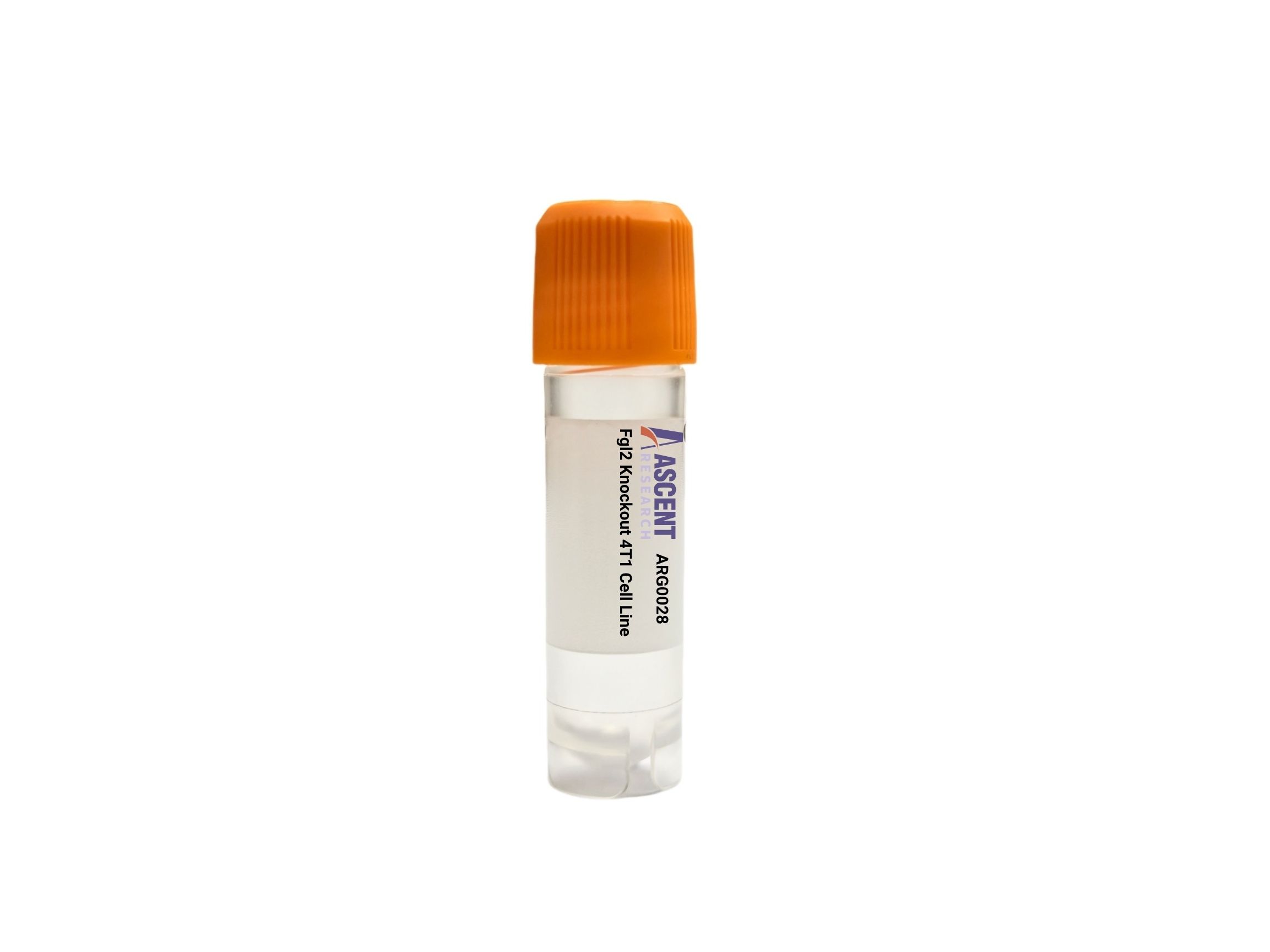
Genome-edited Cells
Breast (mammary gland)
Fgl2 Knockout 4T1 is a CRISPR/Cas9-engineered mouse mammary carcinoma cell line generated in the metastatic 4T1 triple-negative breast cancer background. FGL2 is an immune-coagulation regulator controlled by inflammatory pathways including TNF-alpha/NF-kappaB and IFN-gamma/JAK-STAT1, and it promotes prothrombin (F2) to thrombin conversion while modulating dendritic cell and T-cell responses. This knockout model supports studies of tumor immune evasion, breast cancer metastasis, cytokine signaling, and coagulation-associated cancer biology using assays such as RT-qPCR, western blotting, ELISA, flow cytometry, RNA-seq, immune co-culture, and syngeneic tumor implantation.
 MEIS1 Knockout K562 Polyclonal Cells
Cat. No. ARG19362
CLN3 Knockout SK-HEP-1 Polyclonal Cells
Cat. No. ARG15188
CTSL Knockout HT29 Polyclonal Cells
Cat. No. ARG14500
CUEDC1 Knockout HT29 Polyclonal Cells
Cat. No. ARG13982
LRRC41 Knockout A549 Polyclonal Cells
Cat. No. ARG10624
IL1B Knockout CaSki Polyclonal Cells
Cat. No. ARG35483
MEIS1 Knockout K562 Polyclonal Cells
Cat. No. ARG19362
CLN3 Knockout SK-HEP-1 Polyclonal Cells
Cat. No. ARG15188
CTSL Knockout HT29 Polyclonal Cells
Cat. No. ARG14500
CUEDC1 Knockout HT29 Polyclonal Cells
Cat. No. ARG13982
LRRC41 Knockout A549 Polyclonal Cells
Cat. No. ARG10624
IL1B Knockout CaSki Polyclonal Cells
Cat. No. ARG35483
The Fgl2 Knockout 4T1 Cell Line is a CRISPR/Cas9-engineered mouse mammary carcinoma model in which the Fgl2 gene has been disrupted to abrogate functional FGL2 expression. This stable knockout line provides an in vitro system for interrogating the contribution of FGL2 to tumor-cell intrinsic and tumor?Cmicroenvironment-associated processes. Because the parental 4T1 background is highly relevant to metastatic breast cancer research, this model is particularly useful for studies examining how loss of an immune-coagulation regulator reshapes inflammatory signaling, immune interaction, and cancer-associated hemostatic mechanisms.
4T1 is a murine mammary tumor cell line derived from BALB/c mouse mammary carcinoma and is widely used as a syngeneic model of aggressive triple-negative breast cancer. The line is notable for rapid growth, invasive behavior, and strong metastatic potential, making it valuable for investigating tumor progression, dissemination, and host immune responses in immunocompetent settings. As a tumor epithelial model, 4T1 is frequently used to study tumor-immune crosstalk, inflammatory cytokine signaling, and metastatic phenotypes relevant to breast cancer biology.
FGL2 functions at the intersection of coagulation and immune regulation. In its membrane-associated form, FGL2 acts as a prothrombinase that promotes conversion of prothrombin (F2) to thrombin, thereby contributing to fibrin formation involving fibrinogen chains FGA, FGB, and FGG. In its secreted form, FGL2 exerts immunomodulatory effects, including suppression of adaptive immune responses through interactions affecting dendritic cells, T cells, macrophages, and Fc gamma RIIB-associated pathways. Fgl2 expression is regulated by inflammatory inputs including TNF-alpha, IFN-gamma, IL-2, NF-kappaB, STAT1, and MAPK signaling, placing it downstream of cytokine-responsive networks that include TNF, IFNG, NFKB1, RELA, JAK1, JAK2, and STAT1. Through these relationships, FGL2 is mechanistically linked to innate immune regulation, inflammatory responses, apoptosis-associated programs, tumor immune evasion, and coagulation-related disease biology.
Within the 4T1 host context, Fgl2 knockout enables direct analysis of how a coagulation-linked immunoregulatory factor influences aggressive breast cancer phenotypes. This model is relevant for evaluating changes in inflammatory gene expression, cytokine responsiveness, tumor-associated immunosuppressive mechanisms, and phenotypes associated with metastatic progression. It may also support studies of pathway dependency downstream of TNF-alpha or IFN-gamma stimulation and help define how FGL2 loss alters communication between tumor cells and immune effector populations.
Applications include RT-qPCR, western blotting, ELISA, and RNA-seq to profile transcriptional and secreted inflammatory programs; flow cytometry and immunofluorescence to assess cell-surface and phenotypic changes; thrombin generation assays to examine coagulation-associated outputs; and migration, invasion, or apoptosis assays to evaluate functional consequences of Fgl2 disruption. The line is also suitable for co-culture experiments with T cells or macrophages, cytokine profiling under TNF-alpha or IFN-gamma stimulation, drug sensitivity studies, and in vivo syngeneic tumor implantation workflows designed to investigate tumor immunology and metastatic breast cancer. Researchers may contact Ascent Research for additional technical information, product details, or related gene-edited cell models.