Genome-edited Cells
Blood (peripheral blood)
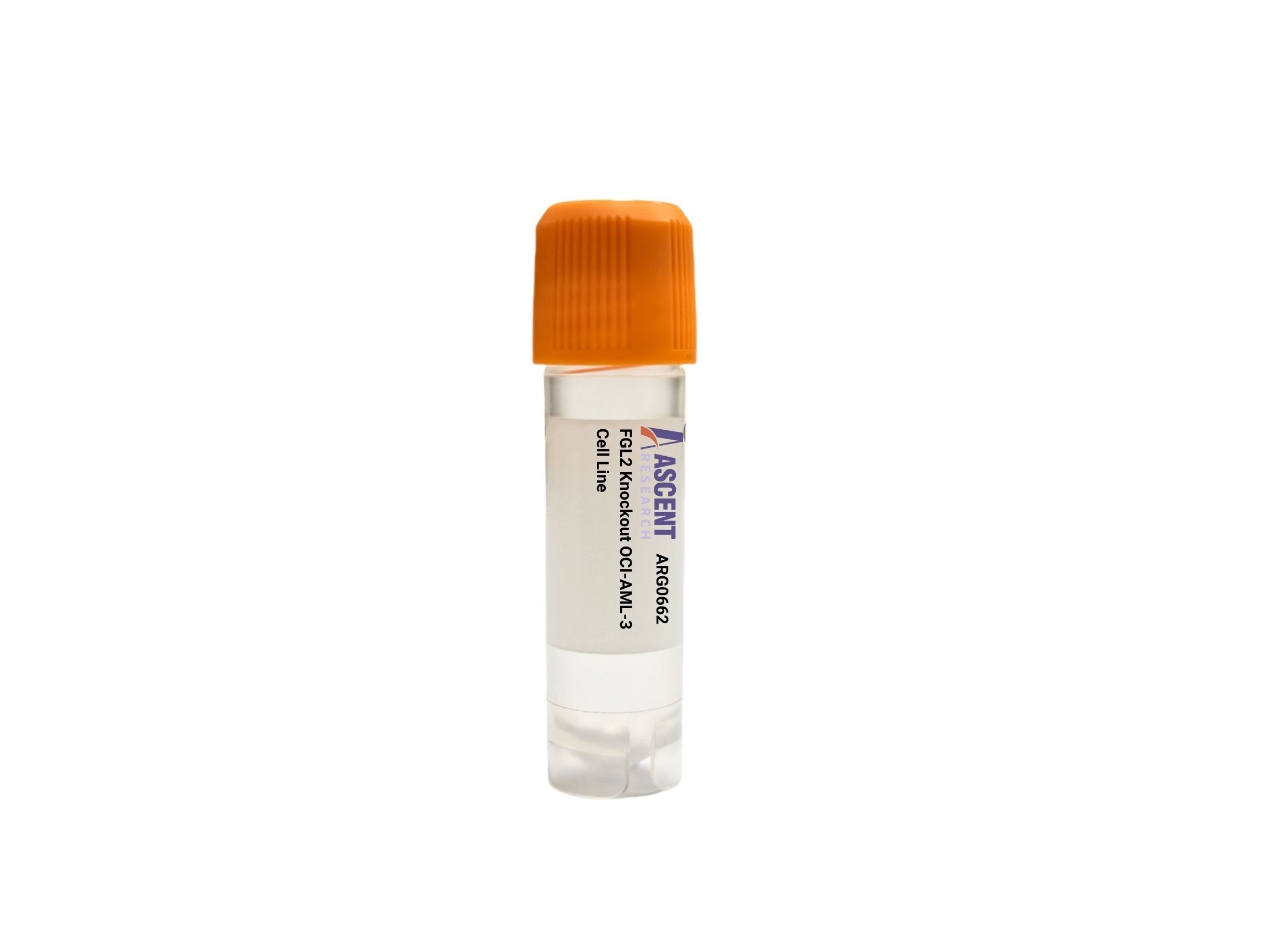
The FGL2 Knockout OCI-AML-3 Cell Line is a CRISPR/Cas9-mediated gene disruption model in the human AML cell line OCI-AML-3. FGL2 encodes a secreted immunomodulatory protein that acts as an immune checkpoint by binding Fc??RIIB, thereby suppressing T cell activation via PTPN11/SHP-2 and promoting Treg differentiation. Its expression is upregulated by IFN-?? and TNF-?? through STAT1 and NF-??B, and it promotes thrombin generation and immunosuppressive cytokines such as IL-10 and TGF-??. This knockout cell line enables studies on immune evasion in leukemia, T cell?Ctumor cell crosstalk, and coagulation-related pathophysiology. Key applications include co-culture T cell proliferation assays, FoxP3+ Treg flow cytometry, cytokine ELISA, and drug sensitivity screening, supported by Western blot and RT-qPCR validation.
The FGL2 Knockout OCI-AML-3 Cell Line is a genetically engineered human acute myeloid leukemia (AML) cell model in which CRISPR/Cas9-mediated gene disruption has been employed to eliminate expression of the FGL2 gene. This cell line serves as a defined loss-of-function system for studying the immunomodulatory and procoagulant functions of FGL2 within the context of AML biology. The product is supplied as a live cell line, ready for expansion and downstream experimental use.
The parental OCI-AML-3 cell line was originally derived from a patient diagnosed with acute myeloid leukemia of the FAB M4 subtype and harbors recurrent genetic alterations characteristic of AML. OCI-AML-3 is widely utilized as a model system to investigate leukemic cell behavior, including proliferation, differentiation, and drug sensitivity, as well as to recapitulate critical aspects of leukemogenesis in vitro and in xenograft settings. The cell line??s established genetic background provides a reliable platform for interrogating gene function through targeted knockout strategies.
FGL2 (fibrinogen-like protein 2) encodes a secreted protein that functions as a bifunctional immune checkpoint and coagulation regulator. Transcriptionally activated by IFN-??, TNF-??, and IL-2 through STAT1, NF-??B, and IRF1 signaling pathways, FGL2 is released into the extracellular milieu where it engages Fc??RIIB on effector immune cells, triggering inhibitory signaling via PTPN11/SHP-2. This interaction suppresses T cell receptor signaling, inhibits T cell proliferation, and promotes the differentiation of regulatory T cells (Tregs), in part through the downstream induction of immunosuppressive cytokines such as IL-10 and TGF-??. FGL2 also promotes thrombin generation, linking immune regulation to coagulation. Interacting partners include T cell glycans, CD44, and integrins.
In the AML microenvironment, FGL2 overexpression has been implicated in the establishment of an immunosuppressive niche that allows leukemic blasts to evade host T cell-mediated immune surveillance. By disrupting FGL2 expression in the OCI-AML-3 background, researchers can systematically dissect how loss of this checkpoint alters immune cell crosstalk, Treg polarization, and the cytokine milieu. This knockout cell line thus provides a tractable tool to evaluate the contribution of FGL2 to leukemia progression and to test strategies aimed at restoring anti-leukemic immunity.
The FGL2 Knockout OCI-AML-3 Cell Line is suitable for a variety of research applications, including co-culture experiments with primary T cells to quantitatively assess T cell proliferation and FoxP3+ Treg induction via flow cytometry, cytokine profiling using ELISA for IL-10 and TGF-??, and thrombin generation assays to examine coagulation-related pathophysiology. The cell line can also be employed in drug sensitivity screens to determine whether FGL2 loss alters responses to immunomodulatory agents or conventional chemotherapeutics. Standard validation assays such as Western blotting and RT-qPCR are recommended to confirm FGL2 protein and mRNA ablation. For further details and technical support, please contact Ascent Research.