Genome-edited Cells
Pancreas
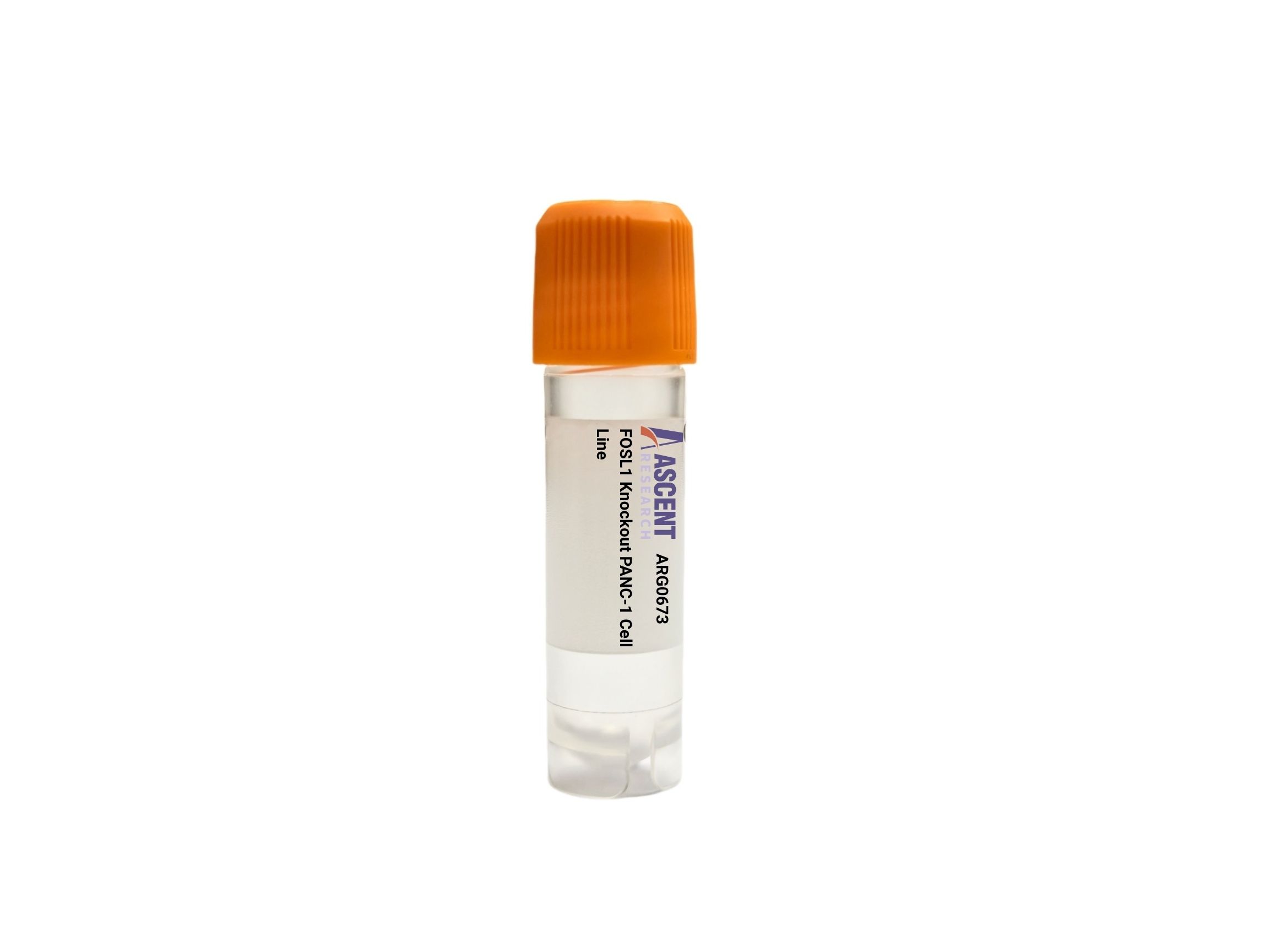
FOSL1 Knockout PANC-1 Cell Line is a CRISPR/Cas9-edited knockout cell line that disrupts the AP-1 transcription factor subunit FOSL1 in the human pancreatic ductal adenocarcinoma cell line PANC-1. This loss-of-function model enables investigation of FOSL1 signaling downstream of oncogenic KRAS/MAPK activity and its role in cancer cell proliferation, invasion, and chemoresistance. Key transcriptional targets ablated include MMP1 and VEGFA. Ideal for functional studies of AP-1 pathway biology in pancreatic cancer, this knockout line supports drug target validation, migration/invasion assays, and transcriptomic profiling. It offers a defined genetic background for dissecting FOSL1?dependent mechanisms in a clinically relevant model of PDAC.
 C8orf33 Knockout NCI-H1975 Polyclonal Cells
Cat. No. ARG31419
AMDHD2 Knockout jurkat Polyclonal Cells
Cat. No. ARG33811
PDIA6 Knockout HEK293T Polyclonal Cells
Cat. No. ARG4007
CTSB Knockout AGS Polyclonal Cells
Cat. No. ARG2382
C8orf33 Knockout NCI-H1975 Polyclonal Cells
Cat. No. ARG31419
AMDHD2 Knockout jurkat Polyclonal Cells
Cat. No. ARG33811
PDIA6 Knockout HEK293T Polyclonal Cells
Cat. No. ARG4007
CTSB Knockout AGS Polyclonal Cells
Cat. No. ARG2382
 Rat Ovarian Granulosa Cell Medium
Cat. No. ARM0288
Rat Ovarian Granulosa Cell Medium
Cat. No. ARM0288
 Hs 611.T
Cat. No. ARC0313
Hs 611.T
Cat. No. ARC0313
The FOSL1 Knockout PANC-1 Cell Line is a CRISPR/Cas9-edited knockout cell line providing stable disruption of the FOSL1 gene in a human pancreatic ductal adenocarcinoma background. This loss-of-function model eliminates expression of the full-length FOSL1 protein, a core component of the AP-1 transcription factor complex. Generated by CRISPR/Cas9-mediated gene targeting, the cell line offers a homogeneous population for dissecting FOSL1-dependent mechanisms in cancer biology.
The parental PANC-1 cell line is derived from a human pancreatic ductal adenocarcinoma and carries oncogenic KRAS and TP53 mutations, representing key drivers of pancreatic cancer progression. PANC-1 is widely used as an in vitro model for studying pancreatic tumor biology, including uncontrolled proliferation, epithelial-to-mesenchymal transition, and chemoresistance. This well-characterized line provides a clinically relevant context for studying FOSL1 function in the setting of constitutive KRAS/MAPK signaling and p53 deficiency.
FOSL1 encodes a transcription factor subunit that, upon phosphorylation by MAPK/ERK or JNK cascades, heterodimerizes with JUN family proteins (c-Jun, JunB, JunD) and with ATF2 or SMAD3 to form active AP-1 complexes. These complexes bind TRE elements in target gene promoters, modulating transcription downstream of stimuli such as EGF, TGF-??1, TNF-??, and HIF1A. Key transcriptional targets include MMP1 and MMP9 for matrix remodeling, VEGFA for angiogenesis, IL8 for inflammation, CCND1 for cell cycle progression, and CDKN1A for survival. Thus, FOSL1 integrates signals from the MAPK/ERK, TGF-??/SMAD, and Wnt/??-catenin pathways to drive invasion and metastasis.
In PANC-1 cells, oncogenic KRAS drives hyperactivity of the MEK?CERK1/2 axis, leading to sustained FOSL1 activation that cooperates with mutant p53 to promote aggressive tumor phenotypes. Consequently, FOSL1 knockout is expected to impair anchorage-independent growth, cellular motility, and resistance to gemcitabine. Disruption of FOSL1 in this genetic background provides a system to dissect AP-1 contributions to pancreatic cancer maintenance and to uncover compensatory networks for potential co-targeting.
This knockout cell line is suited for functional studies of FOSL1 in proliferation, migration, and invasion, and for investigating AP-1-mediated chemoresistance. Applications include drug target validation, CRISPR-based screens, and transcriptomic analyses (RNA-seq) to map FOSL1-dependent gene networks. Downstream effects can be assessed by Western blotting for FOSL1 and targets (MMP1, VEGFA), RT-qPCR for AP-1 targets, Transwell migration/invasion assays, cell proliferation assays, and drug sensitivity profiling. ChIP-qPCR permits mapping of FOSL1 promoter occupancy, and luciferase reporter assays quantify AP-1 activity. For further technical information, contact Ascent Research.