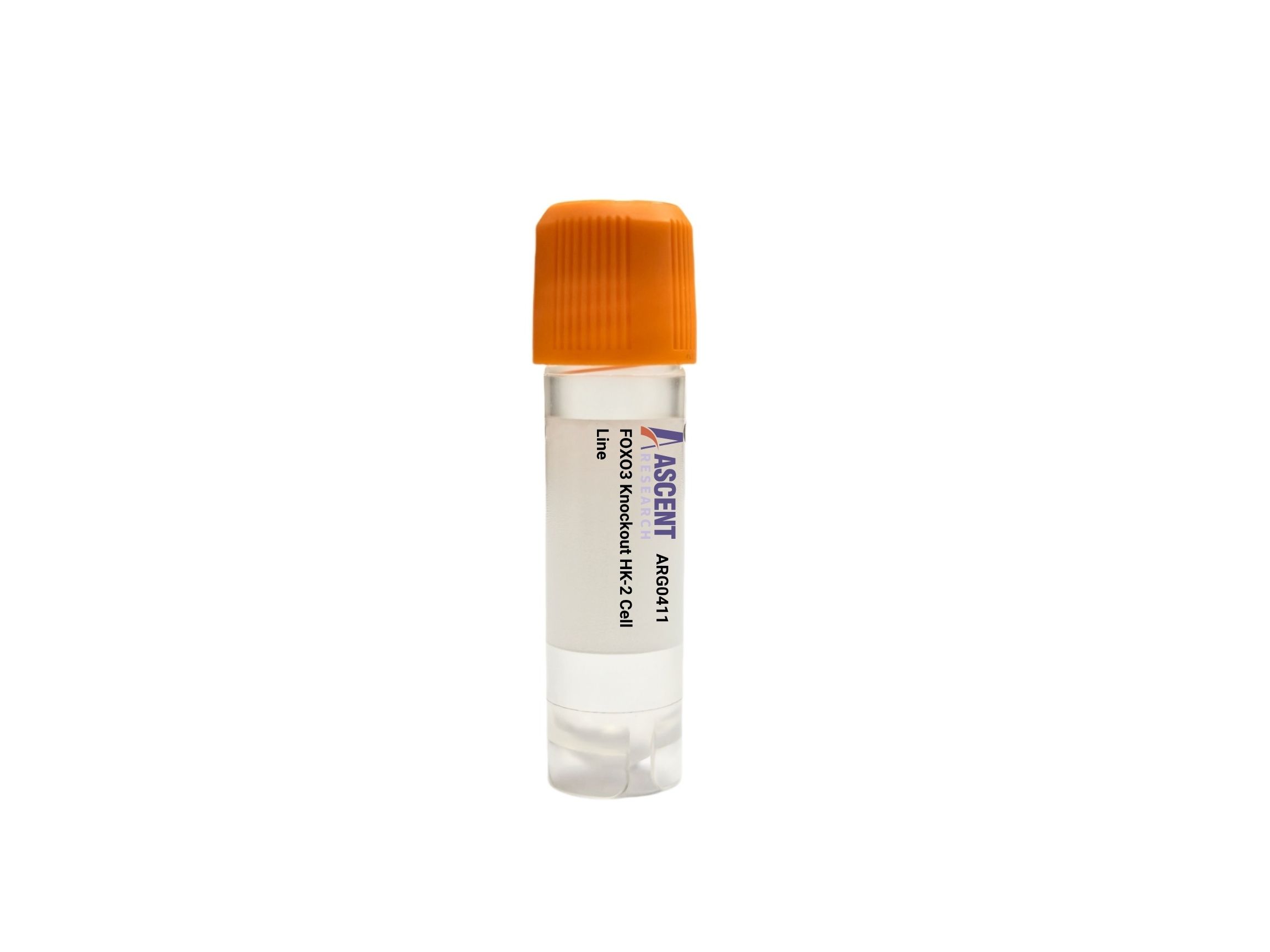
Genome-edited Cells
Kidney
The FOXO3 Knockout HK-2 Cell Line is a CRISPR/Cas9-edited human proximal tubule epithelial cell line lacking functional FOXO3 transcription factor. Derived from the HK-2 cell line, this model enables investigation of FOXO3-dependent processes such as apoptosis, oxidative stress response, and cell cycle regulation in a kidney-relevant context. FOXO3 links PI3K/Akt signaling to transcriptional control of targets like BIM and p27Kip1. Applications include nephrotoxicity screening, diabetic nephropathy studies, and AKI-to-CKD transition research. Suitable assays encompass western blotting, reactive oxygen species detection, and apoptosis analysis, providing a robust tool for renal biology and drug discovery.
 LRP11 Knockout HT29 Polyclonal Cells
Cat. No. ARG14639
EML2 Knockout jurkat Polyclonal Cells
Cat. No. ARG13400
NMNAT2 Knockout T47D Polyclonal Cells
Cat. No. ARG11977
NPTX1 Knockout Hela Polyclonal Cells
Cat. No. ARG7901
HSPB8 Knockout A2780 Polyclonal Cells
Cat. No. ARG29163
IL1R1 Knockout T47D Polyclonal Cells
Cat. No. ARG36808
LRP11 Knockout HT29 Polyclonal Cells
Cat. No. ARG14639
EML2 Knockout jurkat Polyclonal Cells
Cat. No. ARG13400
NMNAT2 Knockout T47D Polyclonal Cells
Cat. No. ARG11977
NPTX1 Knockout Hela Polyclonal Cells
Cat. No. ARG7901
HSPB8 Knockout A2780 Polyclonal Cells
Cat. No. ARG29163
IL1R1 Knockout T47D Polyclonal Cells
Cat. No. ARG36808
The FOXO3 Knockout HK-2 Cell Line is a CRISPR/Cas9-edited knockout cell line derived from the immortalized human proximal tubule epithelial cell line HK-2. This product features disruption of the FOXO3 gene via CRISPR/Cas9-mediated gene targeting, eliminating functional FOXO3 transcription factor expression. It provides a stable loss-of-function model for studying FOXO3-dependent signaling in renal epithelial biology without the limitations of transient gene silencing.
HK-2 cells are an established model of human kidney proximal tubule epithelium, immortalized from normal adult kidney tissue. They retain key proximal tubular functions, including transport activities, metabolic capabilities such as gluconeogenesis, and responsiveness to hormonal stimuli. Widely employed in nephrotoxicity and renal transport research, HK-2 cells offer a reproducible platform for genetic manipulation and pathway dissection relevant to renal physiology and disease.
FOXO3 is a forkhead transcription factor that integrates upstream cues from the PI3K/Akt pathway. Under growth factor stimulation, AKT and SGK1 phosphorylate FOXO3, promoting 14-3-3 protein binding and cytoplasmic sequestration, thereby inhibiting its activity. Stress signals via AMPK, MST1, or JNK promote nuclear localization. FOXO3 transcriptionally regulates target genes such as BIM, PUMA, p27Kip1, Cyclin D1, MnSOD, and Catalase, and interacts with co-factors including SIRT1, p53, and ??-catenin. This network controls apoptosis, oxidative stress resistance, cell cycle progression, and metabolism.
In HK-2 proximal tubule cells, FOXO3 is critical for mediating responses to oxidative stress, nutrient deprivation, and toxic insults, which are central to kidney injury and repair. Knockout of FOXO3 abrogates its regulation of apoptotic and antioxidant gene programs, enabling direct interrogation of its role in proximal tubule cell fate decisions. This model is particularly suited for investigating mechanisms of nephrotoxicity, renal aging, diabetic nephropathy, and the AKI-to-CKD transition, where FOXO3-driven pathways influence tubular damage and recovery.
This cell line supports diverse experimental approaches, including apoptosis assays (Annexin V/PI), reactive oxygen species detection, cell cycle analysis, and immunoblotting or RT-qPCR for target gene validation. It is applicable to nephrotoxicity screening, metabolomic profiling, and migration studies, facilitating research into drug-induced kidney injury and renal metabolism. For further information, please contact Ascent Research.