Genome-edited Cells
Kidney
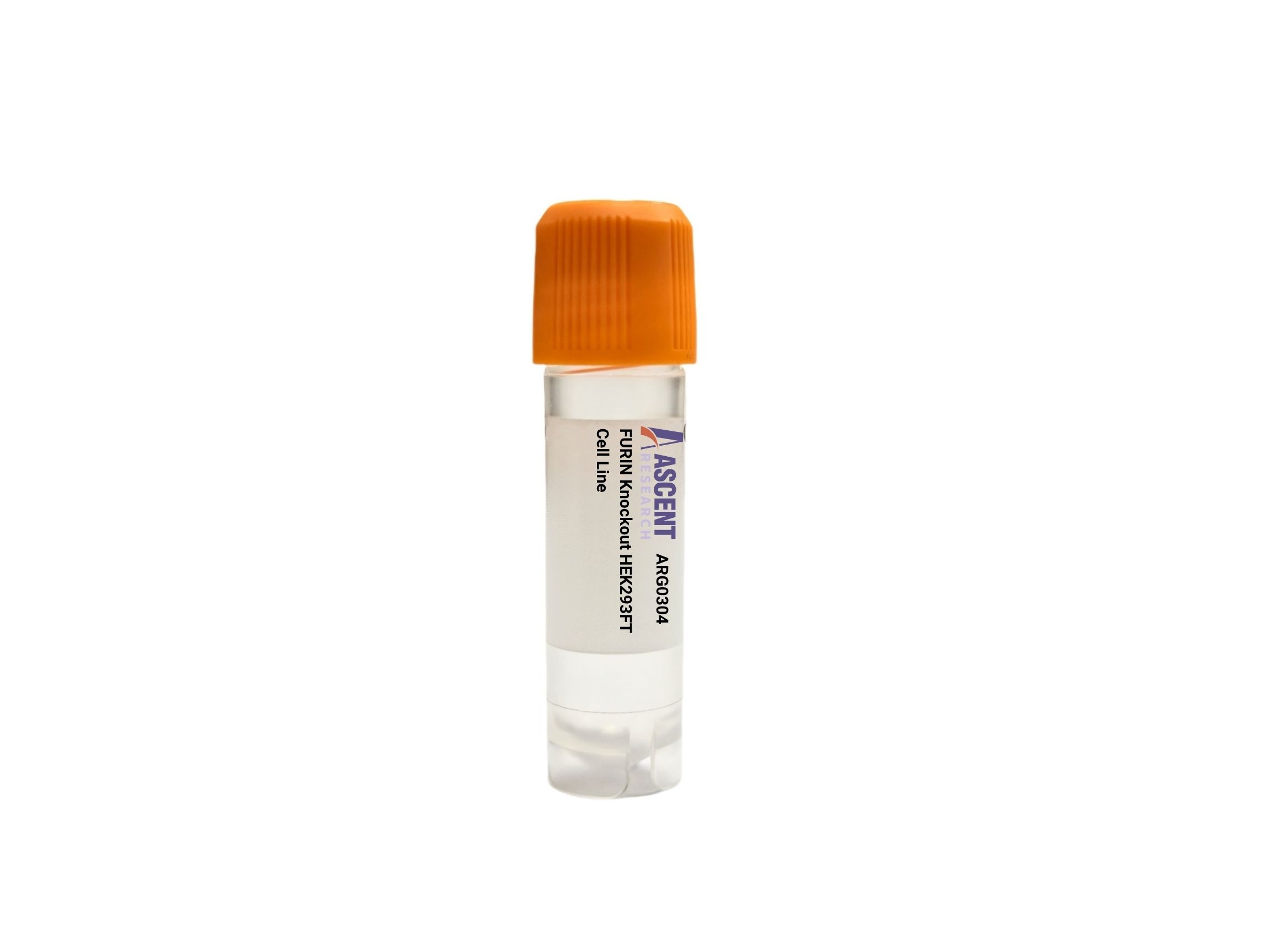
The FURIN Knockout HEK293FT Cell Line is a CRISPR/Cas9-edited knockout model in the HEK293FT embryonic kidney host. FURIN encodes a calcium-dependent serine endoprotease that processes proproteins, including TGF-??, insulin receptor, and viral glycoproteins, by cleavage at consensus motifs. This loss-of-function line enables studies of substrate activation, signaling, and viral entry in a high-transfectability background. By disrupting FURIN-mediated cleavage, the model permits investigation of TGF-?? signaling, MT1-MMP-driven invasion, and receptor maturation. Researchers can apply western blotting, pseudoparticle entry, and luciferase reporter assays to define processing-dependent pathways, and produce non-cleavable recombinant proteins.
 PHF21A Knockout NCI-H1299 Polyclonal Cells
Cat. No. ARG18012
MCAM Knockout DLD-1 Polyclonal Cells
Cat. No. ARG12125
IGF2 Knockout HGC-27 Polyclonal Cells
Cat. No. ARG30013
GSE1 Knockout SK-HEP-1 Polyclonal Cells
Cat. No. ARG32514
ATAD1 Knockout Hela Polyclonal Cells
Cat. No. ARG37417
PCDHB3 Knockout Raji Polyclonal Cells
Cat. No. ARG1707
PHF21A Knockout NCI-H1299 Polyclonal Cells
Cat. No. ARG18012
MCAM Knockout DLD-1 Polyclonal Cells
Cat. No. ARG12125
IGF2 Knockout HGC-27 Polyclonal Cells
Cat. No. ARG30013
GSE1 Knockout SK-HEP-1 Polyclonal Cells
Cat. No. ARG32514
ATAD1 Knockout Hela Polyclonal Cells
Cat. No. ARG37417
PCDHB3 Knockout Raji Polyclonal Cells
Cat. No. ARG1707
The FURIN Knockout HEK293FT Cell Line is a CRISPR/Cas9-edited knockout cell line that eliminates FURIN function in the HEK293FT host. This loss-of-function model enables precise dissection of calcium-dependent serine endoprotease activity in a well-characterized cellular background, disrupting proprotein processing of substrates critical for growth factor signaling and viral infectivity.
The parental HEK293FT line is a highly transfectable, adenovirus 5-transformed human embryonic kidney derivative stably expressing SV40 large T antigen. Widely used for protein expression and viral vector production, its robust growth and manipulability make it an optimal host for knockout-based studies of post-translational processing.
FURIN encodes a trans-Golgi network-resident serine endoprotease that cleaves inactive proproteins at the consensus Arg-X-(Lys/Arg)-Arg motif. This processing step is essential for activation of pro-TGF-??, pro-IGF1R, pro-insulin receptor, and pro-??-NGF, as well as for maturation of MT1-MMP. FURIN expression is upregulated by TGF-??, HIF-1??, STAT6, and IL-13, and its trafficking relies on interaction with PACS-1. By priming viral spike proteins, FURIN facilitates viral entry. Consequently, its knockout impairs TGF-?? signaling, insulin receptor processing, and Notch1 activation, with downstream effects on proliferation, adhesion, and extracellular matrix dynamics.
In HEK293FT cells, removing FURIN activity blocks the constitutive activation of multiple growth factor pathways and compromises viral glycoprotein maturation. This knockout line is thus pertinent for distinguishing FURIN-dependent signaling events, especially given the host’s widespread application in pseudoparticle-based viral entry assays. Additionally, it permits production of non-cleavable recombinant proteins, supporting research into proteolytic regulation of biological activity.
Applications include western blot analysis of proprotein accumulation, RT-qPCR profiling of TGF-?? and insulin receptor-responsive genes, and viral pseudoparticle entry experiments. Immunofluorescence and flow cytometry can assess substrate localization and surface receptor processing, while luciferase reporters quantify signaling outputs. The line is also suited for cancer invasion studies, as MT1-MMP activation is abolished, and for bioproduction of uncleaved protein variants. For further details, please contact Ascent Research.