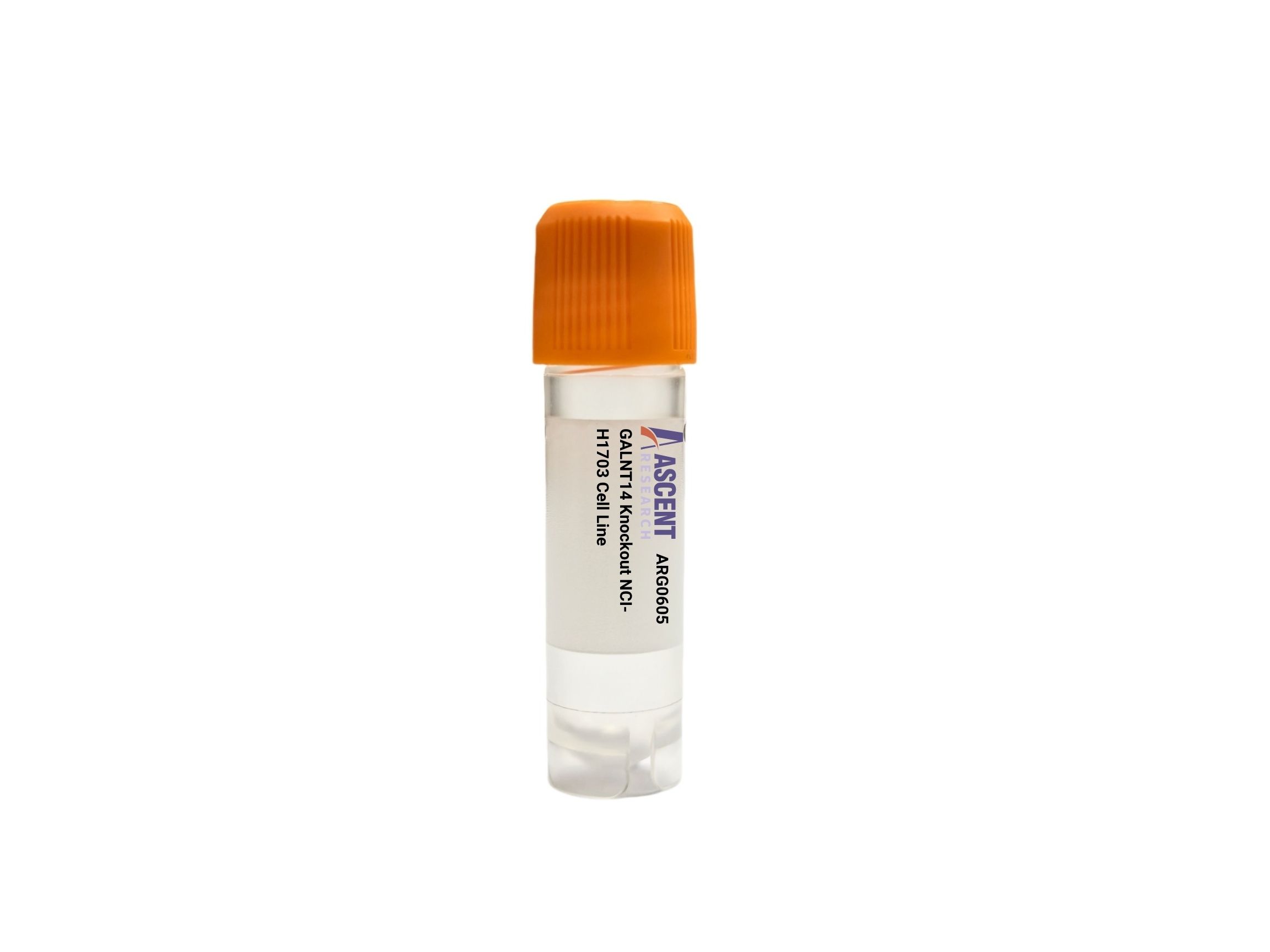
Genome-edited Cells
Lung
The GALNT14 Knockout NCI-H1703 Cell Line is a CRISPR/Cas9-edited human lung squamous cell carcinoma model with loss-of-function disruption of the GALNT14 gene. GALNT14 encodes a glycosyltransferase that initiates mucin-type O-linked glycosylation and modifies death receptors DR4 and DR5, thereby suppressing TRAIL-induced apoptosis. This knockout cell line enables dissection of glycosylation-dependent apoptosis regulation, TRAIL resistance mechanisms, and cell migration in a non-small cell lung cancer background. Applications include glycosylation analysis, apoptosis assays, drug sensitivity studies, and glycoproteomic investigations.
 Immortalized Human Small Airway Epithelial Cell
Cat. No. ARI0354
Immortalized Human Small Airway Epithelial Cell
Cat. No. ARI0354
 C12orf57 Knockout Raji Polyclonal Cells
Cat. No. ARG21421
NNMT Knockout Hela Polyclonal Cells
Cat. No. ARG8010
BRD3 Knockout HEK293 Polyclonal Cells
Cat. No. ARG23227
DNAJB9 Knockout HT29 Polyclonal Cells
Cat. No. ARG39154
C12orf57 Knockout Raji Polyclonal Cells
Cat. No. ARG21421
NNMT Knockout Hela Polyclonal Cells
Cat. No. ARG8010
BRD3 Knockout HEK293 Polyclonal Cells
Cat. No. ARG23227
DNAJB9 Knockout HT29 Polyclonal Cells
Cat. No. ARG39154
 COV504
Cat. No. ARC0153
COV504
Cat. No. ARC0153
The GALNT14 Knockout NCI-H1703 Cell Line is a CRISPR/Cas9-edited human cell line featuring a loss-of-function disruption of the GALNT14 gene. This knockout cell line, derived from the NCI-H1703 lung squamous cell carcinoma background, serves as a defined genetic tool for investigating the impact of mucin-type O-linked glycosylation on death receptor signaling and tumor cell biology. The targeted disruption abrogates GALNT14 enzymatic function, enabling dissection of glycosylation-dependent mechanisms in an epithelial cancer model.
The parental NCI-H1703 cell line was established from a primary lung squamous cell carcinoma of a 54-year-old male smoker and grows as an adherent monolayer with epithelial morphology. This line retains key features of non-small cell lung cancer, including functional TRAIL death receptor pathways, and is extensively used for apoptosis, drug resistance, and migration studies. Its robust in vitro characteristics make it well-suited for genetic manipulation and downstream phenotypic analyses.
GALNT14 encodes a polypeptide N-acetylgalactosaminyltransferase that catalyzes the initial step of O-linked glycosylation by transferring N-acetylgalactosamine to serine and threonine residues of substrate proteins. Prominent substrates include the death receptors DR4 (TRAIL-R1) and DR5 (TRAIL-R2). GALNT14-mediated glycosylation reduces receptor sensitivity to TRAIL by hindering ligand-induced clustering and assembly of the death-inducing signaling complex (DISC), which comprises FADD and caspases. GALNT14 is subject to transcriptional regulation and responds to cellular stress signals, and its activity generates O-glycosylated substrates that interact with lectins, thereby modulating cell adhesion and migration. In summary, GALNT14 sits at a nexus between glycosylation and extrinsic apoptosis, influencing TRAIL-DR4/DR5-FADD-caspase signaling.
In the NCI-H1703 context, GALNT14 disruption offers a powerful model to investigate apoptosis resistance in lung squamous cell carcinoma. Aberrant GALNT14 expression has been associated with reduced TRAIL sensitivity and chemoresistance in non-small cell lung cancer, contributing to tumor immune evasion. Knockout of GALNT14 may restore death receptor clustering and enhance apoptotic signaling, providing a system to dissect the molecular basis of glycosylation-dependent survival. This model also supports glycoproteomic comparisons to identify novel O-glycosylated targets driving malignant behaviors such as migration and invasion.
This GALNT14 knockout cell line enables a range of experimental applications. Western blotting can assess DR4 and DR5 glycosylation status, while TRAIL-induced apoptosis assays with Annexin V/PI staining yield quantitative apoptotic readouts. Caspase activity measurements (e.g., caspase-8, caspase-3) delineate downstream signaling. Migration and invasion assays, O-glycomic profiling, and co-immunoprecipitation of death receptor complexes further expand the utility. These assays support research on TRAIL resistance, glycosylation-mediated apoptosis regulation, lung cancer drug sensitivity, and cell motility. For technical inquiries, contact Ascent Research.