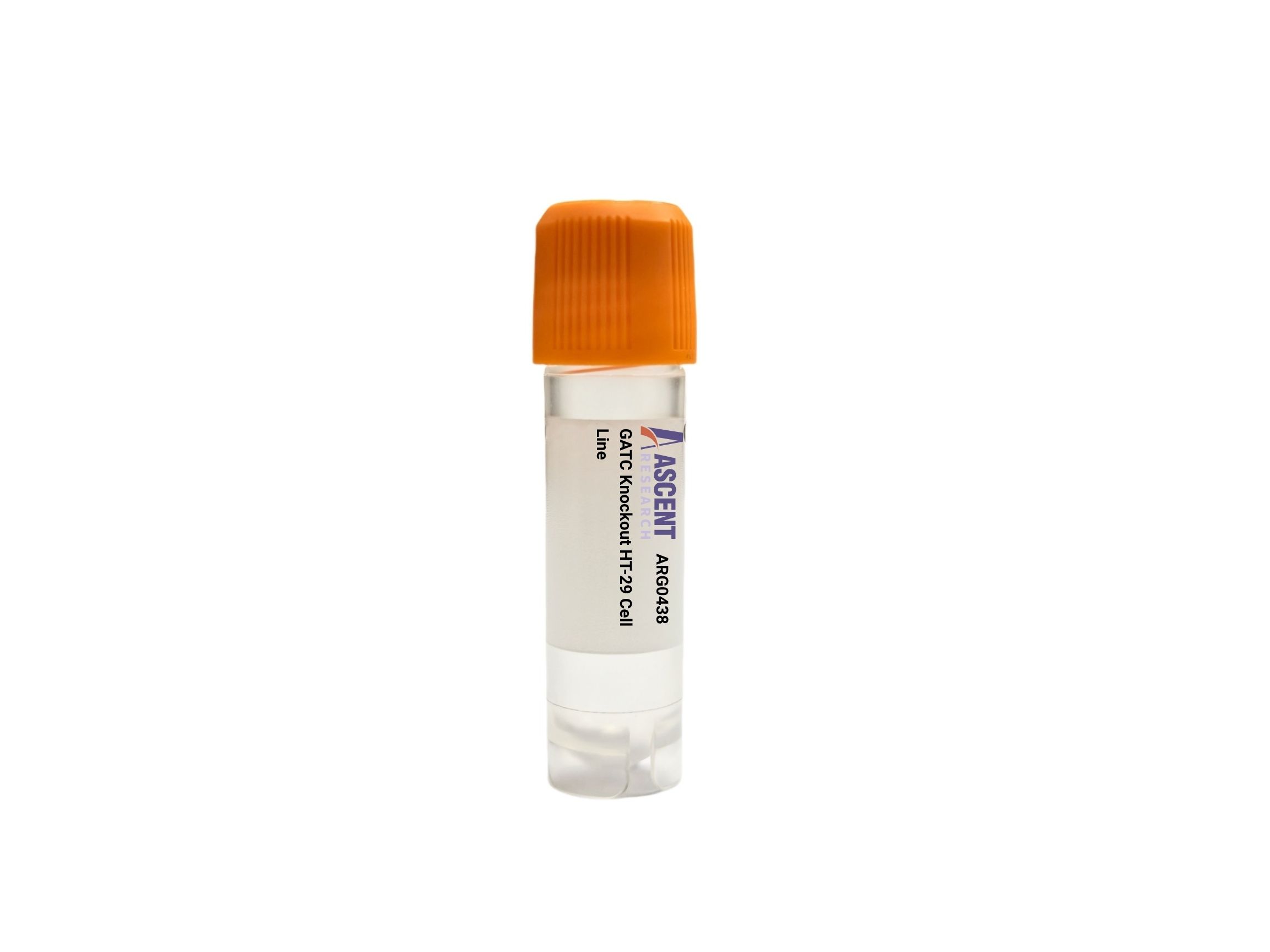
Genome-edited Cells
Large intestine (colon)
The GATC Knockout HT-29 Cell Line is a CRISPR/Cas9-edited human knockout model disrupting the GATC gene in the colorectal adenocarcinoma HT-29 background. GATC encodes a subunit of the mitochondrial GatCAB amidotransferase, essential for glutaminyl-tRNA(Gln) synthesis and mitochondrial translation. Disruption impairs oxidative phosphorylation via loss of MT-ND1 and MT-CO1 synthesis, regulated by NRF1 and PPARGC1A. This cell line enables investigation of mitochondrial dysfunction in cancer metabolism, drug sensitivity testing, and disease modeling for mitochondrial disorders. Applications include OXPHOS subunit analysis, ATP assays, Seahorse respirometry, and ROS detection, making it a versatile tool for translational research.
 OTUD5 Knockout A2780 Polyclonal Cells
Cat. No. ARG19180
CNKSR3 Knockout A549 Polyclonal Cells
Cat. No. ARG10374
HLA-DRA Knockout A2780 Polyclonal Cells
Cat. No. ARG29119
FER Knockout HEK293T Polyclonal Cells
Cat. No. ARG3913
NEDD4 Knockout Raji Polyclonal Cells
Cat. No. ARG1973
OTUD5 Knockout A2780 Polyclonal Cells
Cat. No. ARG19180
CNKSR3 Knockout A549 Polyclonal Cells
Cat. No. ARG10374
HLA-DRA Knockout A2780 Polyclonal Cells
Cat. No. ARG29119
FER Knockout HEK293T Polyclonal Cells
Cat. No. ARG3913
NEDD4 Knockout Raji Polyclonal Cells
Cat. No. ARG1973
 Rat Ovarian Stromal Cells
Cat. No. ARP0289
Rat Ovarian Stromal Cells
Cat. No. ARP0289
The GATC Knockout HT-29 Cell Line is a CRISPR/Cas9-edited knockout cell line derived from human HT-29 colorectal adenocarcinoma cells. This model features targeted disruption of the GATC gene, which encodes a subunit of the mitochondrial GatCAB amidotransferase complex. The loss-of-function is achieved through genome editing, providing a stable platform for investigating mitochondrial translation and cancer metabolism.
HT-29 cells are a well-characterized human colorectal adenocarcinoma line that retains epithelial morphology and is extensively used in cancer research. Their genetic tractability and relevance to colorectal tumor biology make them an ideal host for CRISPR-mediated knockout studies, particularly for exploring metabolic vulnerabilities in colon cancer.
GATC is a component of the GatCAB complex that catalyzes amidation of glutamyl-tRNA(Gln) to glutaminyl-tRNA(Gln), essential for mitochondrial protein synthesis. This complex includes QRSL1 (GatA) and GATB and functions with the mitochondrial ribosome. GATC expression is controlled by NRF1, PPARGC1A, and TFAM. Disruption of GATC abrogates this amidation, impairing synthesis of mitochondrially encoded OXPHOS subunits such as MT-ND1 and MT-CO1. Consequently, oxidative phosphorylation is compromised, reducing ATP levels, increasing ROS, and dissipating mitochondrial membrane potential. This also alters ATP5A expression and triggers metabolic reprogramming, impacting cancer cell proliferation.
In HT-29 colorectal cancer cells, GATC knockout creates a model of mitochondrial translation deficiency that mimics aspects of combined oxidative phosphorylation deficiency disorders. The resulting reliance on glycolysis reveals metabolic vulnerabilities and can influence drug sensitivity. This system is valuable for studying how mitochondrial dysfunction interfaces with oncogenic pathways and for testing mitochondrial-targeted therapies in colorectal cancer.
Applications include metabolic flux analysis, drug sensitivity screening with mitochondrial inhibitors, and mechanistic studies of mitochondrial translation in cancer. Key assays are western blotting for OXPHOS subunits, ATP measurement, Seahorse respirometry, ROS detection, RT-qPCR of mitochondrial genes, and flow cytometry for mitochondrial mass and membrane potential. Viability and apoptosis assays can further characterize stress responses. This cell line is a versatile tool for cancer metabolism and mitochondrial disease research. For further information, please contact Ascent Research.