Genome-edited Cells
Uterus (cervix)
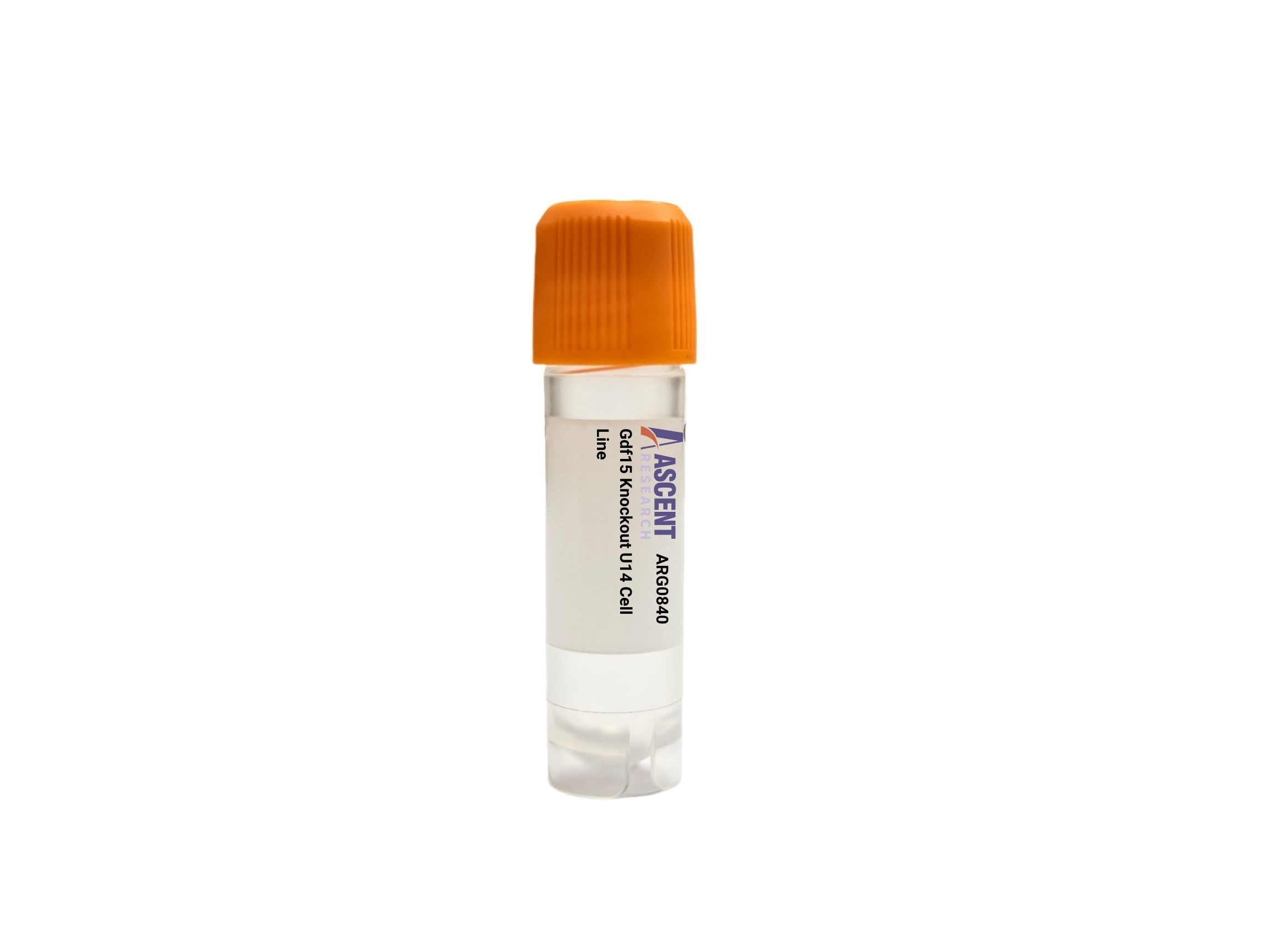
The Gdf15 Knockout U14 Cell Line is a CRISPR/Cas9-edited human glioblastoma cell line with targeted disruption of the GDF15 gene, encoding a stress-responsive cytokine linking TGF-beta and MAPK/ERK signaling to cell growth, apoptosis, and metabolism. Derived from the U14 malignant glial tumor line, it enables precise functional studies of GDF15 in a disease-relevant background. Applications include investigation of glioma progression, cachexia, and drug target validation using western blotting, migration assays, and RNA-seq. Key interacting factors include GFRAL, TGFBR2, SMAD2/3, and downstream targets BAX and p21.
 CYP51A1 Knockout NCI-H1975 Polyclonal Cells
Cat. No. ARG17377
MICU1 Knockout HT29 Polyclonal Cells
Cat. No. ARG14771
PFKM Knockout Hela Polyclonal Cells
Cat. No. ARG8264
ADRA2A Knockout HAP1 Polyclonal Cells
Cat. No. ARG21713
GPR156 Knockout Hela Polyclonal Cells
Cat. No. ARG37251
CAPN1 Knockout NCI-H1299 Polyclonal Cells
Cat. No. ARG42164
CYP51A1 Knockout NCI-H1975 Polyclonal Cells
Cat. No. ARG17377
MICU1 Knockout HT29 Polyclonal Cells
Cat. No. ARG14771
PFKM Knockout Hela Polyclonal Cells
Cat. No. ARG8264
ADRA2A Knockout HAP1 Polyclonal Cells
Cat. No. ARG21713
GPR156 Knockout Hela Polyclonal Cells
Cat. No. ARG37251
CAPN1 Knockout NCI-H1299 Polyclonal Cells
Cat. No. ARG42164
The Gdf15 Knockout U14 Cell Line is a CRISPR/Cas9-edited human glioblastoma cell line with targeted disruption of GDF15. Derived from the U14 cell line, it provides a loss-of-function model for investigating GDF15??s role as a stress-responsive cytokine. The knockout was achieved via CRISPR/Cas9-mediated gene disruption, yielding stable ablation of GDF15 expression. This genetically defined system is ideal for functional genomics, drug target validation, and signaling pathway analysis in glioblastoma research.
The parental U14 line is a well-established human malignant glial tumor model that recapitulates key glioblastoma features, including rapid proliferation, invasiveness, and aberrant activation of TGF-beta, MAPK/ERK, PI3K/AKT, and JAK/STAT pathways. Its genetic and epigenetic landscape provides a disease-relevant context for studying glioma biology. The knockout of GDF15 in this background enables precise interrogation of gene function without confounding wild-type activity, preserving the intact tumor microenvironment signaling networks.
GDF15, a TGF-beta superfamily cytokine, is induced by stress signals such as p53, NF-kappaB, TNF-alpha, IL-1beta, and hypoxia. It signals through the GFRAL/RET complex or TGFBR2, activating SMAD2/3 phosphorylation and downstream effectors like AKT and ERK. These pathways regulate key targets including p21, BAX, BCL2, and MMPs, influencing cell cycle arrest, apoptosis, and matrix remodeling. GDF15 also interacts with ALK receptors and extracellular matrix components, integrating multiple inputs to modulate proliferation and migration. This signaling network is central to its roles in cancer and metabolic responses.
In glioblastoma, elevated GDF15 promotes tumor aggressiveness by enhancing proliferation, inhibiting apoptosis, and facilitating invasion. The Gdf15 knockout U14 cell line eliminates endogenous GDF15, enabling assessment of its contribution to these malignant traits and identifying compensatory pathway shifts. This model is invaluable for studying GDF15-driven mechanisms in glioma progression and for exploring its link to cancer cachexia and metabolic dysregulation, providing a clean null background for mechanistic and therapeutic studies.
Typical applications include transwell migration and viability assays for invasion and growth, apoptosis profiling with BCL2 family markers, and phospho-signaling analysis via western blotting or arrays. Transcriptomic studies using RNA-seq or RT-qPCR can map GDF15-dependent gene networks. The model is suitable for drug screening and target validation in glioblastoma, cachexia, and stress response research. For detailed protocols and technical assistance, researchers are encouraged to contact Ascent Research.