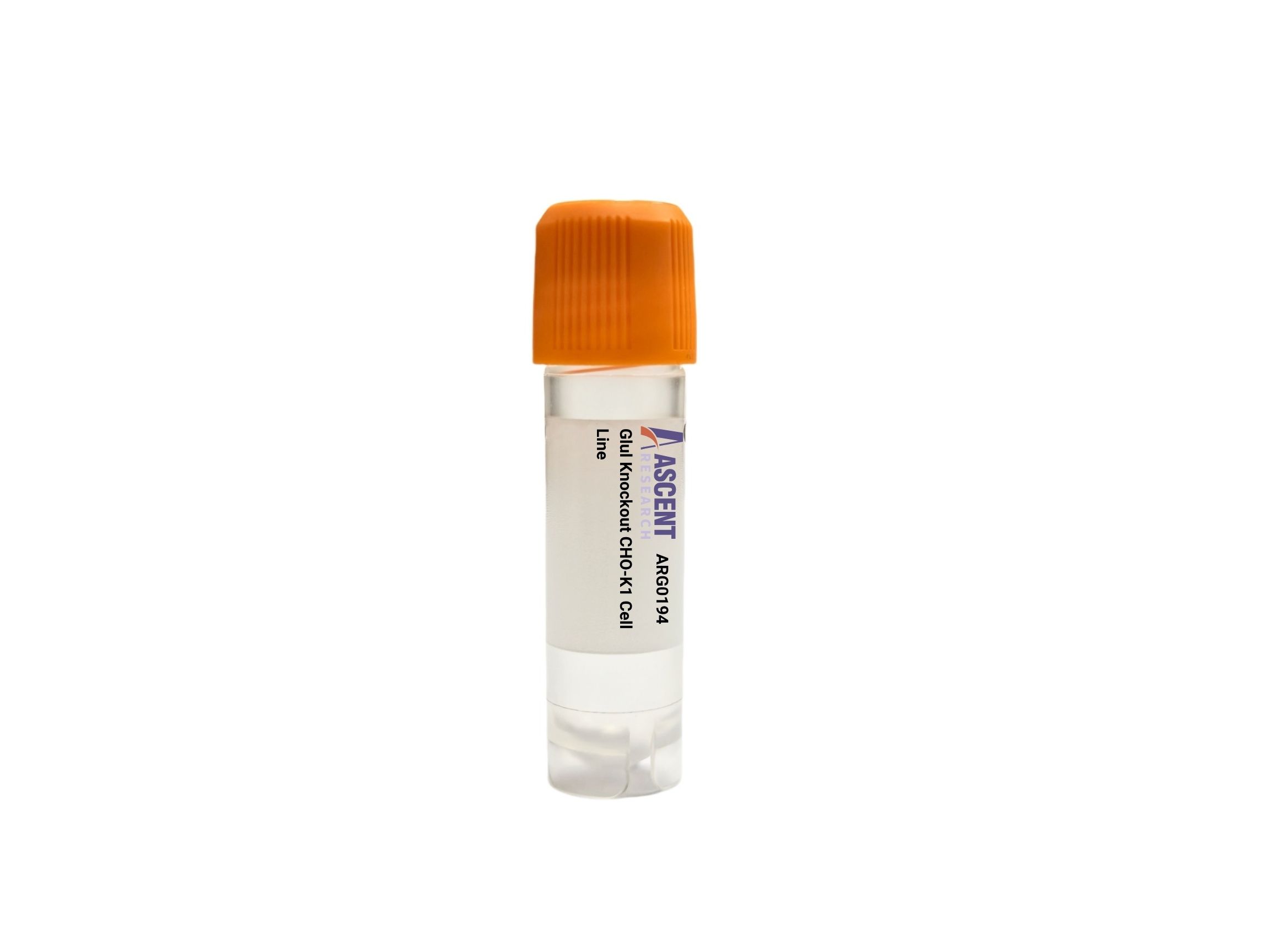
Genome-edited Cells
Ovary
Glul Knockout CHO-K1 is a CRISPR/Cas9-engineered Chinese hamster ovary cell model with disruption of the glutamine synthetase gene, Glul, in an epithelial-like production cell background. GLUL normally catalyzes ATP-dependent glutamine synthesis from glutamate and ammonia and functions within networks involving ATF4, mTOR, SLC1A5, and ASNS. In CHO-K1 cells, loss of GLUL supports investigation of glutamine dependence, ammonia handling, nutrient stress adaptation, and anabolic metabolism. The model is suited for metabolic flux analysis, LC-MS metabolomics, glutamine/ammonia quantification, proliferation studies in glutamine-depleted media, RNA-seq, and signaling studies related to mTOR and ATF4.
 PET117 Knockout SK-HEP-1 Polyclonal Cells
Cat. No. ARG15113
LMBR1 Knockout HT29 Polyclonal Cells
Cat. No. ARG14791
LRRC20 Knockout jurkat Polyclonal Cells
Cat. No. ARG12971
ALB Knockout CAL27 Polyclonal Cells
Cat. No. ARG35333
FGD6 Knockout A549 Polyclonal Cells
Cat. No. ARG10097
MECP2 Knockout HCT116 Polyclonal Cells
Cat. No. ARG6989
PET117 Knockout SK-HEP-1 Polyclonal Cells
Cat. No. ARG15113
LMBR1 Knockout HT29 Polyclonal Cells
Cat. No. ARG14791
LRRC20 Knockout jurkat Polyclonal Cells
Cat. No. ARG12971
ALB Knockout CAL27 Polyclonal Cells
Cat. No. ARG35333
FGD6 Knockout A549 Polyclonal Cells
Cat. No. ARG10097
MECP2 Knockout HCT116 Polyclonal Cells
Cat. No. ARG6989
The Glul Knockout CHO-K1 Cell Line is an engineered Chinese hamster ovary-derived cell model in which the Glul gene has been disrupted using CRISPR/Cas9 genome editing, resulting in loss of functional glutamine synthetase expression. This stable in vitro knockout model is generated in CHO-K1, an epithelial-like ovary cell line with strong biosynthetic capacity and active central carbon and amino acid metabolism. It is designed for mechanistic studies of glutamine biosynthesis, nitrogen handling, nutrient-responsive signaling, and metabolic adaptation under defined culture conditions.
CHO-K1 is a widely used adherent mammalian production cell line derived from Chinese hamster ovary tissue. Its robust growth, adaptability to diverse media formulations, and long-standing use in recombinant protein production and cell engineering make it a relevant background for studying nutrient utilization and metabolic network rewiring. Because CHO-K1 cells support high anabolic demand and are frequently used for media optimization and metabolic engineering, they provide a practical host context for interrogating pathways that couple amino acid availability to proliferation, biosynthesis, and stress adaptation.
GLUL catalyzes the ATP-dependent conversion of glutamate and ammonia to glutamine, thereby linking nitrogen assimilation to amino acid homeostasis, nucleotide biosynthesis, redox balance, and TCA cycle-associated metabolic flux. Its activity is regulated by glutamine availability, ammonia and nitrogen status, amino acid deprivation, ATF4, mTORC1-associated nutrient signaling, glucocorticoid receptor signaling, and cAMP-responsive pathways. GLUL interacts functionally with glutamate, ammonia, ATP, and divalent cofactors including manganese and magnesium, and it is positioned within a broader network that includes GLS, GLUD1, GOT1, GPT2, ASNS, SLC1A5, SLC38A2, mTOR, and ATF4. Loss of GLUL is expected to reduce the intracellular glutamine pool, alter asparagine and nucleotide synthesis, modulate hexosamine biosynthesis and mTORC1 activity, and influence protein synthesis, ammonia detoxification, and survival during glutamine limitation. These processes are directly relevant to cancer metabolism, glutamine addiction, hyperammonemia-related biology, and bioprocess nutrient optimization.
In the CHO-K1 background, Glul deletion provides a useful system for examining how epithelial-like production cells respond when de novo glutamine synthesis is impaired. Given the host line??s dependence on coordinated carbon and nitrogen metabolism, the knockout enables analysis of compensatory dependence on glutamine transporters such as SLC1A5 and SLC38A2, altered coupling to GLS- and GLUD1-linked glutamate metabolism, and changes in ATF4- or mTOR-directed nutrient stress responses. This makes the model informative for studying pathway dependency under anabolic demand, ammonia stress, or glutamine-depleted culture conditions.
This cell line can be applied in experiments that quantify glutamine and glutamate levels, ammonia accumulation, and proliferation under controlled nutrient limitation. Representative workflows include genomic edit confirmation by Sanger sequencing, GLUL loss assessment by RT-qPCR and western blotting, viability and apoptosis measurements during glutamine withdrawal, and LC-MS metabolomics or isotope tracing to resolve nitrogen and carbon flux redistribution. Researchers may also use Seahorse assays to evaluate bioenergetic consequences, RNA-seq to profile adaptive transcriptional programs involving ATF4-linked nutrient stress pathways, and drug sensitivity studies targeting glutamine metabolism or mTOR-associated anabolic signaling. Additional applications include metabolic engineering studies, media optimization strategies for bioproduction, and comparative analyses of nutrient-response phenotypes in engineered CHO systems. Researchers may contact Ascent Research for additional technical information, product details, or related gene-edited cell models.