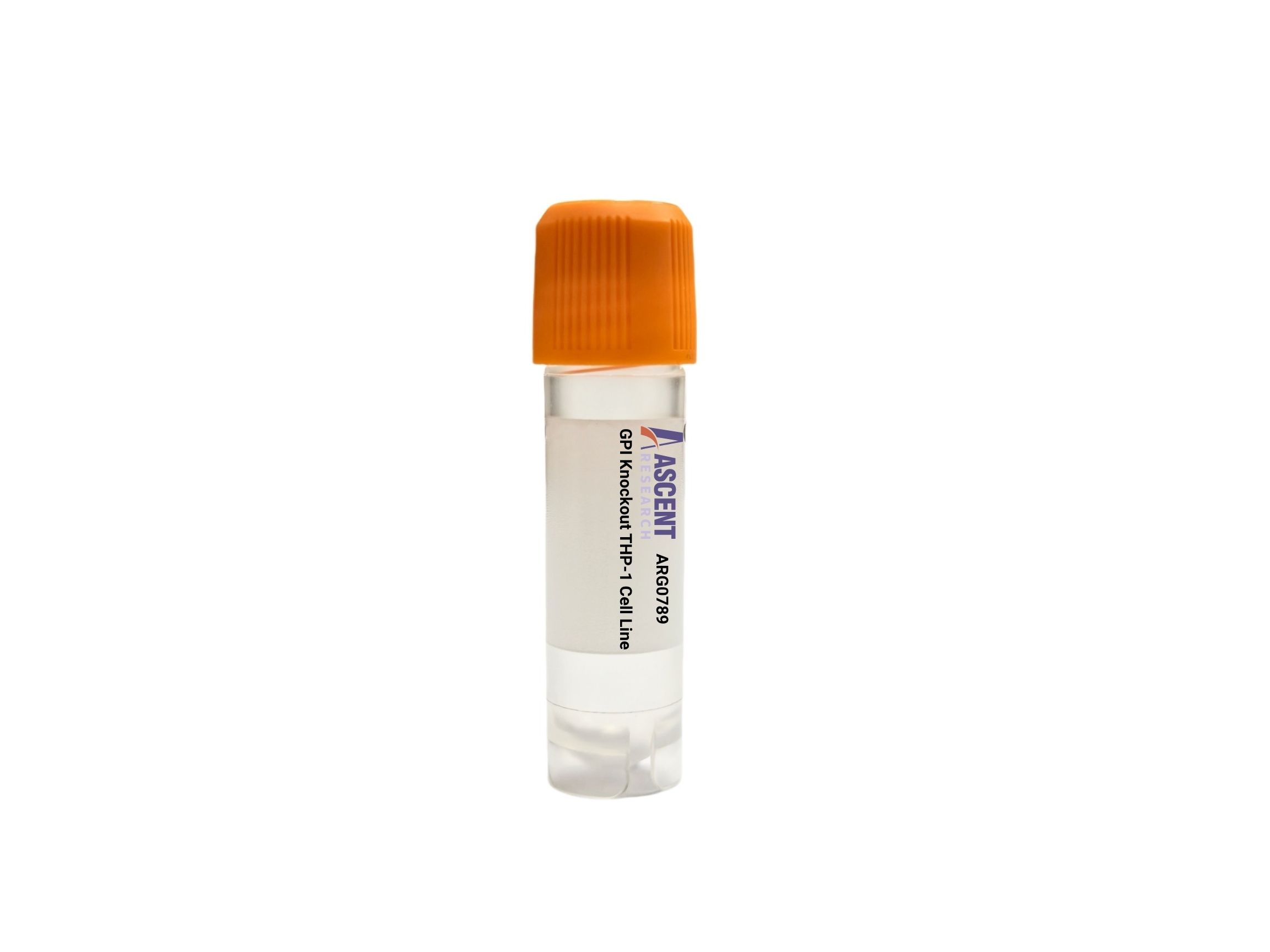
Genome-edited Cells
Blood (peripheral blood)
The GPI Knockout THP-1 Cell Line is a CRISPR/Cas9-edited knockout model in the acute monocytic leukemia THP-1 background, targeting glucose-6-phosphate isomerase. This loss-of-function model ablates GPI's dual roles as a glycolytic enzyme and autocrine motility factor (AMF)/neuroleukin, interrupting key metabolic and signaling pathways. By disrupting glycolysis and AMF-AMFR-driven signaling through RhoA/Rac1, AKT, and Bcl-2, this cell line enables studies of metabolic reprogramming in leukemia, GPI deficiency disorders, and cancer metastasis. Applications include metabolic flux assays (e.g., Seahorse ECAR), Boyden chamber migration, proliferation and apoptosis analyses, and glycolysis-targeted drug screening.
 KCNC2 Knockout HAP1 Polyclonal Cells
Cat. No. ARG22920
ANKRD12 Knockout jurkat Polyclonal Cells
Cat. No. ARG33824
EHBP1 Knockout A2780 Polyclonal Cells
Cat. No. ARG40751
CAMKK2 Knockout AGS Polyclonal Cells
Cat. No. ARG26827
MDP1 Knockout 786-O Polyclonal Cells
Cat. No. ARG4682
KCNC2 Knockout HAP1 Polyclonal Cells
Cat. No. ARG22920
ANKRD12 Knockout jurkat Polyclonal Cells
Cat. No. ARG33824
EHBP1 Knockout A2780 Polyclonal Cells
Cat. No. ARG40751
CAMKK2 Knockout AGS Polyclonal Cells
Cat. No. ARG26827
MDP1 Knockout 786-O Polyclonal Cells
Cat. No. ARG4682
 MDA-MB-361 Luciferase Stable Cell Line
Cat. No. ARG0563
MDA-MB-361 Luciferase Stable Cell Line
Cat. No. ARG0563
The GPI Knockout THP-1 Cell Line is a CRISPR/Cas9-edited knockout cell line that completely disrupts the glucose-6-phosphate isomerase (GPI) gene in the THP-1 background. This stable loss-of-function model ablates both the intracellular catalytic function of GPI in glycolysis and its extracellular role as autocrine motility factor (AMF)/neuroleukin, providing a versatile platform for metabolic and signaling studies.
THP-1 is a human acute monocytic leukemia cell line derived from the peripheral blood of a 1-year-old male patient, and it is widely employed in innate immunity and hematological malignancy research. It exhibits monocyte-like features and can be differentiated into macrophage-like cells when exposed to phorbol esters or other stimuli, making it a standard model for monocyte/macrophage biology, immune response research, and leukemogenesis studies. Its robust growth characteristics and amenability to genetic manipulation facilitate detailed investigation of gene function.
GPI catalyzes the reversible isomerization of glucose-6-phosphate to fructose-6-phosphate, a critical junction in glycolysis, gluconeogenesis, and the pentose phosphate pathway. Extracellularly, secreted GPI functions as AMF and neuroleukin, binding to its receptor AMFR/gp78. This interaction activates downstream Rho GTPases (RhoA, Rac1), PI3K/AKT, and MAPK pathways, culminating in enhanced cell migration, invasion, and upregulation of anti-apoptotic Bcl-2. GPI expression is tightly regulated by hypoxia-inducible factor 1-alpha (HIF1A), the oncogene MYC, insulin, and glucose availability, situating GPI at a nexus of metabolic and oncogenic control. Intracellularly, GPI interacts with tubulin and phosphofructokinase, integrating cytoskeletal dynamics and glycolytic flux. Disruption of GPI therefore not only impairs energy metabolism but may also alter nucleotide biosynthesis and cellular redox homeostasis by shifting substrate utilization.
In the THP-1 leukemia context, GPI knockout profoundly disrupts the metabolic reprogramming essential for cancer cell survival and proliferation, likely impairing both energy production and biosynthetic precursor generation. The concomitant loss of AMF autocrine signaling thereby attenuates AMFR-mediated migratory and invasive capacities, making this cell line particularly valuable for dissecting AMF-AMFR crosstalk in the tumor microenvironment. This dual deficiency makes the knockout line an excellent model for investigating the Warburg effect in leukemia, the pathophysiology of hereditary GPI deficiency (e.g., hemolytic anemia, neurological impairment), and AMF-dependent metastatic mechanisms.
Researchers can employ this cell line in metabolic flux analyses such as extracellular acidification rate (ECAR) measurements using Seahorse analyzers, Boyden chamber migration assays, and proliferation or apoptosis studies. It serves as a relevant tool for glycolysis inhibitor screening, validation of GPI disruption by Western blotting or RT-qPCR, and interrogation of downstream signaling nodes including AKT phosphorylation, RhoA/Rac1 activation, and Bcl-2 expression levels. For additional information or to place an order, please contact Ascent Research.