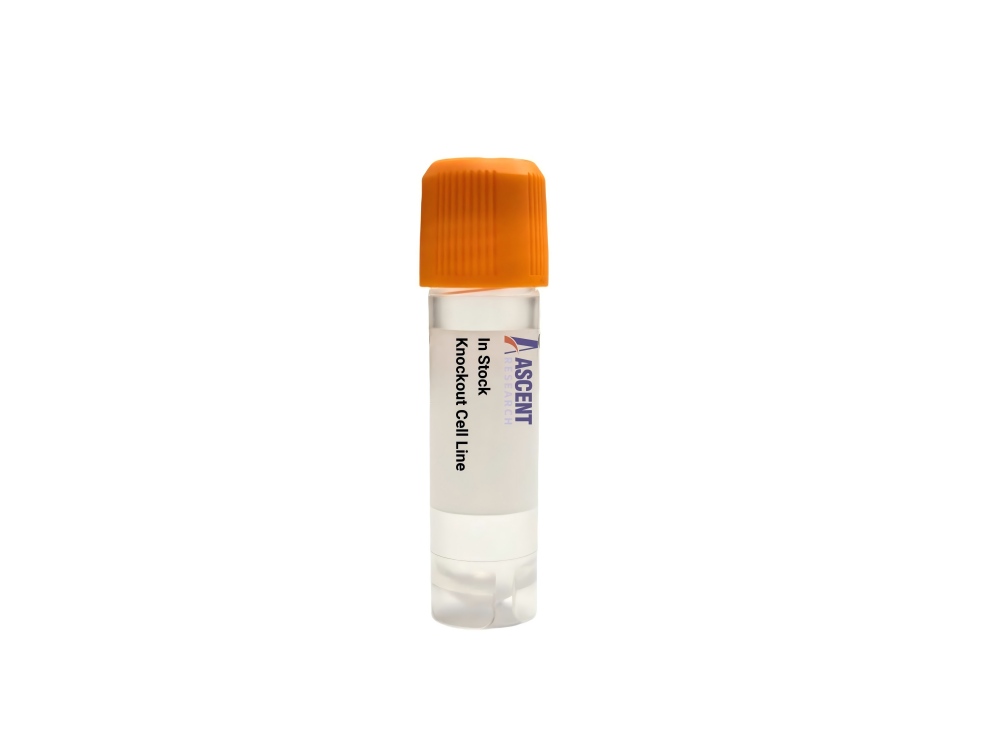
In Stock Cell Lines
Mus musculus (Mouse)
Ascites
Adherent
The Gpnmb Knockout RAW 264.7 Cell Line is a CRISPR/Cas9-edited macrophage cell line for loss-of-function studies of Gpnmb, a transmembrane glycoprotein involved in adhesion, osteoclast differentiation, and immune regulation. Derived from the BALB/c RAW 264.7 host, this knockout model disrupts integrin ??v??3-mediated signaling through FAK, ERK1/2 (MAP2K1/2), and AKT (PI3K) pathways, which are normally activated by TGF-?? and MITF. The cell line is suitable for investigating macrophage polarization, osteoclastogenesis via RANKL-induced TRAP staining, phagocytosis, and tumor-immune crosstalk in bone metastasis, melanoma, and inflammatory disease research. Assays such as Western blotting, flow cytometry, and cytokine ELISA enable functional validation.
 GDPD1 Knockout HT29 Polyclonal Cells
Cat. No. ARG14275
GSE1 Knockout SK-HEP-1 Polyclonal Cells
Cat. No. ARG32514
GPRIN1 Knockout jurkat Polyclonal Cells
Cat. No. ARG34190
CAMSAP3 Knockout NCI-H1975 Polyclonal Cells
Cat. No. ARG42103
CDKN1C Knockout Raji Polyclonal Cells
Cat. No. ARG1552
GDPD1 Knockout HT29 Polyclonal Cells
Cat. No. ARG14275
GSE1 Knockout SK-HEP-1 Polyclonal Cells
Cat. No. ARG32514
GPRIN1 Knockout jurkat Polyclonal Cells
Cat. No. ARG34190
CAMSAP3 Knockout NCI-H1975 Polyclonal Cells
Cat. No. ARG42103
CDKN1C Knockout Raji Polyclonal Cells
Cat. No. ARG1552
 PD-L1 Overexpression MC-38 Stable Cell Line
Cat. No. ARG0538
PD-L1 Overexpression MC-38 Stable Cell Line
Cat. No. ARG0538
The Gpnmb Knockout RAW 264.7 Cell Line is a CRISPR/Cas9-edited macrophage knockout cell line derived from the BALB/c mouse RAW 264.7 host. This product provides a constitutive loss-of-function model for Gpnmb (also known as osteoactivin or DC-HIL) through targeted gene disruption. The cell line is supplied as a stable knockout, ready for expansion and use in functional assays without the need for transient silencing or drug selection. It enables investigation of Gpnmb in macrophage biology, osteoclast differentiation, and immune regulation.
RAW 264.7 is an Abelson murine leukemia virus-transformed monocyte/macrophage line from BALB/c mice, exhibiting robust phagocytic and inflammatory responses. These cells differentiate into multinucleated osteoclast-like cells upon RANKL stimulation, making them a standard model for osteoclastogenesis and immunological studies. The macrophage background endogenously expresses integrins, cytokine receptors, and pattern-recognition receptors that are critical for studying cell adhesion and immune modulation in the context of Gpnmb function.
Gpnmb encodes a type I transmembrane glycoprotein implicated in adhesion, osteoclast differentiation, and immune regulation. Its transcription is driven by MITF and induced by TGF-?? and IL-10. Gpnmb interacts with integrin ??v??3 (ITGAV/ITGB3), CD44, and heparan sulfate proteoglycans, activating downstream focal adhesion kinase (FAK), ERK1/2 (via MAP2K1/2), and AKT (via PI3K). These pathways regulate survival, migration, and osteoclast formation, positioning Gpnmb as an integrator of matrix and growth factor signals.
Knockout of Gpnmb in RAW 264.7 cells impairs integrin-dependent adhesion and signaling, offering a tool to study its role in osteoclastogenesis and macrophage polarization. The model is valuable for bone metastasis and osteoporosis research, where Gpnmb affects the bone microenvironment. Its function as an immune checkpoint via HSPG interaction also allows investigation of tumor-immune crosstalk in melanoma and inflammation models, integrating TGFBR1/2-SMAD2/3 with MAPK/AKT pathways.
Applications include phagocytosis assays, Transwell migration, and RANKL-induced osteoclast differentiation assessed by TRAP staining. Knockout validation is performed by Western blotting and RT-qPCR; flow cytometry detects integrin surface levels. ELISA quantifies cytokines (TNF-??, IL-6) in inflammatory contexts. The tool supports tumor-associated macrophage studies, osteoimmunology, and drug target validation. For inquiries, contact Ascent Research.